
Historical sources on Ned Kelly
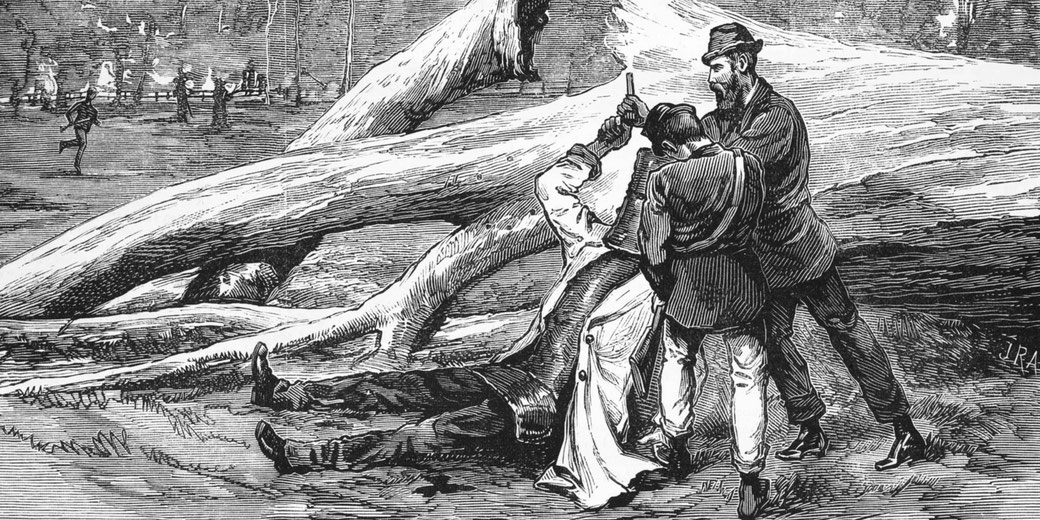
This collection of historical sources explores the life, crimes, and public image of the Australian bushranger Ned Kelly through a range of contemporary perspectives.
The sources include Kelly's own defence of his actions in the famous Jerilderie Letter, newspaper reports on the killing of police officers at Stringybark Creek, accounts of the dramatic siege at Glenrowan, and reports of his execution in Melbourne.
By examining these sources, you can investigate the events that turned Kelly into one of the most famous and controversial figures in Australian history, and consider why debates about his character and actions continue more than a century after his death.
Source 1
"I was tried and committed as Hall swore I claimed the mare the Doctor died or he would have proved Hall a perjurer [a person who lies after swearing to tell the truth] Hall has been tried several times for perjury but got clear as this is no crime in the Police force it is a credit to a Policeman to convict an innocent man but any muff [fool] can pot a guilty one Halls character is well known about El Dorado and Snowy Creek and Hall was considerably in debt to Mr L.O. Brien and he was going to leave Greta Mr O. Brien seen no other chance of getting his money so there was a subscription [a fund collected from a group of people] collected for Hall and with the aid of this money he got James Murdock who was recently hung in Wagga Wagga to give false evidence against me but I was acquitted [found not guilty] on the charge of horsestealing and on Halls and Murdocks evidence I was found guilty of receiving and got 3 years experience in Beechworth Pentridges dungeons [the Beechworth and Pentridge gaols]."
Contextual information:
Ned Kelly dictated this letter to fellow gang member Joe Byrne in February 1879, while the Kelly Gang held the town of Jerilderie, intending it to be printed as a defence of his actions against the Victorian police. The letter sets out his own account of his early convictions, including the three-year sentence described above, alongside his grievances against named police officers. It survives as one of only two original documents in Kelly's own words and was donated to the State Library of Victoria in 2000.
Bibliographical reference:
Kelly, E. (1879). The Jerilderie letter [Manuscript dictated to Joe Byrne].
Copyright: Public domain.
Source 2
"The bushranging outrage at Springybark Creek [an older spelling of Stringybark Creek] was one of the chief topics of conversation in town yesterday. From the full and lucid [clear and well organised] account telegraphed from Mansfield by our special reporter, it will be seen that the murder of the troopers was deliberately planned by Kelly and his gang, who stole secretly upon the camp when two of the men where away. Of the two who were surprised, one was shot and the other made prisoner, so that it was an easy matter to dispose of the remaining two on their return. Of the four police who constituted the party, Constables Scanlon and Longeron are killed, Constable McIntyre has escaped, and Sergeant Kennedy is missing. What his fate has been can only be conjectured [guessed at], but there is every reason to fear the worst [Sergeant Kennedy's body was found some days later; he had been killed along with the other two]."
"No effort will be spared to secure the arrest of the band of desperadoes [dangerous outlaws], and for that purpose the Government has offered a reward of £200 for such information as will lead to the apprehension and conviction of each of the offenders [four gang members in total, making £800 altogether; this figure was raised several times over the following months as the gang stayed at large]."
Contextual information:
The Argus was Melbourne's leading daily newspaper in the nineteenth century. This report was published three days after the killing of three police officers at Stringybark Creek in the Wombat Ranges near Mansfield on 26 October 1878, and shows how quickly the colonial government responded with a reward notice once news of the killings reached Melbourne.
Bibliographical reference:
The Argus. (1878, October 29). Bushranging in Victoria. The Argus (Melbourne, Vic.).
Copyright: Public domain.
Source 3
"GLENROWAN, MONDAY NIGHT. At last the Kelly gang and the police have come within shooting distance, and the adventure has been the most tragic of any in the bushranging annals [historical record] of the colony. Most people will say that it is high time, too, for the murders of the police near Mansfield occurred as long ago as the 26th of October, 1878, the Euroa outrage on the 9th December of the same year, and the Jerilderie affair on the 8th and 9th of February, 1879."
"The armour in which each member of the gang was clad was of a most substantial character. It was made of iron a quarter of an inch thick, and consisted of a long breast-plate, shoulder-plates, back-guard and helmet. The helmet resembled a nail can without a crown, and with a long slit at the elevation of the eyes to look through. All these articles are believed to have been made by two men, one living near Greta and the other near Oxley. The iron was procured by the larceny [theft] of ploughshares [the curved blades fitted to a farm plough], and larcenies [thefts] of this kind having been rather frequent of late in the Kelly district the police had begun to suspect that the gang were preparing for action. Ned Kelly's armour alone weighed 97lb. [about 44 kilograms], a considerable weight to carry on horseback."
Contextual information:
An Argus correspondent travelled to Glenrowan on the police special train and reported on the siege as it unfolded on 28 June 1880. The Kelly Gang had torn up the railway line and taken hostages in the local hotel, planning to derail the police train; the siege ended with three gang members dead and Ned Kelly captured after he came out of the hotel wearing the armour described in this report.
Bibliographical reference:
The Argus. (1880, June 29). Destruction of the Kelly gang. The Argus (Melbourne, Vic.), p. 5.
Copyright: Public domain.
Source 4
"The execution of Ned Kelly, the bushranger, took place this morning at 10 o'clock, within the precincts of the Melbourne Gaol, in the presence of magistrates, medical men, and representatives of the press, about twenty in all."
"Mr. Castieau, the governor of the gaol, informed the condemned man that the hour of his execution was fixed for 10 o'clock. Kelly simply replied, 'Such is life.' [These famous words are disputed by some modern historians, who argue Kelly more likely said something closer to 'Ah well, I suppose,' and that the shorter, punchier phrase may have appeared in only one newspaper before being adopted as legend.] His leg irons were then struck off, and after a short time he was marched, accompanied by a number of warders from the condemned cell in the old wing of the prison to the central building."
Contextual information:
This report was sent by telegraph from Melbourne to Adelaide on the morning of the execution and printed the same day, a common practice once the telegraph connected the Australian colonies. Ned Kelly was hanged at the Old Melbourne Gaol after being convicted of the murder of Constable Thomas Lonigan at Stringybark Creek.
Bibliographical reference:
[By telegraph]. (1880, November 11). The execution. The Express & Telegraph (Adelaide, SA), p. 2 (Second Edition).
Copyright: Public domain.