
Marshall Plan historical sources
In the aftermath of the Second World War, Europe faced economic collapse, food shortages, and political instability that threatened the fragile peace of 1945.
The sources below trace how the United States responded to this crisis through the Truman Doctrine and the Marshall Plan.
Together, these documents allow you to examine the origins, aims, and impact of one of the most significant foreign policy initiatives of the early Cold War.
Source 1
"In considering the requirements for the rehabilitation of Europe the physical loss of life, the visible destruction of cities, factories, mines, and railroads was correctly estimated, but it has become obvious during recent months that this visible destruction was probably less serious than the dislocation of the entire fabric of European economy...
"The truth of the matter is that Europe's requirements for the next 3 or 4 years of foreign food and other essential products — principally from America — are so much greater than her present ability to pay that she must have substantial additional help, or face economic, social, and political deterioration of a very grave character...
"It is logical that the United States should do whatever it is able to do to assist in the return of normal economic health in the world, without which there can be no political stability and no assured peace. Our policy is directed not against any country or doctrine but against hunger, poverty, desperation, and chaos. Its purpose should be the revival of working economy in the world so as to permit the emergence of political and social conditions in which free institutions can exist. Such assistance, I am convinced, must not be on a piecemeal basis as various crises develop. Any assistance that this Government may render in the future should provide a cure rather than a mere palliative...
"Any government that is willing to assist in the task of recovery will find full cooperation, I am sure, on the part of the United States Government. Any government which maneuvers to block the recovery of other countries cannot expect help from us. Furthermore, governments, political parties, or groups which seek to perpetuate human misery in order to profit therefrom politically or otherwise will encounter the opposition of the United States."
Contextual information:
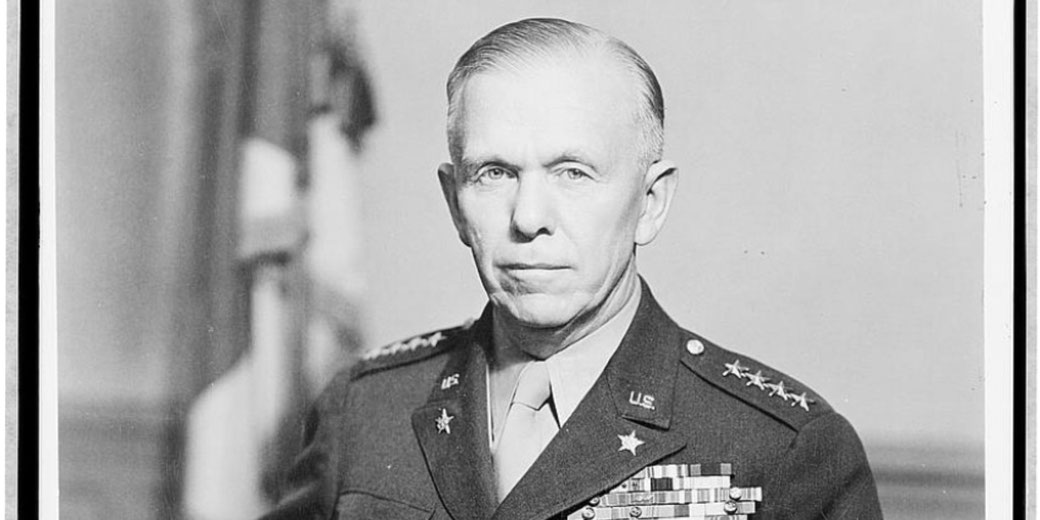
George Catlett Marshall (1880–1959) served as U.S. Army Chief of Staff during World War II and was appointed Secretary of State by President Truman in January 1947, serving until January 1949. He delivered this address at the Harvard University commencement on June 5, 1947, to a crowd of approximately 15,000 in Harvard Yard. The speech was drafted with input from George F. Kennan (head of the State Department Policy Planning Staff) and Charles "Chip" Bohlen, and drew on a memorandum by Under Secretary of State for Economic Affairs William L. Clayton. Marshall was later awarded the Nobel Peace Prize in 1953 for this initiative.
Bibliographical reference:
Marshall, G. C. (1947, June 5). Remarks by the Secretary of State at Harvard University, June 5, 1947 [Speech transcript]. U.S. National Archives and Records Administration, Milestone Documents. https://www.archives.gov/milestone-documents/marshall-plan
Copyright: Public Domain
Source 2
“At the present moment in world history nearly every nation must choose between alternative ways of life. The choice is too often not a free one...
"One way of life is based upon the will of the majority, and is distinguished by free institutions, representative government, free elections, guarantees of individual liberty, freedom of speech and religion, and freedom from political oppression...
"The second way of life is based upon the will of a minority forcibly imposed upon the majority. It relies upon terror and oppression, a controlled press and radio; fixed elections, and the suppression of personal freedoms...
"I believe that it must be the policy of the United States to support free peoples who are resisting attempted subjugation by armed minorities or by outside pressures...
"I believe that we must assist free peoples to work out their own destinies in their own way...
"I believe that our help should be primarily through economic and financial aid which is essential to economic stability and orderly political processes...
"I therefore ask the Congress to provide authority for assistance to Greece and Turkey in the amount of $400,000,000 for the period ending June 30, 1948...
"The seeds of totalitarian regimes are nurtured by misery and want. They spread and grow in the evil soil of poverty and strife. They reach their full growth when the hope of a people for a better life has died. We must keep that hope alive...
"The free peoples of the world look to us for support in maintaining their freedoms."
Contextual information:
Harry S. Truman (1884–1972) served as the 33rd President of the United States from April 1945 to January 1953. He delivered this address before a joint session of the 80th Congress on March 12, 1947, at 1:00 p.m. The speech was prompted by Britain's announcement in February 1947 that it could no longer provide financial aid to Greece and Turkey. The policy articulated in this speech became known as the Truman Doctrine and served as a cornerstone of U.S. Cold War foreign policy for four decades.
Bibliographical reference:
Truman, H. S. (1947, March 12). Special message to the Congress on Greece and Turkey: The Truman Doctrine [Presidential address transcript]. (Document 171, 80th Congress, 1st Session; Records of the United States House of Representatives; Record Group 233). U.S. National Archives and Records Administration, Milestone Documents. https://www.archives.gov/milestone-documents/truman-doctrine
Copyright: Public domain.
Source 3
"Eightieth Congress of the United States of America At the Second Session”
"Begun and held at the City of Washington on Tuesday, the sixth day of January, one thousand nine hundred and forty-eight"
"An Act to promote world peace and the general welfare, national interest, and foreign policy of the United States through economic-financial and other measures necessary to the maintenance of the conditions abroad in which free institutions may survive and consistent with the maintenance of the strength and stability of the United States.”
"Be it enacted by the Senate and the House of Representatives of the United States of America in Congress assembled, That this Act may be cited as the 'Foreign Assistance Act of 1948'."
"Sec. 101. This title may be cited as the 'Economic Cooperation Act of 1948'."
"Sec. 102. (a) Recognizing the intimate economic and other relationships between the United States and the nations of Europe, and recognizing that disruption following in the wake of war is not contained by national frontiers, the Congress finds that the existing situation in Europe endangers the establishment of a lasting peace, the general welfare and national interest of the United States, and the attainment of the objectives of the United Nations. The restoration or maintenance in European countries of principles of individual liberty, free institutions, and genuine independence rests largely upon the establishment of sound economic conditions, stable international economic relationships, and the achievement by the countries of Europe of a healthy economy independent of extraordinary outside assistance. The accomplishment of these objectives calls for a plan of European recovery, open to all such nations which cooperate in such plan, based upon a strong production effort, the expansion of foreign trade, the creation and maintenance of internal financial stability, and the development of economic cooperation, including all possible steps to establish and maintain equitable rates of exchange and to bring about the progressive elimination of trade barriers."
Contextual information:
The Economic Cooperation Act of 1948 (Public Law 80-472, 62 Stat. 137) was enacted as Title I of the broader Foreign Assistance Act of 1948. It was signed into law by President Truman on April 3, 1948, after passage by the Republican-controlled 80th Congress. The Senate approved its version (S. 2202) on March 13, 1948, and the House passed its version on March 31, 1948. The Act established the Economic Cooperation Administration (ECA) as an independent federal agency to administer the European Recovery Program.
Bibliographical reference:
Economic Cooperation Act of 1948, Pub. L. No. 80-472, 62 Stat. 137 (1948). U.S. National Archives and Records Administration (Enrolled Acts and Resolutions of Congress, 1789–1996; General Records of the United States Government; Record Group 11). https://www.archives.gov/milestone-documents/marshall-plan
Copyright: Public domain.
Source 4
"On April 3, 1948, President Truman signed the Economic Recovery Act of 1948. It became known as the Marshall Plan, named for Secretary of State George Marshall, who in 1947 proposed that the United States provide economic assistance to restore the economic infrastructure of postwar Europe."
"When World War II ended in 1945, Europe lay in ruins: its cities were shattered; its economies were devastated; its people faced famine. In the two years after the war, the Soviet Union's control of Eastern Europe and the vulnerability of Western European countries to Soviet expansionism heightened the sense of crisis."
"To meet this emergency, Secretary of State George Marshall proposed in a speech at Harvard University on June 5, 1947, that European nations create a plan for their economic reconstruction and that the United States provide economic assistance."
"On December 19, 1947, President Harry Truman sent Congress a message that followed Marshall's ideas to provide economic aid to Europe. Congress overwhelmingly passed the Economic Cooperation Act of 1948, and on April 3, 1948, President Truman signed the act that became known as the Marshall Plan."
"Over the next four years, Congress appropriated $13.3 billion for European recovery. This aid provided much needed capital and materials that enabled Europeans to rebuild the continent's economy."
"For the United States, the Marshall Plan provided markets for American goods, created reliable trading partners, and supported the development of stable democratic governments in Western Europe. Congress's approval of the Marshall Plan signaled an extension of the bipartisanship of World War II into the postwar years."
Contextual information:
This summary was authored by staff of the U.S. National Archives and Records Administration (NARA) as part of its "Milestone Documents" educational series, which highlights 100 documents that shaped American history. NARA is an independent federal agency responsible for preserving and providing access to the records of the U.S. government. The page is an accessible educational overview of the Marshall Plan's origins, implementation, and significance.
Bibliographical reference:
U.S. National Archives and Records Administration. (2022). Marshall Plan (1948). Milestone Documents. https://www.archives.gov/milestone-documents/marshall-plan
Copyright: Public domain.
Source 5
"On March 12, 1947, President Harry S. Truman presented this address before a joint session of Congress. His message, known as the Truman Doctrine, asked Congress for $400 million in military and economic assistance for Turkey and Greece."
"Addressing a joint session of Congress on March 12, 1947, President Harry S. Truman asked for $400 million in military and economic assistance for Greece and Turkey and established a policy, aptly characterized as the Truman Doctrine."
"President Truman declared, 'It must be the policy of the United States to support free peoples who are resisting attempted subjugation by armed minorities or by outside pressures.' The sanction of aid to Greece and Turkey by a Republican Congress indicated the beginning of a long and enduring bipartisan Cold War foreign policy."
Contextual information:
This article was created by staff of the U.S. National Archives and Records Administration as part of its "Milestone Documents" series. The page provides historical context for the Truman Doctrine speech transcript (Document 171, 80th Congress, 1st Session, Records of the United States House of Representatives, Record Group 233).
Bibliographical reference:
U.S. National Archives and Records Administration. (2022). Truman Doctrine (1947). Milestone Documents. https://www.archives.gov/milestone-documents/truman-doctrine
Copyright: Public domain
Source 6
"In a June 5, 1947, speech to the graduating class at Harvard University, Secretary of State George C. Marshall issued a call for a comprehensive program to rebuild Europe. Fanned by the fear of Communist expansion and the rapid deterioration of European economies in the winter of 1946–1947, Congress passed the Economic Cooperation Act in March 1948 and approved funding that would eventually rise to over $12 billion for the rebuilding of Western Europe."
"The Marshall Plan generated a resurgence of European industrialization and brought extensive investment into the region. It was also a stimulant to the U.S. economy by establishing markets for American goods."
Contextual information:
The Office of the Historian is a federal office within the U.S. Department of State's Bureau of Administration, Shared Knowledge Services. It is responsible for preparing and publishing the official documentary record of U.S. foreign policy in the Foreign Relations of the United States series. The "Milestones in the History of U.S. Foreign Relations" series provides accessible summaries of key events in American diplomatic history.
Bibliographical reference:
U.S. Department of State, Office of the Historian. (n.d.). Marshall Plan, 1948. Milestones in the History of U.S. Foreign Relations, 1945–1952. https://history.state.gov/milestones/1945-1952/marshall-plan
Copyright: Public domain