
Historical sources on the WWII Kokoda Campaign
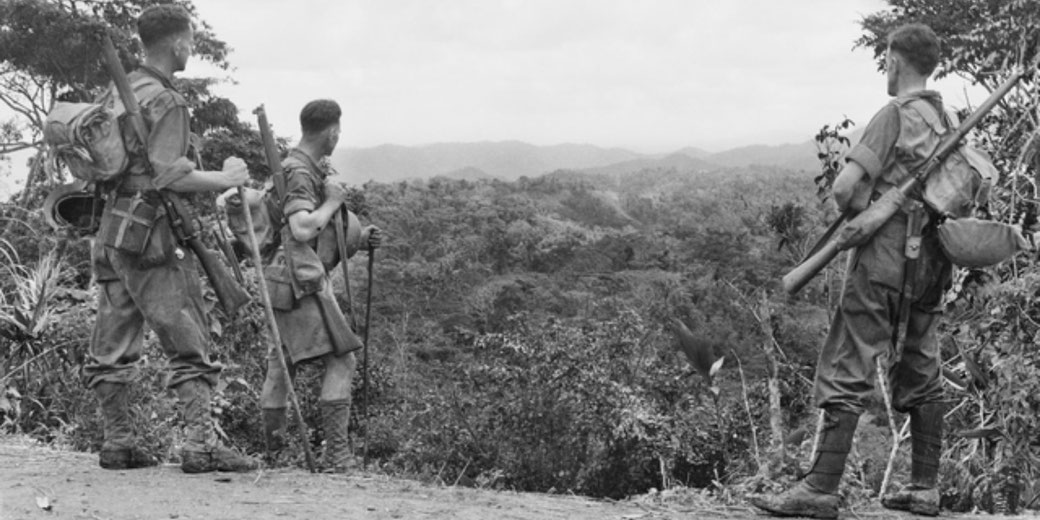
The sources on this page examine the Kokoda Campaign of 1942, which formed part of the wider fighting in Papua during the Second World War.
They trace the shift from the failed Japanese attempt to seize Port Moresby by sea after the Battle of the Coral Sea to the advance overland along the Kokoda Track.
These sources allow you to examine both the strategic importance of the campaign and the lived experience of those involved in one of Australia’s most significant wartime battles.
Source 1
Extract A
“The opposing carrier forces finally located each other in the early morning of 8 May and their planes joined battle at once. On the Allied side both the Lexington and the Yorktown were damaged, the Lexington seriously. On the Japanese side the Shokaku was heavily damaged, though the damage was by no means fatal; and the Zuikaku, though undamaged, lost most of its planes. With the Shoho gone and the Shokaku in no condition to continue the fight, Admiral Inouye, whose oil was running low, broke off the engagement and withdrew to the north.”
Extract B
“The battle was over. The Allies had suffered heavier losses than the Japanese, but the fact that the latter had been turned back from Port Moresby left the victory, strategically at least, with the Pacific Fleet.”
Extract C
“On 9 May, Imperial General Headquarters advised General Horii that because of the action at the Coral Sea the invasion of Port Moresby would have to be temporarily suspended. He was assured, however, that he would not have long to wait for a resumption, for it had been definitely decided that the operation would be carried out sometime in July.”
Extract D
“One further loophole in Port Moresby’s scheme of defense remained. From Buna, a point on the northeast coast of Papua, a difficult and little-known trail led over the Owen Stanleys to Port Moresby via Kokoda, a small plateau in the foothills of the range on which there was a small mountain airfield. General MacArthur’s headquarters realized that an enemy force landing at Buna could quickly invest Kokoda and move on Port Moresby through a nearby 6,000 foot mountain pass known as the Gap.”
Extract E
“Five days later, General Morris established a new unit, MAROUBRA Force, and gave it the mission of holding Kokoda. The new force included the 39th Australian Infantry Battalion (less one company) from the 30th Brigade, and the PIB—280 natives and twenty whites. One company of the battalion, Company B, was ordered to Kokoda on 26 June, but did not leave until 7 July, eleven days later.”
Extract F
“A PIB patrol first sighted the Japanese at 1750, 22 July, a few miles from Awala. The enemy struck at Awala the following afternoon just as the headquarters of Company B and its accompanying platoon reached the area. After a short skirmish, Templeton’s force withdrew, taking up a defensive position that night just short of the Wairopi Bridge. The next day, with the enemy closing in, it pulled back over the bridge and demolished it before the Japanese could make the crossing.”
Extract G
“By 19 August, Brig. A. W. Potts’s 21st Australian Infantry Brigade, the leading brigade of the two 7th Division brigades ordered to Port Moresby, had already arrived there. It did not tarry but began moving at once to Isurava, where MAROUBRA Force—by this time a battalion and two companies of the 30th Brigade—was making a stand under the brigade commander, Brig. Selwyn H. Porter.”
Extract H
“General Horii, who had left for the front on 22 August, had issued orders on the 24th for a general offensive. The attack began at dawn on 26 August and developed such power after a week of unremitting pressure that the Australians found themselves unable to stand firm with the forces at hand.”
Extract I
“The enemy advance continued despite the mountain trail, the bitter resistance of the Australians, and the sustained bombing and strafing of Japanese supply lines by the Allied Air Force. By 7 September, the date organized resistance ceased at Milne Bay, the troops of the South Seas Detachment had made tremendous gains. They had driven the Australians from Isurava, Alola, Eora Creek, and Templeton’s Crossing. They had gained possession of the Gap, had taken Myola, Kagi, and Efogi on the southern slopes of the range, and stood poised to take Menari, Nauro, and Ioribaiwa, the last villages between them and Port Moresby.”
Extract J
“In contrast to General Horii’s five reinforced battalions, the Australians, until Efogi was reached, never had more than three battalions in the forward area to oppose the Japanese advance. One of them was the depleted 39 Battalion, which had been in action for more than a month and should have been relieved long before.”
Contextual information:
Samuel Milner was an American military historian commissioned by the United States Army’s Office of the Chief of Military History to write the official account of the Papuan campaign. His work was published in 1957 as part of the United States Army in World War II series (commonly known as the “Green Books”), and drew on official records, war diaries, captured Japanese documents, and interviews with participants from both sides.
Bibliographical reference:
Milner, S. (1957). Victory in Papua. United States Army in World War II: The War in the Pacific (pp. 38–39, 43–44, 62–63, 74, 88–89). Office of the Chief of Military History, Department of the Army. CMH Pub 5-4.
Copyright: Public domain. This is a United States Government publication and is not subject to copyright under 17 U.S.C. § 105.
Source 2
“The enemy in the meantime had not diminished his pressure along the Kokoda Trail. Australian units arriving from Port Moresby were immediately committed to stemming the steady advance of determined Japanese troops. There was no opportunity to choose advantageous positions or to build elaborate defenses; fighting took place wherever the enemy was encountered. During September the Australians continued to withdraw, still “fighting tenaciously and gallantly under conditions of extraordinary hardship and difficulty,” as General MacArthur phrased it. From Isurava they fell back across The Gap but were again outflanked by Japanese infiltration tactics, despite concentrated Allied bombing and strafing attacks from the air. On 14 September the Australians took up a last desperate stand at Imita Ridge. This ridge, within view of the sea on the Australian side, was the final remaining hurdle before Port Moresby.”
Contextual information:
The Reports of General MacArthur were prepared by General MacArthur’s staff during the Allied occupation of Japan and published by the U.S. Government Printing Office in 1966. Volume I covers MacArthur’s campaigns in the Pacific from 1941 to 1945. This passage describes the critical moment when the Australian withdrawal ended at Imita Ridge in September 1942.
Bibliographical reference:
MacArthur, D. (1966). Reports of General MacArthur: The campaigns of MacArthur in the Pacific (Vol. I, Chapter III). Government Printing Office. CMH Pub 13-3.
Copyright: Public domain. United States Government publication, not subject to copyright under 17 U.S.C. § 105.
Source 3
“Failure in their attempt by sea did not end the Japanese effort to capture Port Moresby, which would afford them an invasion base only 340 miles from the Cape York Peninsula in Australia. In July they landed at Buna, Gona, and Sanananda on the northeast coast of Papua and pushed southward across the Papuan Peninsula.”
“The Japanese fought their way across the deep gorges and razor-backed ridges of the Owen Stanley Mountains and descended the southern slopes to within 32 miles of the port. Here Australian resistance stiffened and on 14 September the advance was held at Imita Range, south of Ioribaiwa. During the next 2 weeks the Allied Air Force continued relentless strafing and bombing of the Japanese supply lines running over the mountains to Buna, Sanananda, and Gona. The enemy, half-starved, attacked on front and flank by the Australians, yielded Ioribaiwa on 28 September and began to withdraw hastily up the trail.”
Contextual information:
This pamphlet was produced by the War Department’s Historical Division in 1944 as part of the American Forces in Action series. It was originally prepared for military personnel, including wounded soldiers in hospitals, to tell them the story of the campaigns in which they had served. It was later released as a public document.
Bibliographical reference:
War Department, Historical Division. (1944). Papuan Campaign: The Buna-Sanananda Operation, 16 November 1942–23 January 1943. American Forces in Action Series (Introduction). Government Printing Office.
Copyright: Public domain. United States Government publication, not subject to copyright under 17 U.S.C. § 105.
Source 4
Extract A
“By 4 May, when a Japanese landing force embarked at Rabaul for Port Moresby, Allied air and naval forces had grown to decisive strength. The result for the Japanese was a major setback. As enemy troopships and an escorting carrier task force approached the eastern end of New Guinea, they were met by two American carrier task forces. In the ensuing Battle of the Coral Sea, the Japanese Navy lost so many ships that the landing force had to return to Rabaul.”
Extract B
“For the advance out of Buna the Japanese assembled a force of about 1,800 men augmented by 1,300 laborers from Rabaul and Formosa and 52 horses. This force proposed to cross Papua through the village of Kokoda, some 50 miles from Buna and over 100 miles from Port Moresby. Next to the village lay a facility highly valued by both sides: an airfield. Quickly moving inland, the Japanese met their first opposition late in the afternoon of 22 July.”
Extract C
“Along the Kokoda Trail the Allies found a different situation. Instead of continuing their drive toward the certain capture of Port Moresby, the Japanese stopped at the village of Ioribaiwa, thirty miles short of their objective. Surprised at the sudden halt, the Allies soon learned that the Japanese agreed with their own strategic view: that success on New Guinea was directly related to success on Guadalcanal. The Japanese drive against the U.S. Marine beachhead in the Solomons had been repulsed, and on 18 September General Horii received orders to withdraw to Buna for a possible reinforcement of the Imperial Japanese Army forces on Guadalcanal.”
Contextual information:
This campaign brochure was written by Charles R. Anderson and published by the U.S. Army Center of Military History as part of the U.S. Army Campaigns of World War II series. It provides a short, accessible overview of the entire Papuan campaign from July 1942 to January 1943, intended for both military and public readership.
Bibliographical reference:
Anderson, C. R. (n.d.). Papua. U.S. Army Campaigns of World War II. U.S. Army Center of Military History. CMH Pub 72-7.
Copyright: Public domain. United States Government publication, not subject to copyright under 17 U.S.C. § 105.
Source 5
“The Kokoda campaign was fought between July and November 1942. Our side started off at the village of Kokoda with undertrained soldiers who were outgunned and had an average age of 18½ years. But they fought courageously against an enemy who was battle hardened, superior in numbers and better equipped with artillery. The Japanese had landed in their thousands at Buna and Gona in the north and were going to sweep south overland to Port Moresby within a period of days.”
Contextual information:
This speech was delivered in the Australian House of Representatives during a debate on a motion commemorating the Kokoda campaign. The Member for Barker was speaking in support of preserving the memory of the Kokoda Track campaign for future generations of Australians.
Bibliographical reference:
Commonwealth of Australia. (1997, March 3). Private members’ business: Kokoda campaign commemoration. House of Representatives, Parliamentary Debates (Hansard). Retrieved from ParlInfo, Parliament of Australia.
Source 6
“This was the last major man-to-man battle in history. If you could not walk out, or the brave Papuan fuzzy wuzzy angels could not carry you out, you died.”
Contextual information:
This speech was delivered in the Australian House of Representatives during a debate on a private members’ motion concerning the Kokoda Track. The speaker was referring to the critical role played by Papuan carriers, nicknamed “Fuzzy Wuzzy Angels” by Australian soldiers, who carried wounded troops along the Kokoda Track to safety.
Bibliographical reference:
Commonwealth of Australia. (2001, August 6). Private members’ business: Kokoda Track. House of Representatives, Parliamentary Debates (Hansard). Retrieved from ParlInfo, Parliament of Australia.