
Historical sources on the French Directory
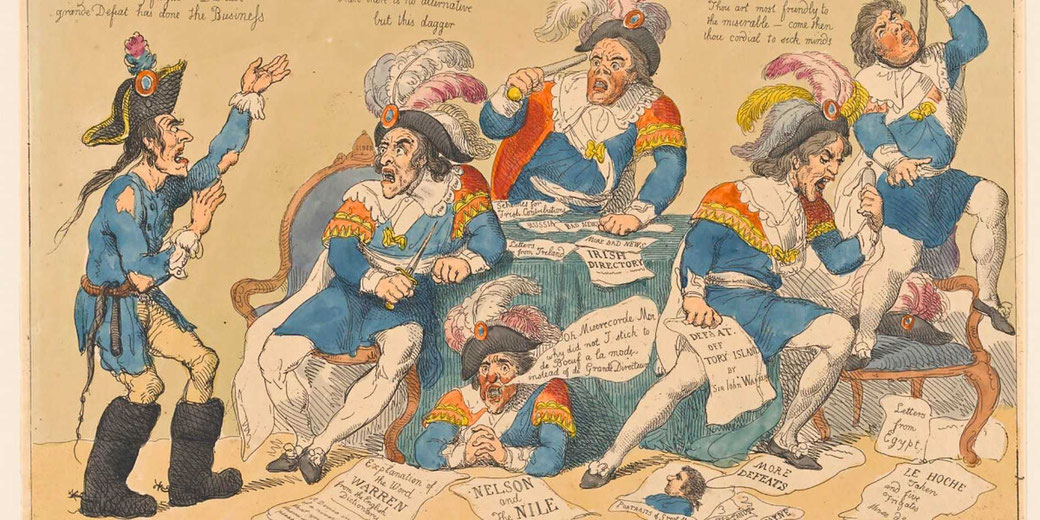
Between the fall of the monarchy in August 1792 and the rise of Napoleon Bonaparte in 1799, France passed through a turbulent phase of revolution, repression, and political experiment that culminated in the establishment and collapse of the French Directory.
The sources collected here trace that sequence in clear stages, beginning with the creation of the National Convention, moving through the violence of the Revolutionary Tribunal and the laws of the Terror, and then turning to the constitutional settlement of 1795 which created a two-chamber legislature and a five-man executive.
Further extracts show the constant pressure placed on the Directory by royalist and radical opponents, along with its reliance on military force to maintain control, before concluding with the replacement of the regime by the Consulate under Bonaparte.
Source 1
"The National Assembly, considering that the dangers of the fatherland have reached their height, that it is the highest duty of the legislative body to use all means of safety which the circumstances demand, and that it cannot, without betraying its duty, let France continue to be driven headlong into the abyss when the remedy is in its hands, considering that the only efficacious remedy for the ills which rend France is a national convention; that, in a representative government, the people have the right, when their representatives become unfaithful to them, to appoint others; that the legislative body, which cannot regard the present as its faithful representation, has the right to supply this lack ... decrees as follows: 1. There shall be a National Convention. 2. Every Frenchman twenty-one years of age, domiciled for a year ... shall be an active citizen ... shall vote in the primary assembly of his canton for the nomination of electors. These electors shall name the deputies to the National Convention."
Contextual information:
This decree was passed by the Legislative Assembly on 11 August 1792, the day after the storming of the Tuileries, and it formally called the body that would replace the Legislative Assembly.
Bibliographical reference:
Decree for Electing the Convention (11 August 1792). (As found in Anderson, F. M. (Ed.). (1908). The constitutions and other select documents illustrative of the history of France, 1789-1907 (2nd ed., pp. 125-127). H. W. Wilson Company).
Copyright: Public domain.
Source 2
"The Revolutionary Tribunal is instituted to punish the enemies of the people. The enemies of the people are those who seek to destroy public liberty, either by force or by cunning. Those who have sought to mislead opinion and to prevent the instruction of the people, to deprave morals and to corrupt the public conscience, to impair the energy and the purity of revolutionary and republican principles, or to impede the progress thereof, either by counterrevolutionary or insidious writings, or by any other machination; Contractors of bad faith who compromise the safety of the Republic, and squanderers of the public fortune, other than those included in the provisions of the law of 7 Frimaire; Those who, charged with public office, take advantage of it in order to serve the enemies of the Revolution, to harass patriots, or to oppress the people; Finally, all who are designated in previous laws relative to the punishment of conspirators and counterrevolutionaries, and who, by whatever means or by whatever appearances they assume, have made an attempt against the liberty, unity, and security of the Republic, or labored to prevent the strengthening thereof. The penalty provided for all offenses under the jurisdiction of the Revolutionary Tribunal is death."
Contextual information:
The Law of 22 Prairial was passed on 10 June 1794 at the initiative of Robespierre and his ally Couthon on the Committee of Public Safety. It removed the right of defendants to mount a defence before the Revolutionary Tribunal and made death the only possible sentence, producing the period known as the Great Terror in which executions accelerated sharply until Robespierre's fall in July 1794.
Bibliographical reference:
Law of 22 Prairial (10 June 1794). (As found in Anderson, F. M. (Ed.). (1908). The constitutions and other select documents illustrative of the history of France, 1789-1907 (2nd ed., pp. 152-157). H. W. Wilson Company).
Copyright: Public domain.
Source 3
"August 22, 1795 (5 Fructidor, Year III). Duvergier, Lois, VIII, 223-242. This constitution was drawn up after the suppression of the insurrection of Prairial, which had demanded that the constitution of the Year I should be put in operation. It was referred to the people, but coupled with the requirement that at least two-thirds of the members of the Convention must be elected to the two legislative councils. This 'decree of the two-thirds' led to the unsuccessful royalist insurrection of Vendemiaire. The new constitution was then put into effect (October 26, 1795). It remained in operation until 18 Brumaire."
Contextual information:
Frank Maloy Anderson was a professor of history at the University of Minnesota who compiled this documentary collection, first published in 1904 and revised in 1908.
Bibliographical reference:
Anderson, F. M. (Ed.). (1908). The constitutions and other select documents illustrative of the history of France, 1789-1907 (2nd ed., pp. 212-253). H. W. Wilson Company.
Copyright: Public domain.
Source 4
Extract A (Articles on the Council of Five Hundred and Council of Ancients)
"Art. 44. The legislative body is composed of a Council of Ancients and a Council of the Five Hundred. Art. 75. The Council of the Five Hundred cannot deliberate, unless the sitting is composed of at least two hundred members. Art. 76. The proposal of the laws belongs exclusively to the Council of the Five Hundred. Art. 77. No proposition can be considered or decided upon in the Council of the Five Hundred, except in observance of the following forms. There shall be three readings of the proposal; the interval between two of these readings cannot be less than ten days. The discussion is open after each reading; nevertheless, the Council of the Five Hundred can declare that there is cause for adjournment, or that there is no occasion for consideration. Every proposal shall be printed and distributed two days before the second reading. After the third reading the Council of the Five Hundred decides whether or not there is cause for adjournment...
"Art. 86. The Council of Ancients is composed of two hundred and fifty members. Art. 87. In order to be elected a member of the Council of Ancients it is necessary to be at least forty years of age ... Art. 92. The resolutions of the Council of the Five Hundred adopted by the Council of Ancients are called Laws."
Extract B (Articles on the Executive Directory)
"Title VI. Executive Power. Art. 132. The executive power is delegated to a Directory of five members appointed by the legislative body, performing then the functions of an electoral body in the name of the nation. Art. 133. The Council of Five Hundred draws up, by secret ballot, the list which must contain fifty names; it presents this list to the Council of Ancients, which chooses from it by secret ballot the members of the Directory. Art. 134. The members of the Directory must be at least forty years of age ... Art. 135. They must have been previously a minister or a member of the legislative body ... Art. 137. The Directory is renewed in part by the election of a new member each year."
Contextual information:
The Constitution of the Year III was adopted by the National Convention on 22 August 1795 and came into effect on 26 October 1795. It established the Directory as the new executive government of France, replacing the Committee of Public Safety that had overseen the Reign of Terror, and created a bicameral legislature divided between the Council of Five Hundred and the Council of Ancients.
Bibliographical reference:
Constitution of the Year III (22 August 1795). (As found in Anderson, F. M. (Ed.). (1908). The constitutions and other select documents illustrative of the history of France, 1789-1907 (2nd ed., pp. 212-253). H. W. Wilson Company).
Copyright: Public domain.
Source 5
“Art. 1. All those are guilty of crime against the internal security of the Republic and against the personal security of the citizens, and shall be punished with death, in conformity with article 612 of the code of offences and penalties, who, by their discourses or by their printed writings, whether distributed or posted, seek to effect the dissolution of the national representation or that of the .Executive Directory, or the murder of all or any of the members who compose them, or the re-establishment of the monarchy, or that of the constitution of 1793. or that of the constitution of 1791. or of any government other than that established by the constitution of the Year III, as accepted by the French people, or the invasion of public properties, or the pillage or partition of individual properties, under the name of an agrarian law, or in any other manner. The penalty of death mentioned in the present article shall be commuted to that of deportation, if the jury declares that there were extenuating circumstances in the offence.”
Contextual information:
The Law against Public Enemies was passed by the Directory's legislature on 16 April 1796 in direct response to two simultaneous threats: the royalist campaign to restore the Bourbon monarchy and a radical left-wing conspiracy led by Gracchus Babeuf. The law's three articles were written to target both groups by name, and together they confirm that the Directory fought to survive pressure from royalists on the right and radical republicans on the left throughout its existence.
Bibliographical reference:
Law against Public Enemies (16 April 1796). (As found in Anderson, F. M. (Ed.). (1908). The constitutions and other select documents illustrative of the history of France, 1789-1907 (2nd ed., p. 254). H. W. Wilson Company).
Copyright: Public domain.
Source 6
Extract A
"The memorial he prepared was so excellent that he was invited into the topographical bureau of the Committee of Public Safety. His knowledge, sense, energy, fire, were so remarkable that he made strong friends and became an important personage. Such was the impression he made, that when in October, 1795, the government was threatened by the revolting sections, Barras, the nominal head of the defence, asked Napoleon to command the forces which protected the Tuileries, where the Convention had gone into permanent session. He hesitated for a moment. He had much sympathy for the sections. His sagacity conquered. The Convention stood for the republic; an overthrow now meant another proscription, more of the Terror, perhaps a royalist succession, an English invasion. 'I accept,' he said to Barras; 'but I warn you that once my sword is out of the scabbard I shall not replace it till I have established order.' It was on the night of 12th Vendemiaire that Napoleon was appointed."
Extract B
"When the elections of 1797 gave the Royalists a majority in the two legislative councils, the three directors who still adhered to the republican regime resolved to strike. They could not appeal to the people; it was the people's vote which had gone against them. They appealed, therefore, to the army. Bonaparte sent Augereau with a detachment of troops from Italy. On the 18th Fructidor (September 4, 1797) Augereau surrounded the legislative bodies, arrested the Royalist leaders, annulled the elections in forty-nine departments, and left the Jacobins and republicans in control. The blow was effective: Pichegru, one of the foremost Royalist leaders, was deported to Cayenne."
Contextual information:
Ida M. Tarbell was an American journalist and historian, best known for her investigative work on the Standard Oil Company, who published A Life of Napoleon Bonaparte in 1901. She drew on French primary sources and earlier scholarly accounts to produce an accessible popular biography. The passage on Vendemiaire was written at a time when the event was within living memory for many of her readers, and her account of the Coup of 18 Fructidor identifies both the Royalists and the Jacobins as the two political groups competing for control of the Directory.
Bibliographical reference:
Tarbell, I. M. (1901). A life of Napoleon Bonaparte (pp. 51, 95). S. S. McClure.
Copyright: Public domain.
Source 7
"Title IV. Of the Government. Art. 39. The government is confided to three Consuls appointed for ten years and indefinitely re-eligible. Each of them is elected individually with the distinguishing title of First, Second or Third Consul. The constitution appoints as First Consul, Citizen Bonaparte, former provisional consul; as Second Consul, Citizen Cambaceres, former minister of justice; and as Third Consul, Citizen Lebrun, former member of the commission of the Council of Ancients. Art. 41. The First Consul promulgates the laws; he appoints and dismisses at will the members of the Council of State, the ministers, the ambassadors and other foreign agents of high rank, the officers of the army and navy, the members of the local administrations, and the commissioners of the government before the tribunals. He appoints all criminal and civil judges, other than the justices of the peace and the judges of cassation, without power to remove them."
Contextual information:
The Constitution of the Year VIII was adopted on 13 December 1799, approximately five weeks after Napoleon Bonaparte's Coup of 18-19 Brumaire (9-10 November 1799) dissolved the Directory. It was imposed on the legislative commissions by Bonaparte and approved by plebiscite. The new government it created was called the Consulate, with Bonaparte named as First Consul in the constitutional text itself.
Bibliographical reference:
Constitution of the Year VIII (13 December 1799). (As found in Anderson, F. M. (Ed.). (1908). The constitutions and other select documents illustrative of the history of France, 1789-1907 (2nd ed., pp. 270-281). H. W. Wilson Company).
Copyright: Public domain.