
Historical sources on the Fall of France in 1940
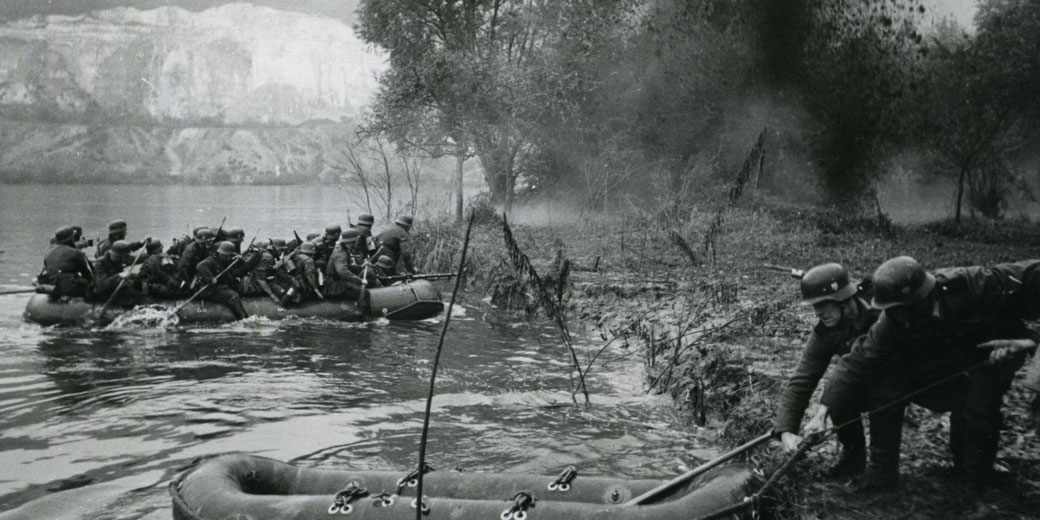
The following sources trace the rapid collapse of France in 1940 through a sequence of tightly connected events, beginning with the outbreak of war in 1939 and culminating in the armistice signed at Compiègne.
They present a clear account of how German forces advanced through Western Europe with speed and coordination, how Allied armies became encircled and forced into retreat, and how the evacuation at Dunkirk saved large numbers of troops without reversing the overall situation.
They also include official military reports and political speeches that show how contemporaries understood these events, from operational detail to public messaging, and they highlight how the success of Blitzkrieg forced a reassessment of military planning.
Source 1
Extract A
"When Hitler's army invaded Poland on 1 September 1939, World War II began. While German forces overran western Poland, Soviet troops entered from the east to claim their portion of that country. France and Britain declared war on Germany and mobilized their forces. The subsequent period of deceptive inactivity, lasting until spring, became known as the Phony War. Nothing happened to indicate that World War II would differ significantly in style or tempo from World War I."
Extract B
"In the spring of 1940 their theories were put to the test as German forces struck against Norway and Denmark in April; invaded the Netherlands, Belgium, and Luxembourg in May; and late in the same month broke through a hilly, wooded district in France. Their columns sliced through to the English Channel, cutting off British and French troops in northern France and Belgium. The French Army, plagued by low morale, divided command, and primitive communications, fell apart. The British evacuated their forces from Dunkerque with the loss of most of their equipment. The Germans entered Paris on 14 June, and the French government, defeatist and deeply divided politically, sued for an armistice. The success of the German Blitzkrieg forced the remaining combatants to rethink their doctrine and restructure their armies."
Contextual information:
This brochure was prepared by Wayne M. Dzwonchyk and John Ray Skates at the U.S. Army Center of Military History, and published in 1992 as part of the Army's 50th anniversary commemoration of World War II. It provides a condensed overview of the entire war for an American audience, covering both the European and Pacific theatres.
Bibliographical reference:
Dzwonchyk, W. M., & Skates, J. R. (1992). A brief history of the U.S. Army in World War II (The U.S. Army Campaigns of World War II, pp. 4–5). Center of Military History, United States Army. https://www.ibiblio.org/hyperwar/USA/USA-C-WWII/index.html
Copyright: Public domain. U.S. government work authored by employees of the Center of Military History, United States Army. Not subject to copyright under 17 U.S.C. § 105.
Source 2
"The German offensive on the Continent began on 10 May, the day on which Churchill became Prime Minister. After four days of fighting, culminating in the bombing of Rotterdam, the Netherlands Government was compelled to surrender. On the same day, 14 May, strong German armored forces broke through in the Ardennes forest. The gap rapidly became wider as German armored columns moved through in two directions, to cut off the Allied forces in Belgium from those in France and to isolate the French forces in the Maginot Line from those to the west. On 28 May the Belgian Army surrendered. On the following day the British began evacuating the greater part of their expeditionary force from Dunkerque. The evacuation, unexpectedly and almost unbelievably successful, even though all equipment had to be left behind, was completed on 4 June. On the next day the Germans began the attack southward on the re-formed French lines, which rapidly gave way."
Contextual information:
This volume is part of the U.S. Army's official history series, commonly known as the "Green Books." Written by Maurice Matloff and Edwin M. Snell of the Office of the Chief of Military History, it describes how American strategic planning responded to German military victories in 1940 and 1941. The passage above comes from Chapter II, "German Victories and American Plans."
Bibliographical reference:
Matloff, M., & Snell, E. M. (1953). Strategic planning for coalition warfare, 1941–1942 (United States Army in World War II: The War Department, Chapter II). Office of the Chief of Military History, Department of the Army. U.S. Government Printing Office. https://www.history.army.mil/books/wwii/Sp1941-42/chapter2.htm
Copyright: Public domain. U.S. government work published by the Office of the Chief of Military History through the U.S. Government Printing Office. Not subject to copyright under 17 U.S.C. § 105.
Source 3
"Both the nominal Commander-in-Chief West Field Marshal Gerd von Rundstedt and Army Group B commander Field Marshal Walter Model, who had primary responsibility for WACHT AM RHINE, questioned the scope of the offensive. Both argued for a more limited attack, to pinch out the American-held salient north of the Ardennes around Aachen. Borrowing a bridge-players term, they referred to Hitler's larger objectives as the grand slam, or big solution, but proposed instead a small solution more compatible with the limited force being raised. Rundstedt and Model believed that Hitler's legions were incapable of conducting a blitzkrieg, or lightning war, campaign. The twin swords that had dominated the field during the 1940 drive across France, tanks and air power, no longer existed in the numbers necessary to strike a decisive blow, nor was the hastily conscripted infantry, even when led by experienced officers and sergeants, up to the early war standards."
Contextual information:
This brochure was written by Roger Cirillo at the U.S. Army Center of Military History as part of a series of 40 illustrated campaign studies published for the World War II 50th anniversary commemoration. It discusses the 1944 Battle of the Bulge but directly references the 1940 campaign in France when defining Blitzkrieg.
Bibliographical reference:
Cirillo, R. (1995). Ardennes-Alsace (The U.S. Army Campaigns of World War II, CMH Pub 72-26). Center of Military History, United States Army. U.S. Government Printing Office. https://www.history.army.mil/brochures/ardennes/aral.htm
Copyright: Public domain. U.S. government work published by the Center of Military History, United States Army, through the U.S. Government Printing Office. Not subject to copyright under 17 U.S.C. § 105.
Source 4
Extract A
"The following despatch was submitted to the Lords Commissioners of the Admiralty on the 18th June, 1940, by Vice-Admiral Sir Bertram H. Ramsay, K.C.B., M.V.O., Flag Officer Commanding, Dover."
Extract B
"Be pleased to lay before Their Lordships the following report on Operation 'Dynamo', namely the evacuation of the Allied Armies from Dunkirk and neighbouring beaches between 26th May and 4th June, 1940. The report takes the form of this covering letter, together with detailed narrative and appendices."
Extract C
"During the course of the operation some 330,000 troops* reached safety in England after being evacuated from Dunkirk, and from the beach stretching 10 miles eastward from the entrance to Dunkirk Harbour. To those on the French coast, when in the early stages anything up to 50,000 troops were waiting to embark on a 10 mile sea front, the presence of perhaps 20 small warships off shore, and 200 small boats spread along the length of coast at any given moment, must have appeared as a feeble effort to tackle this great task..."
*Admiralty footnote: “About one-quarter of these troops were carried in ships manned by the Merchant Navy."
Contextual information:
This is the official after-action report written by Vice-Admiral Bertram Ramsay, the officer responsible for planning and coordinating the Dunkirk evacuation, submitted to the Admiralty on 18 June 1940 and published in the London Gazette in July 1947. It is the primary military record of Operation Dynamo, providing a day-by-day account of the evacuation from 26 May to 4 June 1940.
Bibliographical reference:
Ramsay, B. H. (1947). The evacuation of the Allied armies from Dunkirk and neighbouring beaches [Despatch]. Supplement to The London Gazette, No. 38017, pp. 3295–3312. https://ibiblio.org/hyperwar/UN/UK/LondonGazette/38017.pdf
Copyright: Crown Copyright, expired. Published in the London Gazette in 1947. Under the UK Copyright, Designs and Patents Act 1988, Crown Copyright expires 50 years after publication, meaning this document's Crown Copyright expired in 1997. London Gazette content is also available under the Open Government Licence v3.0.
Source 5
Extract A
"However, the German eruption swept like a sharp scythe around the right and rear of the Armies of the north. Eight or nine armoured divisions, each of about 400 armoured vehicles of different kinds, but carefully assorted to be complementary and divisible into small self-contained units, cut off all communications between us and the main French Armies. It severed our own communications for food and ammunition, which ran first to Amiens and afterwards through Abbeville, and it shore its way up the coast to Boulogne and Calais, and almost to Dunkirk."
Extract B
"Suddenly the scene has cleared, the crash and thunder has for the moment — but only for the moment — died away. A miracle of deliverance, achieved by valour, by perseverance, by perfect discipline, by faultless service, by resource, by skill, by unconquerable fidelity, is manifest to us all. The enemy was hurled back by the retreating British and French troops. He was so roughly handled that he did not harry their departure seriously. The Royal Air Force engaged the main strength of the German Air Force, and inflicted upon them losses of at least four to one; and the Navy, using nearly 1,000 ships of all kinds, carried over 335,000 men, French and British, out of the jaws of death and shame, to their native land and to the tasks which lie immediately ahead. We must be very careful not to assign to this deliverance the attributes of a victory. Wars are not won by evacuations."
Contextual information:
This is the transcript of Winston Churchill's famous "We shall fight on the beaches" speech, delivered to the House of Commons on 4 June 1940 at 3:40 p.m. Churchill was reporting to Parliament on the completion of the Dunkirk evacuation, which had concluded that same day, and was seeking to temper public euphoria while also strengthening national resolve for the fight ahead.
Bibliographical reference:
Churchill, W. S. (1940, June 4). War situation [Speech]. Parliamentary Debates, House of Commons, 5th Series, Vol. 361, cc. 787–798. https://hansard.parliament.uk/commons/1940-06-04/debates/60ee1caa-abcf-48e5-8c55-c4e587b94de7/WarSituation
Copyright: UK Parliamentary Copyright. Hansard transcripts of Parliamentary debates are freely available for reproduction under the Open Parliament Licence. The historic Hansard archive is maintained at hansard.parliament.uk.
Source 6
ARMISTICE AGREEMENT BETWEEN THE GERMAN HIGH COMMAND OF THE ARMED FORCES AND FRENCH PLENIPOTENTIARIES, COMPIÈGNE, JUNE 22, 1940...
"Between the chief of the High Command of the armed forces, Col. Gen. [Wilhelm] Keitel, commissioned by the Fuehrer of the German Reich and Supreme Commander in Chief of the German Armed Forces, and the fully authorized plenipotentiaries of the French Government, General [Charles L. C.] Huntziger, chairman of the delegation; Ambassador [Léon] Noel, Rear Admiral [Maurice R.] LeLuc, Army Corps General [Georges] Parisot and Air Force General [Jean-Marie Joseph] Bergeret, the following armistice treaty was agreed upon:
Article I: "The French Government directs a cessation of fighting against the German Reich in France as well as in French possessions, colonies, protectorate territories, mandates as well as on the seas....
"This armistice agreement, signed in the Forest of Compiègne, June 22, 1940, at 6:50 p.m., German summer time. HUNTZIGER. KEITEL."
Contextual information:
This is the official English translation of the armistice agreement that ended France's participation in World War II, signed on 22 June 1940 at Compiègne. Hitler deliberately selected Compiègne Forest as the location because it was where Germany had signed the armistice ending World War I in November 1918.
Bibliographical reference:
Franco-German armistice agreement, Compiègne, June 22, 1940. (1956). In U.S. Department of State, Documents on German foreign policy 1918–1945 (Series D, Vol. IX, pp. 671–676, Publication No. 6312). U.S. Government Printing Office.
Copyright: Public domain. The English translation was published by the U.S. Department of State through the U.S. Government Printing Office (Publication No. 6312), making it a U.S. government work not subject to copyright under 17 U.S.C. § 105.