
Historical sources on the Eureka Stockade
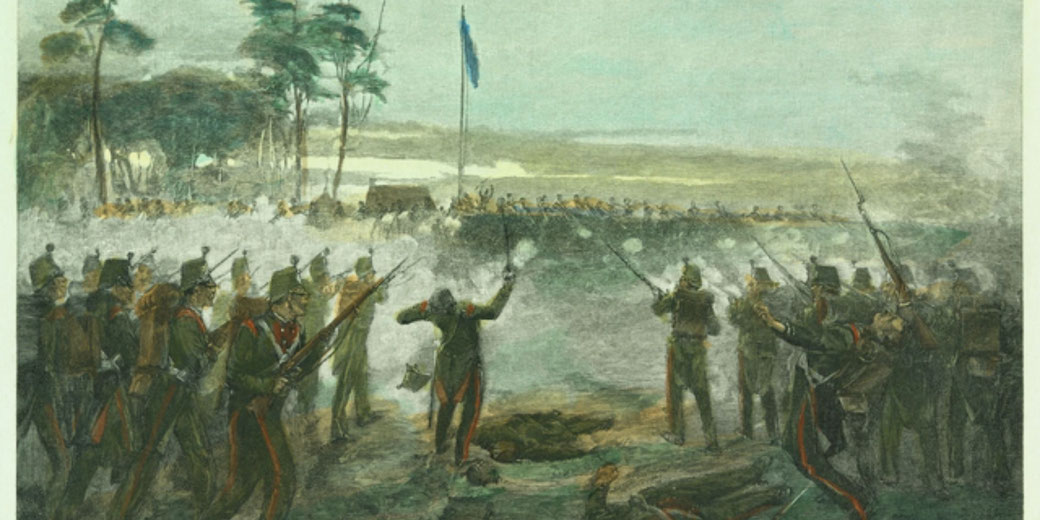
The sources presented on this page provide a detailed and varied account of the events surrounding the Eureka Stockade, one of the most significant uprisings in Australian colonial history.
Drawn from official reports, eyewitness testimony, and later historical writing, they trace the discovery of gold at Ballarat, the growing resentment among miners toward the licence system, and the escalation of tensions that led to armed confrontation.
They offer differing perspectives, including those of government authorities, participants in the rebellion, and later commentators, which allow for careful comparison of motives, experiences, and interpretations.
Source 1
"On the 26th of August a prospecting party of six, led by a man named Connor, unearthed the riches of Golden Point Ballarat, and washed out 30 oz. for the first day's work. There were of course rival claimants for the honour of this important discovery, one party claiming to have tested the ground on the 24th, and another to have begun operations on the 25th. But the Commissioner, when that office was established, after investigations, acknowledged the priority of Connor by granting his party a double area in consideration thereof. None of the claimants were eligible for participation in the subsequently distributed Government rewards, because this was not looked upon as a new field, merely an extension of the recognised 'Buninyong Goldfield,' as it was officially known."
Contextual information:
Henry Giles Turner (1831–1920) was a prominent Melbourne banker, public intellectual, and president of the Royal Society of Victoria. He wrote this two-volume history of the Colony of Victoria with access to official government records and published it in 1904, fifty years after the events at Eureka.
Bibliographical reference:
Adapted from Turner, H. G. (1904). A history of the Colony of Victoria: From its discovery to its absorption into the Commonwealth of Australia (Vol. 2, p. 5). Longmans, Green and Co.
Copyright: Public domain.
Source 2
Extract A
"For the purpose, it is now sufficient to say that I had joined a party; fixed our tent on the Canadian Flat; went up to the Camp to get our gold licence; for one pound ten shilling [also equivalent to 30 shillings] sterling a head we were duly licensed for one month to dig, search for, and remove gold, etc.—We wanted to drink a glass of porter to our future success, but there was no Bath Hotel at the time.—Proceeded to inspect the famous Golden Point (a sketch of which I had seen in London in the 'Illustrated News'). The holes all around, three feet in diameter, and five to eight feet in depth, had been abandoned! we jumped into one, and one of my mates gave me the first lesson in 'fossiking,'—In less than five minutes I pounced on a little pouch— the yellow boy was all there,—my eyes were sparkling,—I felt a sensation identical to a first declaration of love in by-gone times.—'Great works,' at last was my bursting exclamation."
Extract B
"In a word, the thirty shillings a month for the gold licence became a nuisance. A public meeting was announced on Bakery-hill. It was in November, 1853. Four hundred diggers were present."
Extract C
"Here is a short resume of events which led to the popular demonstration on Tuesday, October 17th, 1854. Two men, old friends, named Scobie and Martin, after many years separation, happened to meet each other in Ballaarat. Joy at the meeting, led them to indulge in a wee drop for 'Auld lang Syne.' In this state of happy feeling, they call at the Eureka Hotel, on their way home, intending to have a finishing glass. They knock at the door, and are refused admittance, very properly, on account of their drunkenness. They leave, and proceed on their way, not, perhaps without the usual colonial salutations. At about fifty yards from the hotel, they hear a noise behind them, and retrace their steps. They are met by persons, unknown, who inflict blows on them, which render one insensible and the other lifeless."
Extract D
"On the morning of Thursday, the 22nd June, in the year of Grace, One thousand eight hundred and fifty-four, His Excellency SIR CHARLES HOTHAM, Knight Commander of the Most Noble Military Order of the Bath, landed on the shores of this fair province, as its Lieutenant-Governor, the chosen and commissioned representative of Her Most Gracious Majesty, the QUEEN! Never (writes the Melbourne historian of that day) never in the history of public ovations, was welcome more hearty, never did stranger meet with warmer welcome, on the threshold of a new home: VICTORIA WELCOMES VICTORIA'S CHOICE, was the Melbourne proclamation."
Extract E
"The 'SOUTHERN CROSS' was hoisted up the flagstaff — a very splendid pole, eighty feet in length, and straight as an arrow. This maiden appearance of our standard, in the midst of armed men, sturdy, self-overworking gold-diggers of all languages and colours, was a fascinating object to behold. There is no flag in old Europe half so beautiful as the 'Southern Cross' of the Ballaarat miners, first hoisted on the old spot, Bakery-hill. The flag is silk, blue ground, with a large silver cross, similar to the one in our southern firmament; no device or arms, but all exceedingly chaste and natural. Captain Ross, of Toronto, was the bridegroom of our flag, and sword in hand, he had posted himself at the foot of the flag-staff, surrounded by his rifle division. Peter Lalor, our Commander-in-chief, was on the stump, holding with his left hand the muzzle of his rifle, whose butt-end rested on his foot."
Extract F
"Some five hundred armed diggers advanced in real sober earnestness, the captains of each division making the military salute to Lalor, who now knelt down, the head uncovered, and with the right hand pointing to the standard exclaimed in a firm measured tone:— 'We swear by the Southern Cross to stand truly by each other, and fight to defend our rights and liberties.' An universal well rounded amen, was the determined reply; some five hundred right hands stretched towards our flag."
Extract G
"I awoke. Sunday morning. It was full dawn, not daylight. A discharge of musketry — then a round from the bugle — the command 'forward' — and another discharge of musketry was sharply kept on by the red-coats (some 300 strong) advancing on the gully west of the stockade, for a couple of minutes. The shots whizzed by my tent. I jumped out of the stretcher and rushed to my chimney facing the stockade. The forces within could not muster above 150 diggers."
Extract H
"At the end of Mr. Aspinall's able oration, the jury appeared to me, to be decidedly willing to let me go, with an admonition to sin no more: because Mr. Aspinall took the same line of defence as Mr. Michie, the counsel in the trial of John Manning; that is, he confessed to the riot, but laughed at the treason. However rashly the diggers had acted in taking up arms, however higgledy-piggledy had been the management of the stockade, yet they were justified in resisting unconstitutional force by force."
"The jury, after twenty minutes past nine, were again in the jury-box. I was satisfied by their countenances that 'the People' were victorious."
"The Clerk of the Court: 'Gentlemen of the Jury, have you considered your verdict?' Foreman: 'We have.' The Clerk: 'Do you find the prisoner at the bar Guilty or Not Guilty?' Foreman, with a firm voice: 'NOT GUILTY!' Magna opera Domini — (God save the People) — thus my chains sprang asunder. The people inside telegraphed the good news to the crowd outside, and 'Hurrah!' rent the air in the old British style."
Contextual information:
Raffaello Carboni (1817–1875) was an Italian-born miner who arrived at Ballarat in late 1852 and lived on the Ballarat goldfields and participated in the events surrounding the Eureka Stockade in 1854. He was arrested after the battle, charged with high treason, and acquitted. He wrote this eyewitness account in 1855, just months after the events, making it the only comprehensive first-hand account of the rebellion.
Bibliographical reference:
Carboni, R. (1855). The Eureka Stockade: The consequence of some pirates wanting on quarter-deck a rebellion. J.P. Atkinson & Co. (Facsimile edition: Public Library of South Australia, 1962, pp. 5, 8, 20–21, 16, 59–60, 60, 71–72, 117.)
Copyright: Public domain.
Source 3
"Camp, Ballaarat, December 3, 1854. Sir,—I have the honour to report, for the information of the Major-General, the following details relative to a collision that took place this morning between the troops under my command, and the Ballaarat rebels. The Major-General has already been made aware of the fact, that a large number of ill-disposed persons have, for some days, been openly organizing, drilling, and equipping themselves, with the undisguised object of attacking her Majesty's troops, and, if possible, subverting the Government."
"We then advanced quietly to the entrenchments, where the revolutionary flag was flying; at about one hundred and fifty yards, as we advanced, we were received by rather sharp and well-directed fire from the insurgents, without word or challenge on their part; then, and not till then, I ordered the bugle to sound the 'commence firing.'"
"'Ballaarat, December 3, 1854. 12th Regiment,—Lieutenant Paul severely wounded in the hip; one soldier killed, and seven severely wounded. 40th Regiment,—two privates killed; Captain H. C. Wise dangerously wounded; and six privates severely wounded. Of the mounted men and police we have no return.' E. MACARTHUR, D.A.G."
[Additional note: Captain Wise died on 21 December 1854 from his wounds. Additional soldiers also died of wounds in the following weeks, bringing the military death toll to approximately 5–6.]
Contextual information:
Captain J.W. Thomas of the 40th Regiment commanded the military force that attacked the Eureka Stockade at dawn on 3 December 1854. He wrote this official despatch on the same day as the battle, reporting to Major-General Robert Nickle at headquarters in Melbourne. The casualty return was compiled by Deputy Adjutant-General Edward Macarthur.
Bibliographical reference:
Thomas, J.W. (1854, December 3). Report from Captain J.W. Thomas, 40th Regiment, to Major-General Robert Nickle, Head Quarters, Melbourne. Reproduced in Victoria: With a description of its principal cities, Melbourne and Geelong (1856).
Copyright: Crown copyright expired. Public domain.
Source 4
"As the inhuman brutalities practised by the troops are so well known, it is unnecessary for me to repeat them. There were 34 digger casualties of which 22 died. The unusual proportion of the killed to the wounded is owing to the butchery of the military and troopers after the surrender."
Contextual information:
Peter Lalor (1827–1889) was an Irish-born civil engineer who became the elected commander-in-chief of the rebel miners at the Eureka Stockade. He was shot in the left arm during the battle on 3 December 1854 and had to have it amputated. He wrote this report approximately three months after the battle, giving his own account of the casualties on the miners' side.
Bibliographical reference:
Lalor, P. (1855). Report of Peter Lalor, Commander-in-Chief. Reproduced in Carboni, R. (1855). The Eureka Stockade: The consequence of some pirates wanting on quarter-deck a rebellion. J.P. Atkinson & Co. (Facsimile edition: Public Library of South Australia, 1962, Chapter LXXVII, pp. 99–100.)
Copyright: Public domain.