
Historical sources on the Battle of Britain
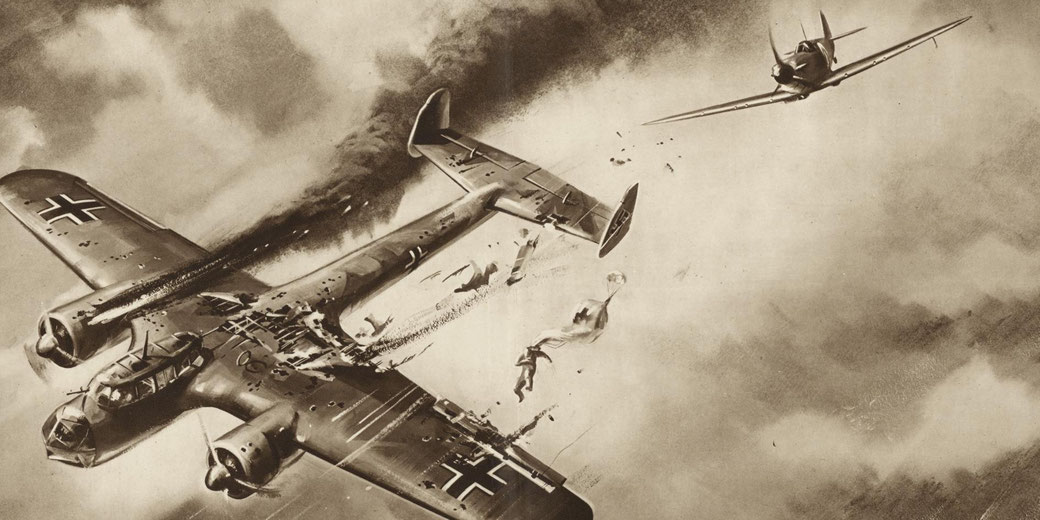
During the summer and autumn of 1940, Britain faced a sustained air assault from Nazi Germany in a campaign that later received the name Battle of Britain.
After the fall of France in June 1940, Adolf Hitler prepared plans for an invasion of the British Isles known as Operation Sealion, yet the success of such an operation depended upon the destruction of the Royal Air Force and the attainment of German air superiority over southern England.
The following sources provide different perspectives on this struggle.
Source 1
"The Battle of France is over. I expect that the Battle of Britain is about to begin. Upon this battle depends the survival of Christian civilization. Upon it depends our own British life, and the long continuity of our institutions and our Empire. The whole fury and might of the enemy must very soon be turned on us. Hitler knows that he will have to break us in this island or lose the war. If we can stand up to him, all Europe may be free and the life of the world may move forward into broad, sunlit uplands. But if we fail, then the whole world, including the United States, including all that we have known and cared for, will sink into the abyss of a new Dark Age made more sinister, and perhaps more protracted, by the lights of perverted science. Let us therefore brace ourselves to our duties and so bear ourselves that, if the British Empire and its Commonwealth last for a thousand years, men will still say, ‘This was their finest hour.’"
Contextual Information:
Winston Churchill delivered this speech to the House of Commons on 18 June 1940, just days before France surrendered to Nazi Germany. As Prime Minister, Churchill was preparing the British public for the coming German air campaign against Britain. The speech is one of the most famous addresses of the Second World War and gave the Battle of Britain its name before the fighting had even begun.
Bibliographical Reference:
Churchill, W. (1940, June 18). Their finest hour [Speech to the House of Commons]. Hansard, HC Deb, vol. 362, cc. 51–61. London, United Kingdom.
Source 2
"It is worth emphasizing that the creation of Fighter Command as an effective defense force and the articulation and conception of an air defense system was due almost entirely to Dowding. As the Air Member for Supply and Research in the early thirties, he provided critical support for the development of radar as well as for the single-seater fighter. As the Commander of Fighter Command in the late thirties, he waged a lonely fight with the Air Staff to build up an integrated air defense system based on the ‘Spitfire’ and ‘Hurricane.’ He then conducted and won the Battle of Britain with the force and strategy that he had created—surely as great a conceptual triumph as the creation of the German panzer force."
(Appendix 1, pp. 327–328)
"On August 1, the Luftwaffe received Hitler’s Directive No. 17 for the conduct of air and sea warfare against England. It declared that the German air force was to overcome the British air force with all means at its disposal and as soon as possible. Attacks were first to be directed against flying units, their ground organization, and their supply installations, then against the aircraft production industry and the industries engaged in production of antiaircraft equipment. After gaining local temporary air superiority, the air war was to continue against harbors."
(Chapter 2, p. 44)
"At the beginning of September, however, the Germans switched their air attacks away from Fighter Command’s airfields and radar network and began the sustained bombing of London. The shift came about for several reasons. On the night of August 24–25, German bombers had accidentally dropped bombs on London. The British retaliated with a raid on Berlin. Hitler, furious at Bomber Command’s effrontery, ordered a massive retaliatory assault on the British capital. On September 7, the Luftwaffe launched its first great attack on London."
(Chapter 2, pp. 51–52)
Contextual Information:
Williamson Murray was an American military historian and former United States Air Force officer who later taught at Ohio State University. His book was published by Air University Press, the academic publishing arm of the US Air Force, and draws on German military archives to examine the Luftwaffe’s campaigns throughout the war. It is considered one of the most important English-language studies of the German air force in the Second World War.
Bibliographical Reference:
Murray, W. (1983). Strategy for defeat: The Luftwaffe, 1933–1945 (pp. 39–55, 327–328). Air University Press. https://www.airuniversity.af.edu/Portals/10/AUPress/Books/B_0012_MURRAY_STRATEGY_FOR_DEFEAT.pdf
Source 3
"It was to this project—Operation ‘Sealion’, as it was called—that Hitler harnessed German air action. Six weeks before the date when all was to be ready, the Luftwaffe would launch a major offensive against the Royal Air Force; and in the light of the degree of air superiority attained in the following fortnight, Hitler could then decide if the German Army’s journey across the Channel would be either practicable or really necessary."
(Chapter 6, p. 152)
"In mid-August, when the Battle of Britain opened, Dowding’s squadrons were not very different in number from those available at the close of the Dunkirk evacuation but they were in altogether better fettle. For whereas on 4th June he had 446 operationally serviceable aircraft, of which 331 were Hurricanes and Spitfires, on 11th August he disposed 704 operationally serviceable aircraft, among which the Hurricanes and Spitfires totalled no less than 620."
(Chapter 6, p. 155)
"Over and over again a mere handful of Spitfires and Hurricanes found themselves fighting desperately with formations of a hundred or more German aircraft."
(Chapter 6, p. 153)
Contextual Information:
Denis Richards was commissioned by the British Air Ministry to write the official history of the Royal Air Force during the Second World War. Volume I covers the period from 1939 to the end of 1941, including the Battle of Britain. It was published by Her Majesty’s Stationery Office (HMSO) as a Crown publication and draws on official records, operational diaries, and firsthand accounts from RAF personnel.
Bibliographical Reference:
Richards, D. (1953). Royal Air Force 1939–1945: Volume I: The fight at odds (pp. 152–155). His Majesty’s Stationery Office.
Source 4
"The foregoing is a summary, necessarily brief and incomplete—for the battle took place too recently for a full account to be written—of almost three months of nearly continuous air fighting. To better comprehend its nature, it is necessary to examine in greater detail an individual day’s fighting. Sunday, 15th September, is as good a day as any other. It was one of ‘the great days,’ as they have come to be called, and the actions then fought were described by the Prime Minister in the House of Commons as ‘the most brilliant and fruitful of any fought upon a large scale up to that date by the fighters of the Royal Air Force.’ The enemy lost one hundred and eighty-five aircraft."
(p. 18)
Contextual Information:
This pamphlet was published by the British Ministry of Information on behalf of the Air Ministry in 1941, shortly after the Battle of Britain itself. Written by Hilary St George Saunders, it was the first official account of the battle and became a bestseller, with over 15 million copies distributed across Britain and overseas. The pamphlet defined the battle as lasting from 8th August to 31st October 1940, which was later revised by the Air Ministry in 1943 to a start date of 10th July.
Bibliographical Reference:
Air Ministry. (1941). The battle of Britain: An Air Ministry account of the great days from 8th August–31st October 1940 (p. 18). His Majesty’s Stationery Office.
Source 5
"To examine the events leading to the failure of the Luftwaffe to gain control of the skies over southeastern England, one must first understand the thinking of the men involved in its development and who were responsible for its employment in war. It is relatively easy, with the benefit of hindsight, to point out specific decisions, or specific failings of one aircraft type versus another. But, it is only through a balanced understanding of why things were, as they were, in late 1940 that a true appreciation of the Battle of Britain can be obtained."
(Chapter 1, p. 1)
"About 40 percent of the fighters are Spitfires and about 60 percent are Hurricanes. Of these types the Spitfire is regarded as the better. In view of the combat performance and the fact that they are not yet equipped with cannon guns both types are inferior to the Me109, while the individual Me110 is inferior to skillfully handled Spitfires."
(Appendix 6, p. 93, quoting German intelligence assessment of the RAF, July 1940)
Contextual Information:
This monograph was produced by the USAF Air War College at Maxwell Air Force Base as an academic study of the German Luftwaffe’s performance during the Battle of Britain. It examines the battle from the German side, drawing on translated German military documents and post-war assessments. The appendix reproduces a captured German intelligence report that assessed the strength and capabilities of RAF Fighter Command before the battle began.
Bibliographical Reference:
USAF Air War College. (n.d.). The Battle of Britain: A German perspective (pp. 1, 93). Maxwell Air Force Base, AL: Air University.