
Historical sources on 1917 WWI battles
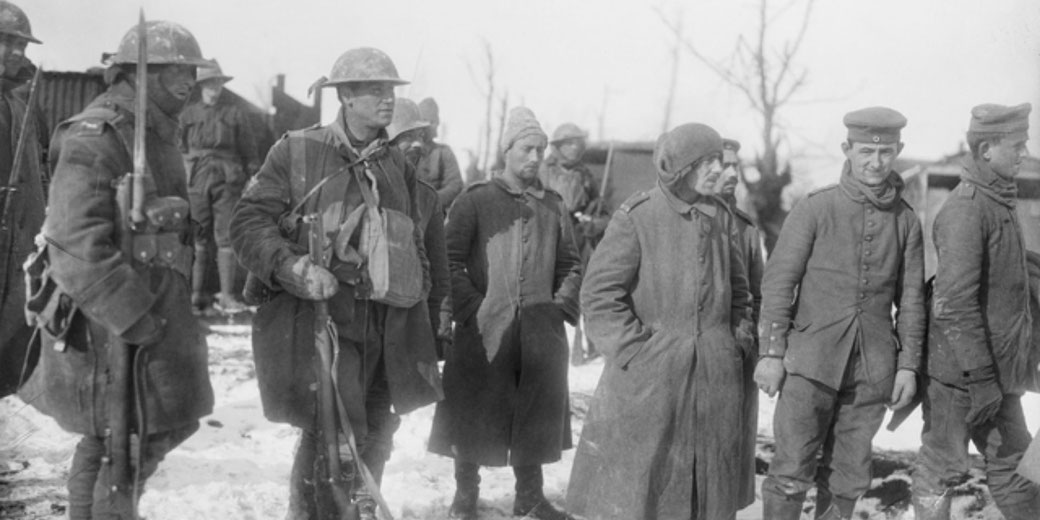
Across the course of 1917, the First World War reached a phase of sustained and costly offensives that tested both strategy and endurance on multiple fronts.
The sources presented here examine key developments of that year, including the German withdrawal to the Hindenburg Line, the brutal fighting at Arras and Passchendaele, and the experimental use of tanks at Cambrai.
They also draw attention to the collapse of the Russian Army and the severe environmental conditions on the Western Front, which shaped the experience of soldiers and the outcomes of battles.
Taken together, these accounts provide detailed contemporary and retrospective perspectives that allow you to analyse how warfare evolved during one of the most demanding periods of the conflict.
Source 1
“‘We followed the enemy quickly to Bapaume northwards towards Queant, but with only small patrols farther east, where he retired in easy stages with rear-guards of machine-gunners to his Hindenburg line behind St. Quentin. The absence of large numbers of British soldiers in this abandoned country scared one. Supposing the enemy were to come back in force? It was difficult to know his whereabouts. We were afraid of running our cars into his outposts. “Can you tell me where our front line is,” asked a friend of mine to a sergeant leaning against a ruined wall and chatting to a private who stood next to him. The sergeant removed his cigarette from his mouth and with just the glint of a smile in his eyes said, “Well, sir, I am the front line.” It was almost like that for a week or two.’..”
“‘On May 3 the battle front was extended on a line of sixteen miles, and while the 3rd and 1st Armies attacked from Fontaine-lez-Croisilles to Fresnoy, the 5th Army stormed the Hindenburg line near Bullecourt. The Australians carried a stretch of this Hindenburg line. Cherisy fell into the hands of East county battalions, Roeux was entered again by English troops, and in Fresnoy, north of Oppy, the Canadians fought masses of Germans assembled for counter-attack and swept them out of the village. Heavy counter-attacks developed later, so that our men had to fall back from Cherisy and Roeux—Fresnoy was abandoned later—but the rest of the ground was held.’..”
“‘It is with thankfulness that one can record to-day the capture of Passchendaele, the crown and crest of the ridge which made a great barrier round the salient of Ypres and hemmed us in the flats and swamps. After an heroic attack by the Canadians this morning they fought their way over the ruins of Passchendaele and into ground beyond it. If their gains be held the seal is set upon the most terrific achievement of war ever attempted and carried through by British arms.’”
Contextual information:
Philip Gibbs was an officially accredited British war correspondent who spent much of the First World War with the British Expeditionary Force on the Western Front. These passages were written in 1917–1918 as contemporary reportage of the German retreat to the Hindenburg Line, the Arras–Bullecourt fighting involving Australian troops, and the Canadian capture of Passchendaele.
Bibliographical reference:
Gibbs, P. (1917). From Bapaume to Passchendaele, 1917. London, UK: William Heinemann.
Copyright: Public domain
Source 2
“‘This month of July was signalised by the last efforts of the Russian Army so long as it remained a serious force. Under Brusiloff and Korniloff they made an attack upon the Austro-German lines, but after initial successes they were paralysed by the growing disaffection and disorganisation of the soldiery, who had all the want of discipline of the old French republicans without the fiery valour and patriotism. From this time onward Russia played no real military part in the great war, save as the betrayer of Roumania, the deserter of Serbia, and the absorber of such ill-spared supplies as she could get from her former allies.’..”
“‘We shall now descend the line to the section which extends from Bullecourt in the north to Villers-Ghislain in the south, opposite to the important town of Cambrai, some seven miles behind the Hindenburg Line. It was here that the Field-Marshal had determined to strike his surprise blow… Besides this terrific barricade there was the further difficulty that the whole method of attack was experimental, and that to advance without artillery fire against such a position would appear to be a most desperate venture. On the other hand it was known that the German line was thin and that their man-power had been attracted northwards by the long epic of the Paschendaale attack. There was a well-founded belief that the tanks would prove equal to the task of breaking the front, and sufficient infantry had been assembled to take advantage of any opening which might be made.’..”
“‘The tanks were about four hundred in number and were under the separate command of General Elles, a dashing soldier who inspired the utmost enthusiasm in his command. It had always been the contention of the tank designers in England that their special weapon needed, what it had never yet found, virgin ground which was neither a morass nor wilderness of shell-holes. The leading lines of tanks had been furnished with enormous faggots of wood which they carried across their bows and which would be released so as to fall forward into any ditch or trench and to form a rude bridge. These ready-made weight-bearers were found to act admirably.’”
Contextual information:
Sir Arthur Conan Doyle, best known for creating Sherlock Holmes, wrote a multi‑volume narrative history of the British army’s campaigns in France and Flanders shortly after the war, based on official reports and publicly available documents. In the 1917 volume he describes Russia’s collapse as an effective fighting force and explains the planning of the Battle of Cambrai, highlighting the experimental mass use of tanks against the Hindenburg Line.
Bibliographical reference:
Conan Doyle, A. (1919). The British Campaign in France and Flanders, 1917 (Vol. 4). London, UK: Hodder & Stoughton.
Copyright: Public domain.
Source 3
“‘The hills forming the sides of this basin are very low and partly wooded. The line of their crests runs approximately from north to south, through Houthulst Forest (road from Poelcappelle to Clercken), Poelcappelle, Passchendaele, Broodseinde, Becelaere, Gheluvelt, the strategic Hill 60 (south of Zillebeke) and St. Eloi. Further south is the Messines-Wytschaete ridge, and to the south-west the Hills of Flanders. Houthulst Forest is the largest of the woods. Next come the islets of Westroosebeke and Passchendaele, then, south of Zonnebeke, Polygone Wood, Nonne-Bosschen (or Nonnes) Wood, and the Woods of Glencorse, Inverness and Herenthage. In this region, with its essentially maritime climate, the war assumed a character entirely different from that of the rest of the front. The marshy ground, almost at sea-level, is further sodden by constant rain and mists, and forms a spongy mass, in which it was impossible to dig trenches or underground shelters. Water is found immediately below the surface, so that the only possible defence-works were parapets. The bursting shells made huge craters which, promptly filling with water, became so many death-traps for wounded and unwounded alike.’..”
“‘In June, 1917, certain at last of their strength, they made their first big effort, and step by step, in accordance with a carefully worked-out plan, they completely liberated Ypres by a series of offensives lasting four months, and broke the iron circle which, for two years, had been strangling the town … British effort took definite shape for the first time on June 7. The attack, planned by Sir Douglas Haig, had for its objective the capture of the crests between Wytschaete and Messines, which the Germans had seized on November 1, 1914.’”
Contextual information:
This illustrated battlefield guide to Ypres was produced by the Michelin company shortly after the war for visitors to the former front lines and is based on French and British official information. It explains the geography and climate of the Ypres–Passchendaele area—its low, marshy ground, heavy rain and water‑filled shell‑holes—and summarises the 1917 offensives planned by British Commander‑in‑Chief Sir Douglas Haig, including the Messines attack that formed part of the wider Third Battle of Ypres.
Bibliographical reference:
Michelin & Cie. (1919). Ypres and the Battles of Ypres (Michelin Illustrated Guides to the Battlefields, 1914–1918). Clermont‑Ferrand, France: Michelin.
Copyright: Public domain.