
Historical sources on WWI Western Front battles in 1916
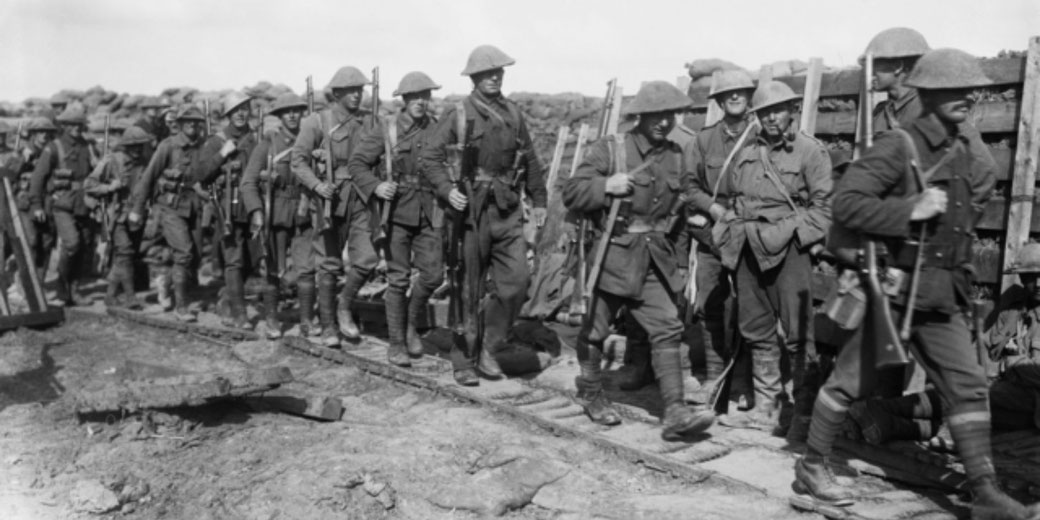
The First World War reached its bloodiest stage in 1916, as the armies on the Western Front fought a series of major battles that produced enormous casualties and little territorial gain.
The sources on this page examine two of the year's most significant campaigns, the Battle of Verdun and the Battle of the Somme, through the words of senior commanders, military historians, and participants.
They explore German and Allied strategic planning, the reasons behind these offensives, the experiences of soldiers during the fighting, and the introduction of new weapons such as tanks.
Source 1
Extract A
"The opening of the British campaign in July found the whole army most eager to emulate the deeds of its Allies, and especially to take some of the weight from the splendid defenders of Verdun [a French fortress city under German attack since February 1916]. Their fight against very heavy odds in men, munitions [weapons and ammunition], and transport, was one of the greatest deeds of arms, possibly the greatest deed of arms of the war. It was known, however, before July that a diversion [a military attack intended to draw enemy attention away from the main battle] was absolutely necessary, and although the British had taken over a fresh stretch of trenches so as to release French reinforcements, some more active help was imperatively called for."
Extract B
"It was accordingly decided that our bombardment should begin on the 24th June, and a large force of artillery was brought into action for the purpose. Artillery bombardments were also carried out daily at different points on the rest of our front, and during the period from the 24th June to 1st July gas was discharged with good effect at more than forty places along our line upon a frontage which in total amounted to over 15 miles."
Extract C
"On July 1st, at 7.30 a.m., after a final hour of exceptionally violent bombardment, our infantry assault was launched. Simultaneously the French attacked on both sides of the Somme, co-operating closely with us. The British main front of attack extended from Maricourt on our right, round the salient [a section of the front line that bulges forward into enemy territory] at Fricourt, to the Ancre in front of St. Pierre Divion."
Extract D
"At 6.20 a.m. on the 15th September the infantry assault commenced, and at the same moment the bombardment became intense. Our new heavily armoured cars [armoured fighting vehicles], known as 'Tanks,' now brought into action for the first time, successfully co-operated with the infantry, and coming as a surprise to the enemy rank and file gave valuable help in breaking down their resistance. The advance met with immediate success on almost the whole of the front attacked. At 8.40 a.m. tanks were seen to be entering Flers, followed by large numbers of troops."
Contextual information:
Field Marshal Sir Douglas Haig was Commander-in-Chief of the British Armies in France and Flanders from December 1915 to the end of the war. He submitted this despatch to the Secretary of State for War on 23 December 1916, covering the operations of the Battle of the Somme from July to November 1916. It was published in the Supplement to the London Gazette on 29 December 1916.
Bibliographical reference:
Haig, D. (1919). Sir Douglas Haig's despatches (December 1915–April 1919) (J. H. Boraston, Ed.; pp. 19, 22, 22, 41). J. M. Dent & Sons. (Original despatch submitted 23 December 1916)
Copyright: Public domain.
Source 2
Extract A
"The Great War had now come into its second winter — a winter which was marked by an absolute cessation of all serious fighting upon the Western front. Enormous armies were facing each other, but until the German attack upon the French lines of Verdun at the end of February [1916], the infantry of neither side was seriously engaged."
Extract B
"None the less it can be said without fear of ultimate contradiction that nothing approaching to the Battle of the Somme, with which this volume is mainly concerned, has ever been known in military history, and that it is exceedingly improbable that it will ever be equalled in its length and in its severity. It may be said to have raged with short intermissions [breaks], caused by the breaking of the weather, from July 1 to November 14, and during this prolonged period the picked forces of three great nations were locked in close battle. The number of combatants [soldiers fighting] from first to last was between two and three millions, and their united casualties came to the appalling total of at least three-quarters of a million."
Extract C
"The continued German pressure at Verdun which had reached a high point in June called insistently for an immediate allied attack at the western end of the line. With a fine spirit of comradeship [friendship and loyalty between people who share hardship] General Haig had placed himself and his armies at the absolute disposal of General Joffre [the French commander-in-chief], and was prepared to march them to Verdun, or anywhere else where he could best render assistance."
Extract D
"However, by the end of June all was in place and ready. The bombardment began about June 23, and was at once answered by a German one of lesser intensity. The fact that the attack was imminent [about to happen] was everywhere known, for it was absolutely impossible to make such preparations and concentrations in a secret fashion."
Extract E
"The attack had been planned for June 28, but the weather was so tempestuous [wild and stormy] that it was put off until it should moderate, a change which was a great strain upon every one concerned. July 1 broke calm and warm with a gentle south-western breeze. The day had come. All morning from early dawn there was intense fire, intensely answered, with smoke barrages thrown during the last half-hour to such points as could with advantage be screened. At 7.30 the guns lifted, the whistles blew, and the eager infantry were over the parapets [low protective walls at the front of a trench]. The great Battle of the Somme, the fierce crisis of Armageddon [a catastrophic, all-destroying battle], had come."
Extract F
"There is one other happening of note which may in truth be taken as an overture [an introductory event that signals what is to come] of that gigantic performance. This was the action of the Seventeenth Corps upon June 30, the eve of the Somme battle, in which the Thirty-ninth Division, supported by guns from the Thirty-fifth and Fifty-first Divisions upon each side of it, attacked the German trenches near Richebourg at a spot known as the Boar's Head. The attack was so limited in the troops employed and so local in area that it can only be regarded as a feint [a pretend attack designed to draw the enemy's attention away from where the real danger is] to take the German attention from the spot where the real danger was brewing."
Contextual information:
Sir Arthur Conan Doyle was a British author who wrote a multi-volume history of the British army's campaign on the Western Front during the First World War. This volume, covering the year 1916, was written with access to military reports and published in 1918 while the war was still under way. Conan Doyle is best known as the creator of Sherlock Holmes, but he also wrote on military history throughout his career.
Bibliographical reference:
Doyle, A. C. (1918). The British campaign in France and Flanders: 1916 (pp. v–vi, 3, 33, 37, 39, 28). Hodder and Stoughton.
Copyright: Public domain.
Source 3
"Within our reach behind the French sector of the Western Front there are objectives [targets] for the retention [keeping] of which the French General Staff would be compelled to throw in every man they have. If they do so the forces of France will bleed to death — as there can be no question of a voluntary withdrawal — whether we reach our goal or not. If France is not to be totally bled to death, whether the actual holding or not of the objectives is of importance. If they keep them they will lose enormous amounts of blood; if they lose them the moral [morale, meaning the confidence and fighting spirit of an army] effect upon France will be enormous."
Contextual information:
General Erich von Falkenhayn was Chief of the German General Staff from September 1914 until August 1916, making him the senior German military commander for most of that period. He wrote this account after the war, drawing on his own records and memory of the decisions he made. This passage is his account of the plan he developed in late 1915 for attacking the French fortress city of Verdun in early 1916. Note that the only source for the text of this plan is Falkenhayn's own post-war memoir: no original copy has been found in the archives, so it should be read as his account of his intentions rather than a verified wartime document.
Bibliographical reference:
Falkenhayn, E. von. (1919). General headquarters 1914–1916 and its critical decisions (pp. 261–262). Hutchinson & Co.
Copyright: Public domain.