
Historical sources on the protestant reformer, Martin Luther
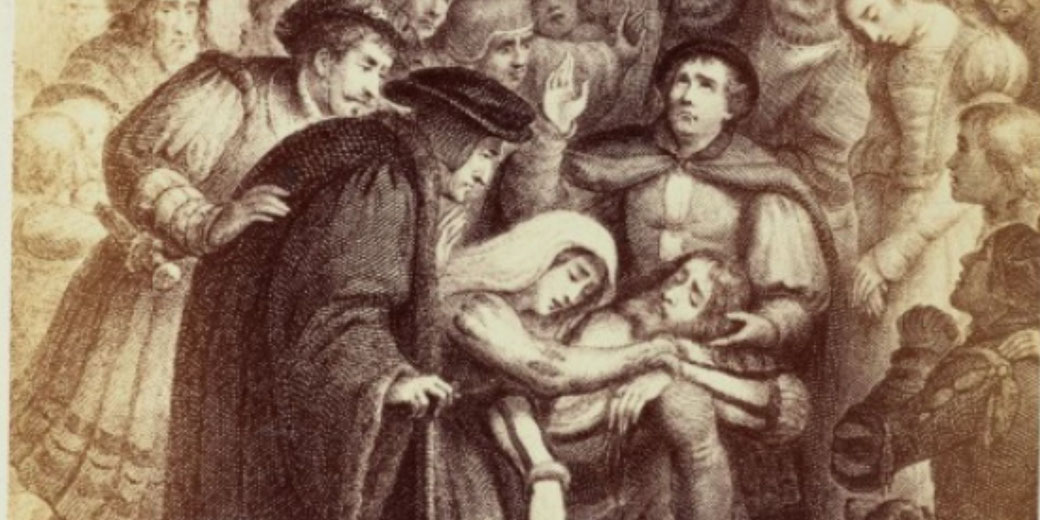
The Protestant Reformation completely transformed Europe during the sixteenth century and at the centre of this movement was Martin Luther, a German monk whose criticisms of the Catholic Church sparked a religious split that permanently changed Western Christianity.
The sources collected on this page trace Luther’s journey from his early years as a university student and monk through to the publication of the Ninety-five Theses in 1517, his conflict with the papacy and Holy Roman Emperor, and his later work translating the Bible into German.
Source 1
Extract A
"After taking, with high rank, the degrees of bachelor of arts in 1502 and of master in 1505, Luther just began the study of [law]. This was in accordance with the wishes of his ambitious father, who bought him an expensive [law textbook]. He had worked in law only two months, however, when he abruptly decided to enter the monastery."
Extract B
"As he was coming back to the university, on July 2, he was overtaken at Stotterheim, near Erfurt, by a terrible thunder-storm, and, in a fright, vowed to St. Anna to be a monk. If it may seem strange that a young man of twenty-two should be panic-stricken by a clap of thunder, it must be remembered that the miner's son regarded such phenomena as frequently occasioned by the direct interposition of the devil. Moreover, it has been shown that he probably had the more than half-formed intention already in his mind."
Extract C
"It was one day at Wittenberg in 1508 or 1509, as he was sitting in his cell in a little tower, that his life message came to him, and with it the first assurance of permanent comfort and peace. He was reading Paul's Epistle to the Romans, and came to the verse (i, 17) 'The just shall live by faith.' Pondering this, it came to him that it was not, as he had been taught, by man's own works that he was redeemed, but by faith in God and the Saviour. Justification by faith has been rightly selected as the cardinal doctrine of the Lutheran theology; he himself recognised in it the corner-stone of his whole life."
Contextual information:
Preserved Smith was an American historian who published this biography of Luther in 1911, drawing directly on Luther's own letters and the accounts of those who knew him. He wrote during a period of intense scholarly interest in the Reformation, and his biography is one of the most detailed English-language accounts of Luther's early life and personal development.
Bibliographical reference:
Smith, P. (1911). The life and letters of Martin Luther (pp. 7, 9, 15). Houghton Mifflin.
Copyright: Public domain.
Source 2
Extract A
"Out of love for the truth and the desire to bring it to light, the following propositions will be discussed at Wittenberg, under the presidency of the Reverend Father Martin Luther, Master of Arts and of Sacred Theology, and Lecturer in Ordinary on the same at that place. Wherefore he requests that those who are unable to be present and debate orally with us, may do so by letter. In the Name of our Lord Jesus Christ. Amen."
Extract B
"27. They preach man who say that so soon as the penny jingles into the money-box, the soul flies out [of purgatory [the place Catholics believed the dead waited before entering heaven]].
28. It is certain that when the penny jingles into the money-box, gain and avarice [greed] can be increased, but the result of the intercession [prayers on behalf of others] of the Church is in the power of God alone...
32. They will be condemned eternally, together with their teachers, who believe themselves sure of their salvation because they have letters of pardon...
36. Every truly repentant Christian has a right to full remission [cancellation] of penalty and guilt, even without letters of pardon...
45. Christians are to be taught that he who sees a man in need, and passes him by, and gives [his money] for pardons, purchases not the indulgences [pardons sold by the Church] of the pope, but the indignation [anger] of God...
50. Christians are to be taught that if the pope knew the exactions [excessive demands for money] of the pardon-preachers, he would rather that St. Peter's church should go to ashes, than that it should be built up with the skin, flesh and bones of his sheep."
Contextual information:
Martin Luther was a German monk and university lecturer at Wittenberg who wrote these propositions in 1517 as an invitation to academic debate about the Church's sale of indulgences. He sent copies to the Archbishop of Mainz and posted them on the door of the Castle Church at Wittenberg on 31 October 1517, a date now marked as the beginning of the Protestant Reformation.
Bibliographical reference:
Luther, M. (1915). Disputation of Doctor Martin Luther on the power and efficacy of indulgences [The Ninety-five Theses] (C. M. Jacobs, Trans.; pp. 29–38). In A. Spaeth, L. D. Reed, & H. E. Jacobs (Eds.), Works of Martin Luther (Vol. I). A. J. Holman. (Original work published 1517)
Copyright: Public domain.
Source 3
Extract A
"Accordingly, on the memorable thirty-first day of October, 1517, which has ever since been celebrated in Protestant Germany as the birthday of the Reformation, at twelve o'clock he affixed (either himself or through another) to the doors of the castle-church at Wittenberg, ninety-five Latin Theses on the subject of indulgences, and invited a public discussion. At the same time he sent notice of the fact to Archbishop Albrecht of Mainz, and to Bishop Hieronymus Scultetus, to whose diocese [area under the authority of a bishop] Wittenberg belonged. He chose the eve of All Saints' Day (Nov. 1), because this was one of the most frequented feasts, and attracted professors, students, and people from all directions to the church, which was filled with precious relics [sacred objects]."
Extract B
"On June 15, 1520, Leo X. issued the bull [official papal decree] Exsurge Domine, charging Luther with forty-one errors and ordering him to recant [withdraw his statements] within sixty days or suffer excommunication [permanent removal from the Church]."
Extract C
"Leo X., after the expiration of the one hundred and twenty days of grace allowed to Luther by the terms of the bull [official papal decree], proceeded to the last step, and on the third day of January, 1521, pronounced the ban [excommunication] against the Reformer, and his followers, and an interdict [an order forbidding Church services] on the places where they should be harbored [sheltered]."
Extract D
"The Emperor, after consultation with the Electors [princes who had the right to choose the Holy Roman Emperor] and Princes, gave Luther twenty-one days to return to Wittenberg under safe-conduct, with the warning that he should preach no more on the journey. On the eighth of May, 1521, after most of the friendly princes had left, Charles V. signed the Edict of Worms which had been drawn up by Aleander, by which Luther, as an obstinate [stubborn], schismatic [someone who has caused a split in the Church], and notorious heretic [someone publicly known for holding beliefs the Church considered false and dangerous], was put under the ban of the empire. He was to be seized and delivered to the Emperor; his followers were to be subjected to the same punishment; his books were to be burnt. The Edict, dated May 8, was not published till May 26."
Extract E
"The richest fruit of Luther's leisure in the Wartburg, and the most important and useful work of his whole life, is the translation of the New Testament, by which he brought the teaching and example of Christ and the Apostles to the mind and heart of the Germans in life-like reproduction. It was a republication [re-release for a new audience] of the gospel. He made the Bible the people's book in church, school, and house. If he had done nothing else, he would be one of the greatest benefactors [people who do good for others] of the German-speaking race."
Extract F
"He began with the New Testament in November or December, 1521, and completed it in the following March, before he left the Wartburg. He thoroughly revised it on his return to Wittenberg, with the effectual help of Melanchthon, who was a much better Greek scholar. Sturz at Erfurt was consulted about coins and measures; Spalatin furnished from the Electoral treasury names for the precious stones of the New Jerusalem (Rev. 21). The translation was then hurried through three presses, and appeared already Sept. 21, 1522, but without his name."
Extract G
"This volume embraces, besides a general introduction to modern church history, the productive period of the German Reformation, from its beginning to the Diet of Augsburg (1530), and the death of Luther (1546), with a concluding estimate of the character and influence of the Reformer."
Contextual information:
Philip Schaff was a Swiss-American church historian who taught at Union Theological Seminary in New York. He published this volume in 1888 as part of his eight-volume History of the Christian Church, a work based on extensive study of German and Latin primary sources. Schaff had direct access to European archives and wrote with the authority of someone trained in the German scholarly tradition of Reformation history.
Bibliographical reference:
Schaff, P. (1888). History of the Christian Church: Vol. VII. Modern Christianity. The German Reformation (§§32, 37, 38, 49, 52, 62). Charles Scribner's Sons.
Copyright: Public domain.