
Historical sources on John Calvin
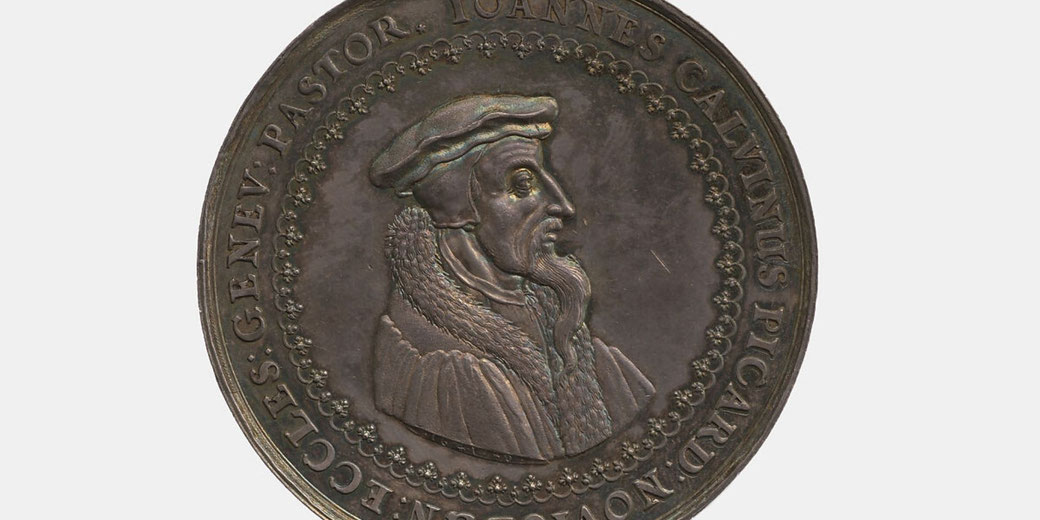
The sources below explore the life, beliefs, and influence of John Calvin, one of the central figures of the Protestant Reformation in sixteenth-century Europe.
They trace Calvin’s journey from his early education in France through to his leadership in Geneva, where he helped establish a disciplined Protestant community that attracted followers from across Europe.
The extracts also examine some of Calvin’s most influential religious ideas, including the authority of Scripture and the doctrine of predestination, which became central teachings within Calvinism.
Source 1
"JOHN CALVIN was born at Noyons [Note: the modern spelling is Noyon], a celebrated town in Picardy, or at least on the confines of Picardy, on the 27th July [Note: most historians give 10th July as the birth date; 27th July was the date given by Beza, Calvin's personal friend and biographer], in the year of our Lord 1509. His father's name was Gerard Calvin, his mother's Joan Franc, both of them persons of good repute [reputation], and in easy circumstances [comfortable financial situation]. Gerard being a person of no small judgment and prudence [wisdom], was highly esteemed [well respected] by most of the nobility of the district, and this was the reason why young Calvin was from a boy very liberally educated [given a thorough education], though at his father's expense, in the family of the Mommors, one of the most distinguished [high-ranking] in that quarter."
"The design of making him a priest was interrupted by a change in the views both of father and son—in the former, because he saw that the Law was a surer road to wealth and honour, and in the latter, because, having been made acquainted with the reformed faith [Protestant Christianity], by a relation [relative] named Peter Robert Olivet, (the person to whom the churches of France owe that translation of the Old Testament, from the Hebrew, which was printed at Neufchatel [Note: this was a French Bible translation, not an English one; it was Calvin's cousin Olivétan, not Calvin himself, who translated the Bible],) he had begun to devote himself to the study of the Holy Scriptures, and, from an abhorrence [deep hatred] at all kinds of superstition [false religious belief], to discontinue his attendance on the public services of the Church."
"Having set out for Orleans [Note: the University of Orléans, in central France], to study law, which was there taught by Peter De l'Etoile, by far the first French lawyer of that period, Calvin, in a short time, made such astonishing progress, that he very often officiated [stood in] for the professors, and was considered rather a teacher than a pupil. On his departure, he was presented with a Doctor's degree, free of expense, and with the unanimous consent of all the professors, as a return for the services which he had rendered to the Academy."
"Calvin having, in passing through Geneva, paid them a visit, as good men are wont [accustomed] to do to each other, Farel, a person obviously inspired with a kind of heroic spirit, strongly urged him, instead of proceeding farther, to stay and labour [work] with him at Geneva. When Calvin could not be induced [persuaded] to consent, Farel thus addressed him: 'You are following only your own wishes, and I declare, in the name of God Almighty, that if you do not assist us in this work of the Lord, the Lord will punish you for seeking your own interest rather than his.' Calvin, struck with this fearful denunciation [threat], submitted to the wishes of the Presbytery [church council] and the Magistrates [city officials], by whose suffrage [vote], the people consenting, he was not only chosen preacher, (this he had at first refused,) but was also appointed Professor of Sacred Literature—the only office he was willing to accept."
"he was under the necessity of publishing what he called the Institutes of the Christian Religion [Note: this is the book that became his major theological work; the first edition was published in 1536 and Calvin continued to expand it throughout his life], and the rudiment [early draft] of much the largest of his works."
Contextual information:
Theodore Beza was a French Protestant theologian who served as Calvin's closest associate and colleague in Geneva, and succeeded him as leader of the Genevan church after Calvin's death in 1564. Beza wrote this biography drawing on his personal knowledge of Calvin, and it was first published in the same year as Calvin's death. Henry Beveridge translated it into English in 1844 for the Calvin Translation Society.
Bibliographical reference:
Beza, T. (1844). The life of John Calvin (H. Beveridge, Trans.). In J. Calvin & T. Beza, Tracts relating to the Reformation (Vol. 1, pp. xxi, xxii, xxviii–xxix, lxiii). Calvin Translation Society. (Original work published 1564)
Copyright: Public domain.
Source 2
"When that which professes to be the Word of God is acknowledged to be so, no person, unless devoid of common sense and the feelings of a man, will have the desperate hardihood [recklessness] to refuse credit to the speaker. But since no daily responses are given from heaven, and the Scriptures are the only records in which God has been pleased to consign [preserve] his truth to perpetual remembrance [so it will be remembered forever], the full authority which they ought to possess with the faithful [believers] is not recognised, unless they are believed to have come from heaven, as directly as if God had been heard giving utterance [speaking aloud] to them. This subject well deserves to be treated more at large [at greater length], and pondered more accurately. But my readers will pardon me for having more regard to what my plan admits than to what the extent of this topic requires. A most pernicious [harmful] error has very generally prevailed [become widespread]; viz. [namely] that Scripture is of importance only in so far as conceded [granted authority] to it by the suffrage [approval] of the Church; as if the eternal and inviolable [unbreakable] truth of God could depend [on any human judgement]."
"By predestination we mean the eternal decree of God, by which he determined with himself whatever he wished to happen with regard to every man. All are not created on equal terms, but some are preordained [chosen in advance] to eternal life, others to eternal damnation [punishment]; and, accordingly, as each has been created for one or other of these ends, we say that he has been predestinated to life or to death."
Contextual information:
John Calvin was a French-born Protestant reformer who led the church in Geneva, Switzerland from 1541 until his death in 1564. He first published the Institutes of the Christian Religion in Latin in 1536 as a defence of the Protestant faith, and continued to expand it through several editions, with the final version published in 1559. Henry Beveridge translated the complete work into English in 1845 for the Calvin Translation Society.
Bibliographical reference:
Calvin, J. Institutes of the Christian Religion (H. Beveridge, Trans., 1845; Book I, Ch. 7, p. 68; Book III, Ch. 21, sec. 5, p. 206). Calvin Translation Society. (Original work published 1536; final edition 1559)
Copyright: Public domain.
Source 3
"The duty of the Consistory [Note: the Consistory was a court made up of ministers and elected lay elders that met weekly in Geneva to supervise the moral behaviour of the city's residents] was the maintenance and exercise of discipline [enforcing rules of moral behaviour]. Every house was to be visited annually [once a year] by a Minister and Elder. To facilitate [make easier] the working of this system the city was divided into three parishes—St. Peter's, the Magdalen, and St. Gervais. Calvin officiated [served] in St. Peter's. The Consistorial Court was the controlling power in the Church of Geneva. It has often been misrepresented [wrongly described] as a sort of tribunal [court] of Inquisition [Note: the Inquisition was a Catholic institution that used torture and execution] or Star Chamber [Note: the Star Chamber was an English court known for harsh and secretive proceedings]. But it could only use the spiritual sword [Note: meaning it could only punish people through religious means, not physical ones], and had nothing to do with civil and temporal [non-religious, legal] punishments, which belonged exclusively [only] to the Council. Calvin wrote to the ministers of Zürich, Nov. 26, 1553: 'The Consistory has no civil jurisdiction [legal authority over crimes], but only the right to reprove [criticise and correct] according to the Word of God, and its severest punishment is excommunication [being banned from the church].'"
"He continued his labours till the last year, writing, preaching, lecturing, attending the sessions of the Consistory and the Venerable Company of pastors [Note: the official body of Geneva's Protestant ministers], entertaining and counselling strangers from all parts of the Protestant world, and corresponding [exchanging letters] in every direction. He did all this notwithstanding [despite] his accumulating physical maladies [illnesses], as headaches, asthma, dyspepsia [digestive illness], fever, gravel [kidney stones], and gout, which wore out his delicate body, but could not break his mighty spirit. When he was unable to walk he had himself transported to church in a chair. On the 6th of February, 1564, he preached his last sermon."
Contextual information:
Philip Schaff was a Swiss-American church historian who taught at Union Theological Seminary in New York. He completed the eight-volume History of the Christian Church between 1858 and 1892, with Volume VIII covering the Swiss Reformation and devoted considerable attention to Calvin and Geneva. Schaff worked from primary sources, including the registers of the Geneva city council and Calvin's own letters.
Bibliographical reference:
Schaff, P. (1892). History of the Christian Church: Vol. VIII. Modern Christianity. The Swiss Reformation (pp. 494, 812). Charles Scribner's Sons.
Copyright: Public domain.