
Historical sources on Charlemagne
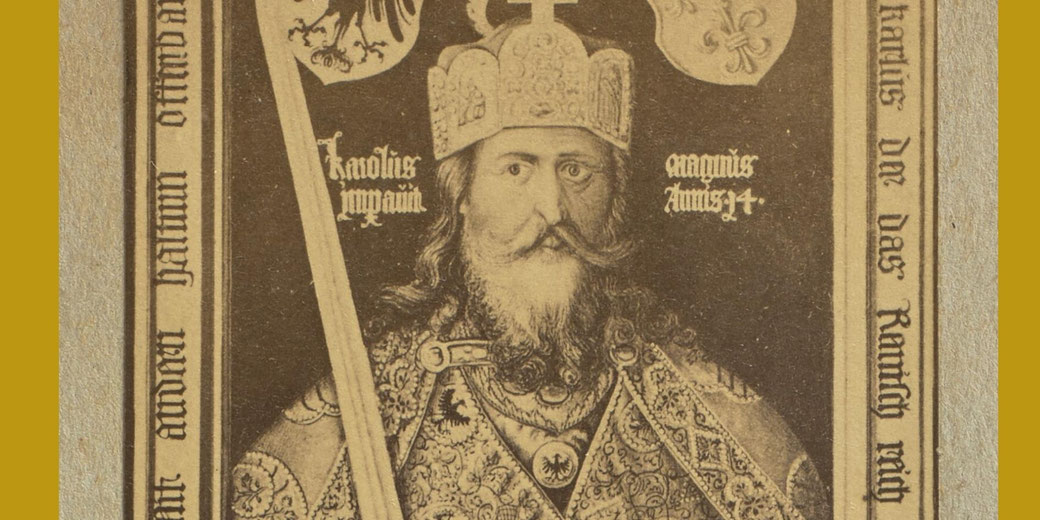
The following sources relate to the life and reign of Charlemagne (742–814), king of the Franks and emperor of western Europe.
They include extracts from popular histories, encyclopaedia entries, a near-contemporary biography by the courtier Einhard, and an official legal code issued during the Saxon Wars.
Together, these sources allow you to examine Charlemagne's military conquests, his commitment to learning and education, and his sometimes brutal methods of enforcing Christianity on conquered peoples.
Source 1
"The great and famous land of France takes its name from a powerful tribe of Northmen, the Franks, who began to overrun the country about three hundred years after the birth of Christ. Before the day of the Franks the land was known as Gaul, and its people, the Gauls, were a Celtic race of the same blood as the ancient Britons. Like the Britons, they, too, were compelled to bow their necks to the yoke of Rome, and to submit to the great Roman General, Julius Caesar. It was from Gaul that Caesar sailed to attack Britain, and it was of Gaul and its conquest that he wrote in his famous work which is still read by all who study the Latin tongue."
"The Gauls fought hard to resist the onset of these terrible warriors, but they fought in vain. Little by little their land fell into the hands of the Northmen, and the country was seized by three great tribes—the Franks, the Burgundians, and the Goths—and from the Franks came the name of France. The Franks settled in the north-eastern part of Gaul; the Burgundians in the south-east; the Goths in the south-west, whence they spread into Spain."
"Early in the eighth century the Mayor of the Palace was a very brave and wise man, who was called Charles Martel—that is, Charles the Hammer. He won this name because he was strong and dauntless, and struck his enemies most dreadful blows. Such a man was badly needed in the land of the Franks, for terrible foes were approaching its borders. These foes were the Saracens—hosts of fierce warriors from Arabia, and followers of Mahomet. They were marching from country to country, aiming at conquest and the spread of their religion. They invaded Africa, crossed into Spain, pushed northward over the Pyrenees, and entered the territory of the Franks. Everywhere they burned, plundered, and destroyed, and slew those who would not adopt their faith; their object was to sweep through Europe and conquer it for Mahomet. The Mayor of the Palace met them at Tours, and there was fought one of the greatest battles in the world's history, when the Frankish hosts and the hordes of fiery Saracens strove together for mastery. Charles won, and Europe was saved. Vast numbers of the Moslems were slain, and the rest were driven out of France."
"Charles the Hammer was followed in his office by his son Pepin, but the Franks were now tired of their Puppet Kings, and wanted a real leader and ruler. The line of the Merovings was set aside, and in 752 Pepin was crowned King of the Franks, and both title and power were given to a strong man. Pepin ruled wisely and well, but he was followed by a son so great and powerful that Pepin is remembered to this day more because of his son than for anything he did himself."
"This son was the mighty Charlemagne, Charles the Great, the most famous monarch that France has ever known, and one of the greatest rulers the world has seen. Charlemagne came to the throne in 768, and at once made his power felt in Europe. He won so many lands by the sword that his kingdom became very large, and he ruled over a great part of Western Europe—over France, a large part of Germany and Italy, and the North of Spain. He received from the Pope of Rome the proud title of Emperor of the West."
Contextual information:
John Finnemore was an early 20th‑century British author of popular history books for younger readers; France: Peeps at History is a narrative overview of French history written in accessible prose. This sequence of paragraphs introduces how the Franks took control of Gaul, how France gained its name from them, how Charles Martel (“the Hammer”) defeated the Saracens at Tours in 732, how his son Pepin replaced the Merovingian “puppet kings,” and how Charlemagne expanded this Frankish realm to include much of what is now France, Germany, Italy, and northern Spain.
Bibliographical reference:
Finnemore, J. (1913). France: Peeps at history. London: Adam and Charles Black, (chap. 1).
Copyright: Public Domain
Source 2
"CHARLES THE GREAT, or CHARLEMAGNE (from Lat. Carolus Magnus, Charles the Great) (742–814). King of the Franks after 768, and Roman Emperor from 800 to 814. He was the son of Pepin the Short, the first Carolingian King, and of Bertha, a daughter of Charibert, Count of Laon, and was born probably on April 2, 742. His birthplace is unknown; but from the fondness which he displayed throughout his life for the cities of Aix-la-Chapelle and Ingelheim, it has been conjectured that he was born in one of these places."
Contextual information: This passage comes from The New International Encyclopædia, an American reference work first published in the early 20th century and now in the public domain. The article on "Charles the Great" gives a concise scholarly biography that fixes Charlemagne’s lifespan as 742–814 and notes the traditional birth date of 2 April 742, while also identifying him as king of the Franks and, from 800, Roman emperor, and as the son of Pepin the Short, the first Carolingian king.
Bibliographical reference:
Charles the Great. (1905). In The New International Encyclopædia (Vol. 3). New York, NY: Dodd, Mead.
Copyright: Public Domain
Source 3
"Charlemagne (742-814): King of the Franks (768-814), king of the Lombards (774-814), and emperor (800-814).
As king of the Franks, Charlemagne conquered the Lombard kingdom in Italy, subdued the Saxons, annexed Bavaria to his kingdom, fought campaigns in Spain and Hungary, and, with the exception of the Kingdom of Asturias in Spain, southern Italy, and the British Isles, united in one superstate practically all the Christian lands of western Europe. In 800 he assumed the title of emperor. (He is reckoned as Charles I of the Holy Roman Empire, as well as Charles I of France.) Besides expanding its political power, he also brought about a cultural renaissance in his empire. Although this imperium survived its founder by only one generation, the medieval kingdoms of France and Germany derived all their constitutional traditions from Charles's monarchy. Throughout medieval Europe, the person of Charles was considered the prototype of a Christian king and emperor."
Contextual information: This summary of Charlemagne’s career is based on older Britannica material and is republished on The Latin Library, a site that assembles classical and historical texts for educational use. It emphasizes that Charlemagne ruled as king of the Franks and Lombards, became emperor in 800, subdued the Saxons and other peoples, and united almost all the Christian lands of western Europe, making him a model of Christian kingship in later medieval thought.
Bibliographical reference:
Charlemagne. (c. 1920). The Latin Library. (Based on older Encyclopædia Britannica text.) Retrieved March 11, 2026, from http://www.thelatinlibrary.com/imperialism/notes/charlemagne.html
Copyright: Public Domain
Source 4
“Charles had the gift of ready and fluent speech, and could express whatever he had to say with the utmost clearness. He was not satisfied with command of his native language merely, but gave attention to the study of foreign ones, and in particular was such a master of Latin that he could speak it as well as his native tongue; but he could understand Greek better than he could speak it. He was so eloquent, indeed, that he might have passed for a teacher of eloquence. He most zealously cultivated the liberal arts, held those who taught them in great esteem, and conferred great honours upon them. He took lessons in grammar of the deacon Peter of Pisa, at that time an aged man. Another deacon, Albin of Britain, surnamed Alcuin, a man of Saxon extraction, who was the greatest scholar of the day, was his teacher in other branches of learning. The King spent much time and labour with him studying rhetoric, dialectics, and especially astronomy; he learned to reckon, and used to investigate the motions of the heavenly bodies most curiously, with an intelligent scrutiny. He also tried to write, and used to keep tablets and blanks in bed under his pillow, that at leisure hours he might accustom his hand to form the letters; however, as he did not begin his efforts in due season, but late in life, they met with ill success.”
“The plan that he adopted for his children's education was, first of all, to have both boys and girls instructed in the liberal arts, to which he also turned his own attention. As soon as their years admitted, in accordance with the custom of the Franks, the boys had to learn horsemanship, and to practise war and the chase, and the girls to familiarize themselves with cloth‑making, and to handle distaff and spindle, that they might not grow indolent through idleness, and he fostered in them every virtuous sentiment.”
Contextual information:
Einhard was a Frankish courtier and close associate of Charlemagne who served at court for decades and later wrote a Latin biography, Vita Karoli Magni (Life of Charlemagne), in the early 9th century. In this passage he emphasises Charlemagne’s serious personal commitment to learning (Latin, some Greek, liberal arts, astronomy), his late but earnest attempts to learn writing, and his deliberate plan to have both sons and daughters instructed in the liberal arts, alongside traditional Frankish martial and domestic training.
Bibliographical reference:
Einhard. Life of Charlemagne (S. E. Turner, Trans.). New York: Harper & Brothers, 1880.
Copyright: Public Domain
Source 5
“The most attractive feature of his character, however, was his love of learning. In addition to his native tongue he could read Latin and understood Greek, but he was unable to write, and Einhard gives an account of his futile efforts to learn this art in later life. He loved the reading of histories and astronomy, and by questioning travellers gained some knowledge of distant parts of the earth. He attended lectures on grammar, and his favourite work was St Augustine's De civitate Dei. He caused Frankish sagas to be collected, began a grammar of his native tongue, and spent some of his last hours in correcting a text of the Vulgate. He delighted in the society of scholars – Alcuin, Angilbert, Paul the Lombard, Peter of Pisa and others, and in this company the trappings of rank were laid aside and the emperor was known simply as David. Under his patronage Alcuin organized the school of the palace, where the royal children were taught in the company of others, and founded a school at Tours which became the model for many other establishments. Charles was unwearying in his efforts to improve the education of clergy and laity, and in 789 ordered that schools should be established in every diocese. The atmosphere of these schools was strictly ecclesiastical and the questions discussed by the scholars were often puerile, but the greatness of the educational work of Charles will not be doubted when one considers the rude condition of Frankish society half a century before. The main work of the Carolingian renaissance was to restore Latin to its position as a literary language, and to reintroduce a correct system of spelling and an improved handwriting. The manuscripts of the time are accurate and artistic, copies of valuable books were made and by careful collation the texts were purified.”
“In secular affairs Charles abolished the office of duke, placed counts over districts smaller than the former duchies, and supervised their government by means of missi dominici, officials responsible to himself alone. Marches were formed on all the borders of the empire, and the exigencies of military service led to the growth of a system of land‑tenure which contained the germ of feudalism. … Taking a lively interest in commerce and agriculture, Charles issued various regulations for the organization of the one and the improvement of the other. He introduced a new system of weights and measures, which he ordered should be used throughout his kingdom, and took steps to reform the coinage. He was a voluminous lawgiver. Without abolishing the customary law of the German tribes, which is said to have been committed to writing by his orders, he added to it by means of capitularies, and thus introduced certain Christian principles and customs, and some degree of uniformity...
“The great event of this visit took place on the succeeding Christmas Day [AD 800], when Charles on rising from prayer in St Peter's was crowned by Leo and proclaimed emperor and Augustus amid the acclamations of the crowd. This act can hardly have been unpremeditated, and some doubt has been cast upon the statement which Einhard attributes to Charles, that he would not have entered the building had he known of the intention of Leo. He accepted the dignity at any rate without demur, and there seems little doubt that the question of assuming, or obtaining, this title had previously been discussed. His policy had been steadily leading up to this position, which was rather the emblem of the power he already held than an extension of the area of his authority...
“In eastern Europe the Avars had owned themselves completely under his power in 805; campaigns against the Czechs in 805 and 806 had met with some success, and about the same time the land of the Sorbs was ravaged; while at the western extremity of the continent the Breton nobles had done homage to Charles at Tours in 800. Thus the emperor's dominions now stretched from the Eider to the Ebro, and from the Atlantic to the Elbe, the Saale and the Raab, and they also included the greater part of Italy; while even beyond these bounds he exercised an acknowledged but shadowy authority.”
Contextual information: This is from the 1911 Encyclopædia Britannica article “Charlemagne,” a classic scholarly reference entry summarizing his life and policies. The first paragraph underlines his personal love of learning, his encouragement of scholars like Alcuin, his role in the Carolingian Renaissance, and his efforts to found or promote schools for both clergy and laity; the second paragraph highlights his administrative and legal reforms, especially the use of missi dominici, his capitularies (royal law‑codes), and the standardization of weights, measures, and coinage. These together give you strong support for quiz items about classical learning and literacy, standardized law and justice practices, and monetary reform.
Bibliographical reference:
Charlemagne. (1911). In Encyclopædia Britannica (11th ed.). London, UK: Cambridge University Press.
Copyright: Public Domain.
Source 6
"It was pleasing to all that the churches of Christ, which are now being built in Saxony and consecrated to God, should not have less, but greater and more illustrious honor, than the fanes of the idols had had.
…
If any one, out of contempt for Christianity, shall have despised the holy Lenten fast and shall have eaten flesh, let him be punished by death. But, nevertheless, let it be taken into consideration by a priest, lest perchance any one from necessity has been led to eat flesh.
…
If any one, in accordance with pagan rites, shall have caused the body of a dead man to be burned and shall have reduced his bones to ashes, let him be punished capitally.
If any one of the race of the Saxons hereafter concealed among them shall have wished to hide himself unbaptized, and shall have scorned to come to baptism and shall have wished to remain a pagan, let him be punished by death.
If any one shall have sacrificed a man to the devil, and after the manner of the pagans shall have presented him as a victim to the demons, let him be punished by death.
If any one shall have formed a conspiracy with the pagans against the Christians, or shall have wished to join with them in opposition to the Christians, let him be punished by death; and whoever shall have consented to this same fraudulently against the king and the Christian people, let him be punished by death."
Contextual information:
These clauses come from the Capitulary for Saxony (also known as the Capitulatio de partibus Saxoniae), a set of laws issued by Charlemagne for the recently conquered Saxon territories during the Saxon Wars, here in the classic English translation by D.C. Munro. The provisions show how Charlemagne sought to suppress traditional pagan practices (such as cremation rituals and sacrifices) and to enforce Christianity by making refusal of baptism and various pagan rites capital offenses.
Bibliographical reference:
Charlemagne. (c. 775–790). Capitulary for Saxony [D. C. Munro, Trans.]. In Translations and reprints from the original sources of European history (Vol. 6, No. 5, pp. 2–4). Philadelphia, PA: University of Pennsylvania Press.
Copyright: Public Domain
Source 7
"When this war was ended the Saxon war, which seemed dropped for a time, was taken up again. Never was there a war more prolonged nor more cruel than this, nor one that required greater efforts on the part of the Frankish peoples. For the Saxons, like most of the races that inhabit Germany, are by nature fierce, devoted to the worship of demons and hostile to our religion, and they think it no dishonour to confound and transgress the laws of God and man. There were reasons, too, which might at any time cause a disturbance of the peace. For our boundaries and theirs touch almost everywhere on the open plain, except where in a few places large forests or ranges of mountains are interposed to separate the territories of the two nations by a definite frontier; so that on both sides murder, robbery, and arson were of constant occurrence. The Franks were so irritated by these things that they thought it was time no longer to be satisfied with retaliation but to declare open war against them.
So war was declared, and was fought for thirty years continuously with the greatest fierceness on both sides, but with heavier loss to the Saxons than the Franks. The end might have been reached sooner had it not been for the perfidy of the Saxons. It is hard to say how often they admitted themselves beaten and surrendered as suppliants to King Charles; how often they promised to obey his orders, gave without delay the required hostages, and received the ambassadors that were sent to them. Sometimes they were so cowed and broken that they promised to abandon the worship of devils and willingly to submit themselves to the Christian religion. But though sometimes ready to bow to his commands they were always eager to break their promise, so that it is impossible to say which course seemed to come more natural to them, for from the beginning of the war there was scarcely a year in which they did not both promise and fail to perform.
But the high courage of the King and the constancy of his mind, which remained unshaken by prosperity and adversity, could not be conquered by their changes nor forced by weariness to desist from his undertakings. He never allowed those who offended in this way to go unpunished, but either led an army himself, or sent one under the command of his counts, to chastise their perfidy and inflict a suitable penalty. So that at last, when all who had resisted had been defeated and brought under his power, he took ten thousand of the inhabitants of both banks of the Elbe, with their wives and children, and planted them in many groups in various parts of Germany and Gaul. And at last the war, protracted through so many years, was finished on conditions proposed by the King and accepted by them; they were to abandon the worship of devils, to turn from their national ceremonies, to receive the sacraments of the Christian faith and religion, and then, joined to the Franks, to make one people with them."
Contextual information:
This passage is from Einhard’s Life of Charlemagne, a near‑contemporary Latin biography written by a courtier and later abbot who served Charlemagne and his son Louis the Pious; the quoted text is from A. J. Grant’s public‑domain English translation. Einhard’s account of the Saxon War stresses its length and brutality, the repeated Saxon resistance and broken promises, and Charlemagne’s determination both to punish rebellion and to force the Saxons to abandon their "worship of devils" and receive Christian sacraments, even relocating thousands of them into other parts of his realm.
Bibliographical reference:
Einhard. The life of Charlemagne (A. J. Grant, Trans.). Inpar / York University digital edition.
Copyright: Public domain.