
Historical sources on Tutankhamun
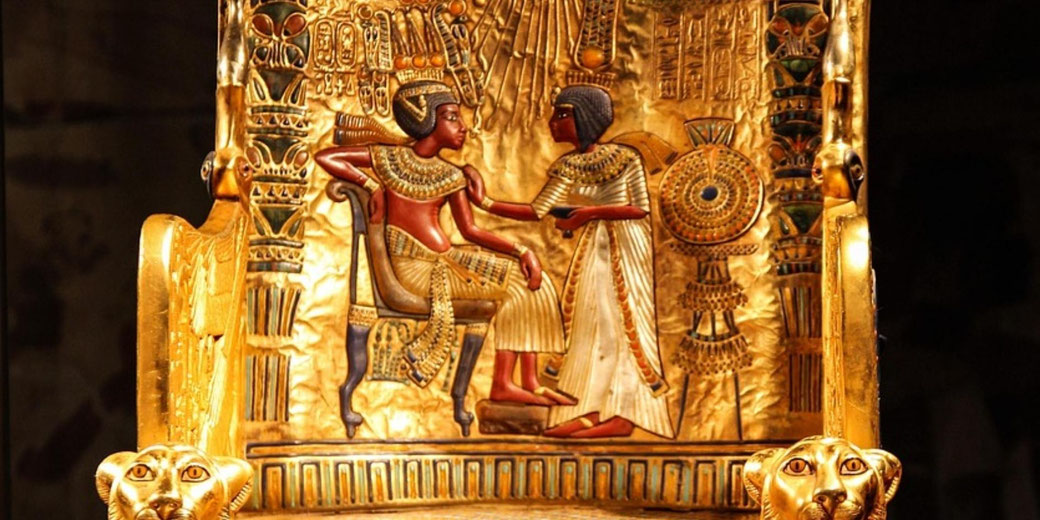
In November 1922, the discovery of Tutankhamun's tomb in Egypt's Valley of the Kings attracted worldwide attention and transformed public interest in ancient Egypt.
For the first time, archaeologists uncovered the burial of an Egyptian pharaoh that survived largely intact, complete with thousands of artefacts, magnificent treasures, and the preserved body of the king himself.
The sources below offer valuable evidence about both Tutankhamun and the remarkable discovery of his tomb. They include firsthand accounts written by Howard Carter, the archaeologist who led the excavation, alongside observations from the Egyptologist Grafton Elliot Smith, who assessed the significance of the find shortly after its discovery.
Source 1
Extract A
"A PORTRAIT OF TUT'ANKH'AMEN — The beaten and burnished [polished until it shone] gold mask of the young king representing him at the age of death — about 18 years old."
Extract B
"It is true that we had expected to find the tomb of Tut ankh-Amen in the Theban Valley, for reasons already pointed out in the first volume, but our supreme surprise was to find it, for all intents and purposes, intact [undamaged and untouched]. Unlike the other royal tombs in the Valley which had all been completely plundered [robbed], only a few fragments of their furniture being left, this tomb was for practical purposes intact, save for the early depredations [damage done by thieves] of a few metal robbers. To this fact our great surprise and good fortune were due."
Extract C
"The king's mummy [preserved body] we found neatly made and fashioned to symbolize [represent in the form of] Osiris [the ancient Egyptian god of the dead]. Covering the head and shoulders was a magnificent [extremely impressive] mask of beaten gold [gold hammered into shape]. The outer wrappings were embellished [decorated] with heavy gold trappings which had somewhat suffered from the action of the unguents [oils used in the burial process]. Enclosed within the wrappings were 143 objects, comprising [including] a diadem [a type of crown], daggers, girdles, personal jewellery and amulets [small objects worn as lucky charms]. Three of these objects introduced an astonishing feature. They were of iron, which I believe is the first authentic purposed introduction of that metal into Egyptian civilisation. It coincides approximately with the period when iron began to overtake bronze in Syria. [Note: Carter identified one of these iron objects as a dagger. Later scientific testing in 2016 confirmed that the iron in this dagger came from a meteorite.]"
Extract D
"Take, for example, the beautiful beaten and burnished [polished until it shone] gold mask of Tut ankh Amen found in this tomb covering his head. Though it retains all the ancient conventions [traditional artistic rules], the moment we become familiar with them — the strangeness of the head-dress, the conventional [traditional] beard — we have a perfect portrait [lifelike image] of the young king at the age of his death."
Contextual information:
Howard Carter was a British archaeologist who led the excavation of Tutankhamun's tomb in Egypt's Valley of the Kings. He published his findings across three volumes between 1923 and 1933, writing for a general audience as well as for scholars. Volume 2 (1927) covers the examination of the burial chamber and the king's mummy.
Bibliographical reference:
Carter, H. (1927). The Tomb of Tut-ankh-Amen (Vol. 2, Frontispiece caption, pp. vi–vii, xxii, 48). George H. Doran.
Copyright: Public domain.
Source 2
"At first I could see nothing, the hot air escaping from the chamber causing the candle to flicker, but presently, as my eyes grew accustomed to the light, details of the room within emerged slowly from the mist, strange animals, statues and gold — everywhere the glint of gold. For the moment — an eternity it must have seemed to the others standing by — I was struck dumb with amazement, and when Lord Carnarvon, unable to stand the suspense any longer, inquired anxiously, 'Can you see anything?' it was all I could do to get out the words, 'Yes, wonderful things.' [This moment took place in November 1922, when Carter first looked into the burial chamber of Tutankhamun's tomb in the Valley of the Kings, Egypt.]"
Contextual information:
Howard Carter was a British archaeologist who spent years searching the Valley of the Kings for an undiscovered royal tomb. This passage is Carter's own account of the moment in November 1922 when he first looked into the burial chamber of Tutankhamun's tomb. A. C. Mace was a fellow archaeologist who assisted with the excavation and co-authored Volume 1 of the published record.
Bibliographical reference:
Carter, H., & Mace, A. C. (1923). The Tomb of Tut-ankh-Amen (Vol. 1, p. 85). Cassell.
Copyright: Public domain.
Source 3
Extract A
"Never before in the history of archaeological inquiry [investigation into ancient history] has any event excited such immediate and world-wide interest as Mr Howard Carter's discovery of Tutankhamen's tomb in November 1922. Very little is known as yet of the king himself, but twelve months hence [twelve months later] no doubt his mummy will give up its secrets and perhaps the story of his life will be revealed."
Extract B
"At the time of his marriage and succession [becoming king] he belonged to the Aton faith [the religion of the sun disc, introduced by his father-in-law Akhenaten, in which only one god was worshipped], which his father-in-law had established, and his name was Tutankhaton. But as soon as Akhenaton died, Tutankhaton and his wife Ankhsenpaaton abandoned the heresy [false or forbidden religious belief] and returned to the orthodox [traditional, accepted] faith of Amen [the chief god of ancient Egypt]. As a token of their conversion [change of religion] they changed their names to Tutankhamen and Ankhsenamen and left Akhenaton's capital for Thebes, the headquarters of the priesthood [religious leaders] of Amen, who no doubt were responsible for Tutankhamen's sudden return to the old religion."
Extract C
"The fact that the tomb of so insignificant [unimportant] a personage [person] as Tutankhamen was equipped with such lavish [very expensive and generous] magnificence [splendour] adds to the importance of the discovery. For if a youthful nonentity [young person of no great importance] who reigned [ruled as king] no more than six or seven years in one of the leanest [poorest] phases of Egypt's history had all this wealth poured into his tomb, one's imagination tries in vain to picture the funerary [relating to burial] equipment of the famous and longer-lived pharaohs [kings of ancient Egypt]… [Note: More recent research suggests Tutankhamun actually ruled for approximately nine to ten years, but in any case his reign was less than ten years long.]"
Contextual information:
Sir Grafton Elliot Smith was a British anatomist and Egyptologist who had earlier studied ancient Egyptian mummies. He published this book in 1923, shortly after Carter's discovery, drawing on his own scientific knowledge and the early reports coming out of Egypt. The book was written for a broad reading public at a time when the discovery had attracted worldwide attention.
Bibliographical reference:
Smith, G. E. (1923). Tutankhamen and the Discovery of his Tomb (pp. 15, 16, 41). George Routledge & Sons.
Copyright: Public domain.