
Historical sources on the Roman army
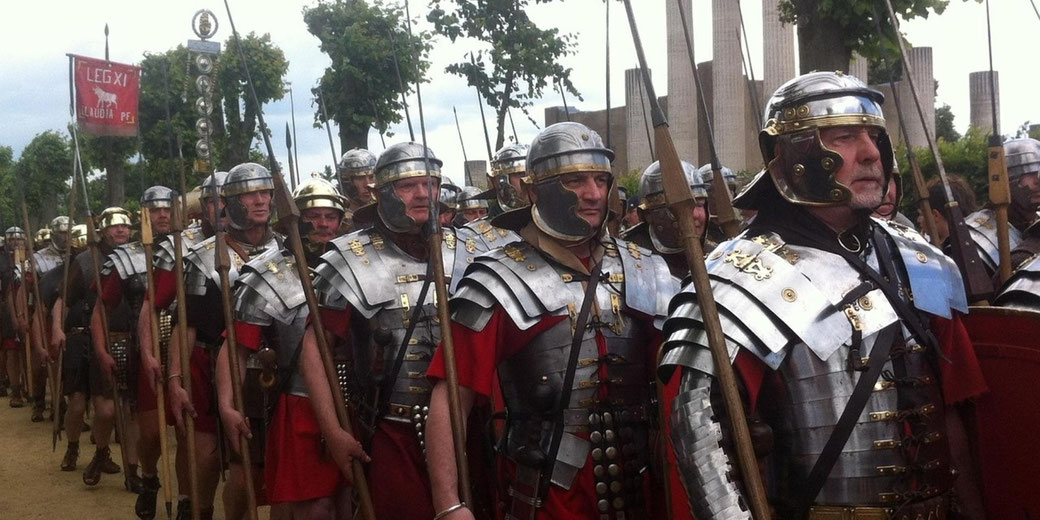
The Roman army was one of the most effective military forces of the ancient world, which enabled Rome to conquer and control territories across Europe, North Africa, and the Near East for centuries.
The sources below provide evidence about different aspects of the Roman military, including recruitment, service requirements, battlefield tactics, weapons, cavalry, and daily routines.
Source 1
Extract A
"As for the rest, a cavalry soldier must serve for ten years in all and an infantry soldier for sixteen years before reaching the age of forty-six, with the exception of those whose census [property value] is under four hundred drachmae [a unit of Greek currency used here to measure wealth], all of whom are employed in naval service. In case of pressing danger twenty years' service is demanded from the infantry. [Note: The service term was later extended to twenty-five years under the Roman Empire, particularly for non-citizen soldiers called auxiliaries.]"
Extract B
"When they have chosen the number determined on — that is when the strength of each legion is brought up to four thousand two hundred, or in times of exceptional danger to five thousand — the old system was to choose the cavalry after the four thousand two hundred infantry, but they now choose them first, the censor selecting them according to their wealth; and three hundred are assigned to each legion. [Polybius is describing the Republican-era legion of around 200 BCE. By the later Imperial period, a full legion was typically organised at closer to six thousand men.]"
Extract C
"The wooden shaft of the javelin measures about two cubits [roughly one metre] in length and is about a finger's breadth in thickness; its head is a span long hammered out to such a fine edge that it is necessarily bent by the first impact, and the enemy is unable to return it. If this were not so, the missile would be of common service to both sides. [This heavy throwing javelin was known to the Romans as the pilum.]"
Contextual information:
Polybius was a Greek historian who lived from around 200 to 118 BCE. He spent many years in Rome as a political hostage and came to know the Roman military first-hand. His Histories cover Rome's rise to power in the Mediterranean and include a detailed account of the Roman army's structure and equipment.
Bibliographical reference:
Adapted from Polybius. Histories (W. R. Paton, Trans., 1923; Vol. III, Book VI, pp. 313, 315, 319). William Heinemann. (Original work written ca. 150 BCE).
Copyright: Public domain.
Source 2
Extract A
"for they do not begin to fight till they have walled their camp about; nor is the fence they raise rashly made, or uneven; nor do they all abide in it, nor do those that are in it take their places at random; but if it happens that the ground is uneven, it is first leveled: their camp is also foursquare by measure, and carpenters are ready, in great numbers, with their tools, to erect their buildings for them."
Extract B
"The camp, and all that is in it, is encompassed with a wall round about, and that sooner than one would imagine, and this by the multitude and the skill of the laborers; and, if occasion require, a trench is drawn round the whole, whose depth is four cubits [about 1.8 metres], and its breadth equal."
Extract C
"Their times also for sleeping, and watching, and rising are notified beforehand by the sound of trumpets, nor is anything done without such a signal; and in the morning the soldiery go every one to their centurions [officers each in charge of around eighty men], and these centurions to their tribunes [senior officers above the centurions], to salute them; with whom all the superior officers go to the general of the whole army, who then gives them of course the watchword and other orders, to be by them carried to all that are under their command; which is also observed when they go to fight, and thereby they turn themselves about on the sudden, when there is occasion for making sallies, as they come back when they are recalled in crowds also."
Extract D
"Now when they are to go out of their camp, the trumpet gives a sound, at which time nobody lies still, but at the first intimation they take down their tents, and all is made ready for their going out; then do the trumpets sound again, to order them to get ready for the march; then do they lay their baggage suddenly upon their mules, and other beasts of burden, and stand, as at the place of starting, ready to march; when also they set fire to their camp, and this they do because it will be easy for them to erect another camp, and that it may not ever be of use to their enemies."
Extract E
"The horsemen have a long sword on their right sides, and a long pole in their hand; a shield also lies by them obliquely on one side of their horses, with three or more darts that are borne in their quiver, having broad points, and no smaller than spears. They have also headpieces and breastplates, in like manner as have all the footmen. [Roman cavalry rode without stirrups, which were unknown in the ancient world. Without stirrups to brace against, a horseman could be unhorsed when striking an enemy at full charge, which is why Roman cavalry typically threw javelins and harassed enemy flanks rather than charging directly into an enemy line.]"
Contextual information:
Flavius Josephus was a Jewish historian and former military commander who wrote in the late first century CE. He witnessed the Roman army at close quarters during the Jewish-Roman War of 66-73 CE, first as a Jewish commander and then as a prisoner attached to the Roman forces. This passage comes from his account of Roman military organisation, which he wrote to explain Roman military strength to his readers.
Bibliographical reference:
Josephus, F. The Wars of the Jews (W. Whiston, Trans., 1895; Book III, Chapter 5, sections 76-78, 84, 86-88, 89-90, 96). John E. Beardsley. (Original work written ca. 75 CE).
Copyright: Public domain.
Source 3
"Caesar first had his own horse and then those of all others sent out of sight, thus to equalise the danger of all and to take away hope of flight. Then after a speech to encourage his troops he joined battle. The legionaries, from the upper ground, easily broke the mass-formation of the enemy by a volley of javelins, and, when it was scattered, drew their swords and charged. The Gauls were greatly encumbered for the fight because several of their shields would be pierced and fastened together by a single javelin-cast; and as the iron became bent, they could not pluck it forth, nor fight handily with the left arm encumbered. [The javelin Caesar describes is the pilum. The iron tip was designed to bend on impact so that it could not be pulled out of a shield or thrown back.]"
Contextual information:
Gaius Julius Caesar was a Roman general and statesman who commanded Roman forces in Gaul (modern France) from 58 to 50 BCE. He wrote The Gallic War as a series of dispatches describing his campaigns, intended partly as a military record and partly to build his political reputation in Rome. This passage describes the opening attack at the Battle of Bibracte in 58 BCE, in which Caesar's legions defeated the Helvetii tribe.
Bibliographical reference:
Adapted from Caesar, J. The Gallic War (H. J. Edwards, Trans., 1917; Book I, Chapter 25, p. 39). William Heinemann. (Original work written ca. 52 BCE).
Copyright: Public domain.