
Historical sources on the role of the Egyptian pharaoh
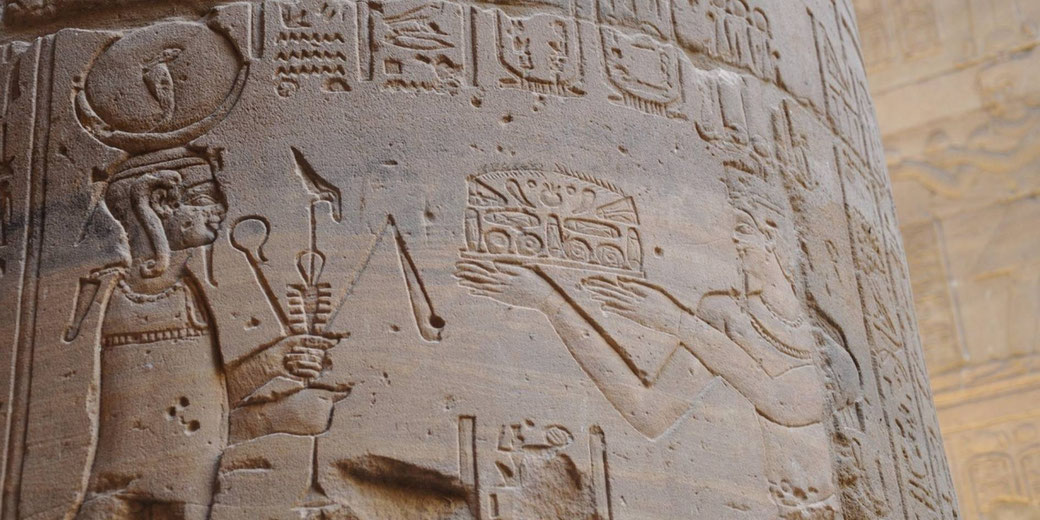
Ancient Egyptian pharaohs commanded armies, supervised government officials, oversaw religious ceremonies, and were widely regarded as the chosen representatives of the gods on earth.
The sources collected on this page explore these different aspects of royal authority, from diplomatic correspondence and religious beliefs to military leadership and economic responsibilities.
They provide key evidence about how Egyptians understood the power, duties, and significance of the pharaoh across different periods of ancient Egyptian history.
Source 1
"In certain of the tablets now as Berlin (Winckler and Abel, 42 and 45) the Phoenician [a people from modern-day Lebanon] governor of the Pharaoh asks that help should be sent him from Melukhkha [a distant region mentioned in ancient letters] and Egypt: 'The king should hear the words of his servant, and send ten men of the country of Melukhkha and twenty men of the country of Egypt to defend the city [of Gebal] for the king.' And again, 'I have sent [to] Pharaoh' (literally, 'the great house') 'for a garrison [a group of soldiers stationed to protect a place] of men from the country of Melukhkha, and... the king has just despatched [sent] a garrison [from] the country of Melukhkha.'"
Contextual information:
Gaston Maspero was a French Egyptologist who served as Director-General of Egyptian Antiquities from 1881 to 1914. This passage comes from his thirteen-volume History of Egypt, Chaldaea, Syria, Babylonia, and Assyria, translated into English by M. L. McClure and edited by A. H. Sayce. Maspero wrote during a period when scholars were first studying the Tel el-Amarna letters, a collection of diplomatic correspondence between ancient Egyptian rulers and foreign kings, which provided key evidence about how the title "pharaoh" was used.
Bibliographical reference:
Maspero, G. (n.d.). History of Egypt, Chaldaea, Syria, Babylonia, and Assyria, Vol. 1 (M. L. McClure, Trans.; A. H. Sayce, Ed., Editor's Preface section). The Grolier Society.
Copyright: Public domain.
Source 2
"In arranging his thoughts and their visible forms Khepera [the ancient Egyptian creator god] was assisted by the goddess Maat, who is usually regarded as the goddess of law, order, and truth, and in late times was held to be the female counterpart [the goddess equivalent] of Thoth, 'the heart of the god Ra [the sun god].' In this legend, however, she seems to play the part of Wisdom, as described in the Book of Proverbs, for it was by Maat that he 'laid the foundation.'"
Contextual information:
Sir Ernest Alfred Wallis Budge was a British Egyptologist who worked at the British Museum and published extensively on ancient Egyptian religion and texts. This passage comes from his Legends of the Gods, published in 1912, which compiled and translated ancient Egyptian religious texts relating to the creation of the world and the roles of the gods. Budge wrote at a time when Egyptology was becoming established as a scholarly field in Britain.
Bibliographical reference:
Budge, E. A. W. (1912). Legends of the Gods: The Egyptian Texts, edited with Translations. Kegan Paul, Trench, Trübner & Co.
Copyright: Public domain.
Source 3
Extract A
"During the New Kingdom [the period of ancient Egypt roughly 1550 to 1070 BC], when the army became more powerful, the Pharaohs preferred to be invested with [to receive officially] military titles, and were called the generals of their father. They participated at the battles, and were the first to venture up the ladders when a fortress was stormed — at least according to official representations [depictions] of battles. Those even who devoted themselves to the priestly profession [the job of being a priest], and who in their old age were high priests, as Meryatum, the pious [deeply religious] son of Ramses II, were not excluded in their youth from taking part in the battles."
Extract B
"The king often appointed his son and heir as co-regent [a joint ruler who shares power with the king] — this was the case under most of the kings of the 12th dynasty [a line of rulers in Egypt around 1990 to 1800 BC]. We read that he 'appoints him his heir on the throne of the god Qeb [the earth god]; he becomes the great captain of the country of Egypt, and gives orders to the whole country.'"
Extract C
"The Egyptian king had always to play a religious part. In the same way as each Egyptian of high standing exercised a kind of priestly office [a religious role] in the temple of his god, so the king was considered the priest of all the gods. Whenever we enter an Egyptian temple, we see the king represented offering his sacrifice to the gods. In most cases this is symbolic of the presents and revenues [income from offerings and estates] with which the king endowed [provided ongoing financial support to] the temple, but it is not probable that they would have had these representations if the king had not sometimes officiated there in person. At many festivals (e.g. the above-mentioned festival of the god Min) it is expressly declared in the official style of the inscription, that the chief business of the king is to 'give praise to his fathers, the gods of Upper and Lower Egypt, because they give him strength and victory, and a long life of millions of years.'"
Extract D
"He alone with the high priest might enter the Holy of Holies [the most sacred inner room of a temple] in the temples, he alone might open the doors of the inner sanctuary [a sacred, restricted space inside a temple] and 'see his father the god.'"
Extract E
"The reason that the small land of Egypt has played as important a part in the history of civilisation as many a large empire, is due to the wealth which yearly accrues to [builds up for] the country from the produce of the soil; agriculture is the foundation of Egyptian civilisation. The results which the agriculturists [farmers] of the Nile valley have obtained, they owe however, not to any special skill or cleverness on their part, but to the inexhaustible fertility [the never-ending ability to produce crops] of the land."
Extract F
"The nourishment that crops need was replenished [restocked] without any human aid each summer by the inundation [annual flooding] of the Nile — which 'supplies all men with nourishment and food.' The great river however did not bestow [give out] its gifts impartially [fairly to all], it also [was] the cause of misfortune. While a high inundation brings nourishment [and] increase to fields over a vast area, a low Nile brings potential famine [a severe shortage of food]. The inundation brings with it, not only the fertile mud, but the needful water for the soil. In this rainless country plants can only grow on those spots that have not been overflowed, but also sufficiently saturated [soaked through] with the water; where this is not the case the hard clay soil is quite bare of vegetation [plant life]."
Extract G
"It was part of the king's work to guide the government and carry on the wars, but in theory his duty towards the gods was still important, Being, in very deed, 'the son of Ra [the sun god], who is enthroned in his heart, whom he loves above all, and who is with him, he is a shining embodiment [living example] of the lord of all, created by the gods of Heliopolis [the ancient Egyptian city known as the City of the Sun]. His divine [godly] father created him to exalt [glorify] his glory. Amun himself crowned him on his throne in the Heliopolis of the south, he chose him for the Shepherd of Egypt, and the defender of mankind.' When the gods blessed the country, it was for the sake of their son; when after many failures they allowed some undertaking to succeed, it was in answer to the prayers of their son. With these ideas what is more natural than that the people should consider the king to be the mediator [the person who acts between two parties] for his country?"
Contextual information:
Adolf Erman was a German Egyptologist and Professor at the University of Berlin, considered one of the foremost authorities on ancient Egyptian language and daily life in the nineteenth century. Life in Ancient Egypt, first published in German and translated into English in 1894 by H. M. Tirard, drew on extensive study of tomb paintings, inscriptions, and papyri to reconstruct how Egyptians lived, worked, and were governed. Erman wrote during the height of German Egyptology, when major collections of primary sources were being catalogued for the first time.
Bibliographical reference:
Erman, A. (1894). Life in Ancient Egypt (H. M. Tirard, Trans.; pp. 58, 62, 65, 68, 425, 427, 432). Macmillan and Co.
Copyright: Public domain.
Source 4
Extract A
"To introduce the Aton faith into Thebes, Amenhotep IV [the pharaoh later known as Akhenaten] erected there a sumptuous [lavish] temple of the new god, which, of course, received liberal endowments [generous funding] from the royal treasury. If the Aton movement was intended as a compromise with the priests of Amon [the chief god of Thebes], it failed. The bitterest enmities [hostilities] soon broke out, culminating [ending] finally in the determination on the king's part to make Aton sole god of the Empire and to annihilate [completely destroy the worship of] Amon. The effort to obliterate [wipe out] all trace of the existence of the upstart Amon resulted in the most extreme measures. The king changed his own name from 'Amenhotep' ('Amen rests' or 'is satisfied') to 'Ikhnaton [the name used by Breasted for Akhenaten],' which means 'Aton is satisfied,' and is a translation of the king's old name into a corresponding idea in the Aton faith. The name of Amon, wherever it occurred on the great monuments of Thebes, was expunged [scraped off or chiselled away], and in doing so not even the name of the king's father, Amenhotep III, was respected. These erasures were not confined to the name of Amon. Even the word 'gods' as a compromising plural was expunged wherever found, and the names of the other gods, too, were treated like that of Amon."
Extract B
"Finding Thebes embarrassed with too many theological traditions [religious beliefs tied to the old gods], in spite of its prestige and its splendour, Ikhnaton forsook [left behind] it and built a new capital about midway between Thebes and the sea, at a place now commonly known as Tell el-Amarna. He called it Akhetaton, 'Horizon of Aton.' The name of the Sun-god is the only divine [godly] name found in the place, and it was evidently intended as a centre for the dissemination [spreading] of Solar monotheism [the belief that there is only one god, the Sun]. Here several sanctuaries [sacred buildings] of Aton were erected, and in the boundary landmarks, imposing stelæ [stone markers carved with inscriptions] which the king set up in the eastern and western cliffs, the place was formally devoted to his exclusive service."
Contextual information:
James Henry Breasted was an American Egyptologist and Professor of Egyptology and Oriental History at the University of Chicago. Development of Religion and Thought in Ancient Egypt, published in 1912, was based on lectures delivered at Union Theological Seminary in New York. Breasted was one of the first American scholars to gain international recognition in Egyptology, and this work was among the earliest English-language studies to trace Egyptian religious thought across the full span of Egyptian history.
Bibliographical reference:
Breasted, J. H. (1912). Development of Religion and Thought in Ancient Egypt (pp. 321-323). Charles Scribner's Sons.
Copyright: Public domain.