
Historical sources on Pompey the Great
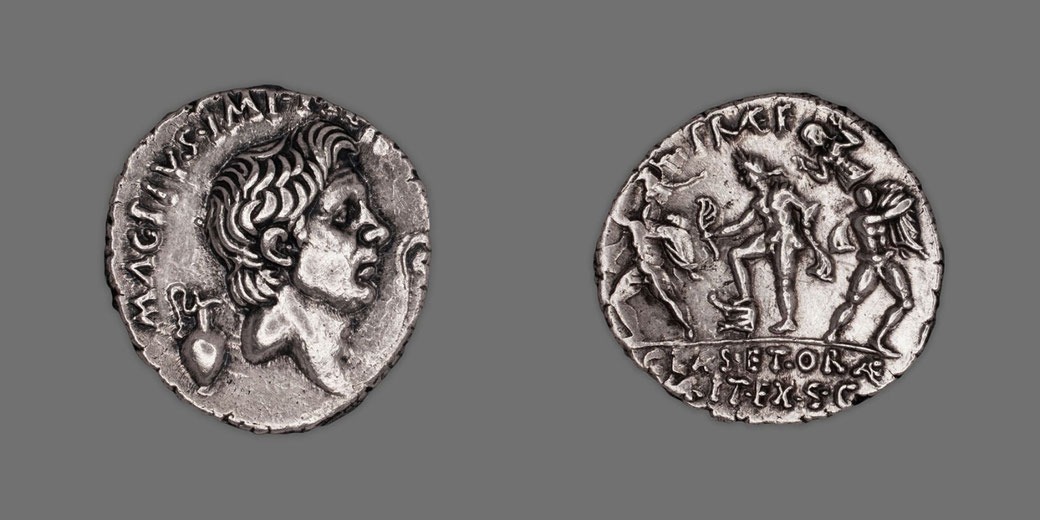
The sources on this page draw together three very different accounts of the Roman general Gnaeus Pompeius Magnus, better known as Pompey the Great (106–48 BCE).
Across these sources, Pompey appears as a commander who defeated pirates in a matter of months, expanded Roman authority across the east, and entered alliances such as the First Triumvirate to secure his position at Rome.
Taken together, these accounts present a man whose reputation rested on both genuine military skill and a readiness to use power for personal advantage, which made him one of the most influential and controversial figures of his age.
Source 1
“POMPEIUS, Gnæus Magnus, commonly known as Pompey, or Pompey the Great (B.C. 106–48). A famous Roman general and statesman. He was a son of Gnæus Pompeius Strabo. At the early age of seventeen he began to learn the military art under his father by service in the field against the Italians in the Social War. Though so young, he gave proof of extraordinary valor and of remarkable energy of character. On the death of his father in B.C. 87, when he was only nineteen years of age, he was left without a protector, and during the temporary triumph of the Marian party he was for some time in considerable danger. When Sulla, to whose side he was attached, returned from Greece to Italy to oppose Marius, Pompey hastened into Picenum, where he had considerable estates and influence, and there raised an army of three legions, with which he successfully opposed the forces of the Marian party, compelling them to quit the district, and effecting a junction with Sulla. During the rest of the war he conducted himself with great prudence and valor, and with such remarkable success, that on the restoration of peace in Italy, the conduct of the war against the remains of the Marian faction in Africa and Sicily was intrusted to him. He speedily performed this commission, and on his return to Rome was honored with the name of Magnus (i.e. ‘the Great’), and with a triumph, which, for one who had not yet held any public office, and was merely an eques, was an unprecedented distinction. His next exploits were the reduction of the followers of Lepidus, whom he drove out of Italy, and the extinction of the Marian party in Spain, led on by the brave Sertorius. This latter work was one of no small difficulty. Pompey suffered some severe defeats at the hands of Sertorius, and it was only after Sertorius had been assassinated that he was able to put an end to the war. In returning to Italy, he fell in with and defeated the remnants of the army of Spartacus, and thus claimed the credit of concluding the Servile War.
He was now the idol of the people, and, though legally ineligible to the consulship, was elected to that important office for the year 70, the senate relieving him of his disabilities rather than provoke him to extremities. Hitherto Pompey had belonged to the aristocratic party; but, as he had of late years been looked upon with suspicion by some of the leading men, he publicly espoused the people’s cause. He carried a law restoring the tribunician power to the people, and aided largely in introducing the bill of Aurelius Cotta (lex Aurelia), that the judices should for the future be taken from the senate, the equites, and the tribuni aerarii, instead of from the senate alone. In B.C. 67–66 Pompey performed a noble service for the Republic in clearing the Mediterranean of the Cilician pirates who infested it in immense numbers; and during the next three years, 65–63, he conquered Mithridates, King of Pontus, and Tigranes, King of Armenia, annexed Syria to the Roman dominions, took Jerusalem, and made Judea tributary to Rome. On his return to Italy he disbanded his army, and entered Rome in triumph for the third time in 61. After his return he was anxious that his acts in Asia should be ratified by the senate and certain lands apportioned among his veteran soldiers. But the senate declined to accede to his wish, and he therefore formed a close intimacy and mutual alliance with Cæsar. Crassus, who possessed enormous wealth, and who exercised a wide influence at Rome, was induced to forego his grudge to Pompey, and thus these three men formed among themselves that coalition which is commonly called ‘the first triumvirate,’ and which for a time frustrated all the efforts of the aristocratic party. This small oligarchy carried all before them.”
Contextual information:
This article on “Pompeius, Gnæus Magnus” comes from The New International Encyclopædia, a large multi‑volume reference work first issued in New York by Dodd, Mead between about 1902 and 1905 and edited by American scholars Daniel Coit Gilman, Harry Thurston Peck, and Frank Moore Colby. It reflects early‑twentieth‑century anglophone scholarship on Rome, written nearly two thousand years after Pompey’s lifetime and summarising his career for a general educated readership in the era just before the First World War.
Bibliographical reference:
Pompeius, Gnæus Magnus. (1905). In The New International Encyclopædia (Vol. 16, p. 269). New York, NY: Dodd, Mead.
Copyright: Public domain.
Source 2
“Moreover, he was thought to have treated Carbo in his misfortunes with an unnatural insolence. For if it was necessary, as perhaps it was, to put the man to death, this ought to have been done as soon as he was seized, and the deed would have been his who ordered it. But as it was, Pompey caused a Roman who had thrice been consul to be brought in fetters and set before the tribunal where he himself was sitting, and examined him closely there, to the distress and vexation of the audience. Then he ordered him to be led away and put to death. They say, moreover, that after Carbo had been led away to execution, when he saw the sword already drawn, he begged that a short respite and a convenient place might be afforded him, since his bowels distressed him. Furthermore, Caius Oppius, the friend of Caesar, says that Pompey treated Quintus Valerius also with unnatural cruelty. For, understanding that Valerius was a man of rare scholarship and learning, when he was brought to him, Oppius says, Pompey took him aside, walked up and down with him, asked and learned what he wished from him, and then ordered his attendants to lead him away and put him to death at once...
“But a general quite unlike Lepidus, namely Sertorius, was in possession of Spain, and was threatening the Romans like a formidable cloud. As if for a final disease of the state, the civil wars had poured all their venom into this man. He had already slain many of the inferior commanders, and was now engaged with Metellus Pius, an illustrious man and a good soldier, but, as men thought, too slow by reason of his years in following up the opportunities of war, and outdistanced when events swept along at high speed. For Sertorius attacked him recklessly and in robber fashion, and by his ambuscades and flanking movements confounded a man who was practised in regular contests only, and commanded immobile and heavy-armed troops. … Pompey, therefore, who kept his army under his command, tried to get himself sent out to reinforce Metellus, and although Catulus ordered him to disband his soldiers, he would not do so, but remained under arms near the city, ever making some excuse or other, until the senate gave him the command, on motion of Lucius Philippus...
“After this, he remained in Spain long enough to quell the greatest disorders and compose and settle such affairs as were in the most inflammatory state; then he led his army back to Italy, where, as chance would have it, he found the servile war at its height. For this reason, too, Crassus, who had the command in that war, precipitated the battle at great hazard, and was successful, killing twelve thousand three hundred of the enemy. Even in this success, however, fortune somehow or other included Pompey, since five thousand fugitives from the battle fell in his way, all of whom he slew, and then stole a march on Crassus by writing to the senate that Crassus had conquered the gladiators in a pitched battle, but that he himself had extirpated the war entirely. … Nevertheless, mingled with the great honour shown the man and the great expectations cherished of him, there was also considerable suspicion and fear; men said he would not disband his army, but would make his way by force of arms and absolute power straight to the polity of Sulla. … But Pompey soon removed this suspicion also by declaring that he would disband his army after his triumph...
“The power of the pirates had its seat in Cilicia at first, and at the outset it was venturesome and elusive; but it took on confidence and boldness during the Mithridatic war, because it lent itself to the king’s service. Then, while the Romans were embroiled in civil wars at the gates of Rome, the sea was left unguarded, and gradually drew and enticed them on until they no longer attacked navigators only, but also laid waste islands and maritime cities. And presently men whose wealth gave them power, and those whose lineage was illustrious, and those who laid claim to superior intelligence, began to embark on piratical craft and share their enterprises, feeling that the occupation brought them a certain reputation and distinction. There were also fortified roadsteads and signal-stations for piratical craft in many places, and fleets put in here which were not merely furnished for their peculiar work with sturdy crews, skilful pilots, and light and speedy ships; nay, more annoying than the fear which they inspired was the odious extravagance of their equipment, with their gilded sails, and purple awnings, and silvered oars, as if they rioted in their iniquity and plumed themselves upon it. Their flutes and stringed instruments and drinking bouts along every coast, their seizures of persons in high command, and their ransomings of captured cities, were a disgrace to the Roman supremacy. For, you see, the ships of the pirates numbered more than a thousand, and the cities captured by them four hundred...
“This was what most of all inclined the Romans, who were hard put to it to get provisions and expected a great scarcity, to send out Pompey with a commission to take the sea away from the pirates. Gabinius, one of Pompey’s intimates, drew up a law which gave him, not an admiralty, but an out-and-out monarchy and irresponsible power over all men. For the law gave him dominion over the sea this side of the pillars of Hercules, over all the mainland to the distance of four hundred furlongs from the sea. These limits included almost all places in the Roman world, and the greatest nations and most powerful kings were comprised within them...
“For five hundred ships were manned for him, and a hundred and twenty thousand men-at-arms and five thousand horsemen were raised. Twenty-four men who had held command or served as praetors were chosen from the senate by him, and he had two quaestors. And since the prices of provisions immediately fell, the people were moved to say in their joy that the very name of Pompey had put an end to the war. However, he divided the waters and the adjacent coasts of the Mediterranean Sea into thirteen districts, and assigned to each a certain number of ships with a commander, and with his forces thus scattered in all quarters he encompassed whole fleets of piratical ships that fell in his way, and straightway hunted them down and brought them into port; others succeeded in dispersing and escaping, and sought their hive, as it were, hurrying from all quarters into Cilicia. Against these Pompey intended to proceed in person with his sixty best ships. He did not, however, sail against them until he had entirely cleared of their pirates the Tyrrhenian Sea, the Libyan Sea, and the sea about Sardinia, Corsica, and Sicily, in forty days all told. This was owing to his own tireless energy and the zeal of his lieutenants...
“The war was therefore brought to an end and all piracy driven from the sea in less than three months, and besides many other ships, Pompey received in surrender ninety which had brazen beaks. The men themselves, who were more than twenty thousand in number, he did not once think of putting to death; and yet to let them go and suffer them to disperse or band together again, poor, warlike, and numerous as they were, he thought was not well.”
Contextual information:
These extracts come from Life of Pompey by Plutarch, a Greek writer and moral philosopher born around 45 CE in Chaeronea, Boeotia, who composed his Parallel Lives in the late first and early second centuries CE under the Roman Empire.
Bibliographical reference:
Plutarch. Life of Pompey (B. Perrin, Trans.). In Plutarch’s Lives (Vol. 5: Agesilaus and Pompey. Pelopidas and Marcellus). (1917) . London, UK: William Heinemann; Cambridge, MA: Harvard University Press. (Sections Pomp. 10, 17, 21, 24–26, 28).
Copyright: Public domain.
Source 3
“These pirates came from Cilicia, a province of Asia Minor, where they had whole villages and towns in their possession, as well as castles on the hilltops. Large numbers of persons who were discontented with Roman rule joined the roving warriors of the sea, and their galleys swarmed all over the Mediterranean. They made sudden attacks on cities on the coast, and at one place seized and carried off two officers (prætors) and their servants. And they plundered the holy temples of Apollo and other gods. Their ships were shaded by purple awnings, the back parts were gilded, the oars were plated with silver, and bands of musicians played while the pirates drank and danced. So much damage was done by this navy of robbers, who swept the sea from Syria to the Pillars of Hercules (Strait of Gibraltar), that the senate of Rome discussed means of putting an end to the pirate power. They resolved to send Pompey to do this dangerous work. Great was the joy of the citizens when they heard that Pompey was to take command. They had faith in his skill and courage. In three months he had cleared the sea of these troublesome folk. He had five hundred galleys. He divided the whole Mediterranean Sea into thirteen parts, and placed a lieutenant over each, with a portion of the fleet. Then, sailing and rowing from the west, Pompey advanced...”
Contextual information:
This passage is from The Children’s Plutarch: Tales of the Romans, a collection of simplified stories based on Plutarch’s Lives that was produced for school‑age readers in the early twentieth century. The version was published around 1910 in New York by Harper & Brothers and adapted by the English educational writer Frederick James Gould (1855–1938), who recast Plutarch’s ancient biographies into clear, moralising narratives suitable for children in Edwardian classrooms.
Bibliographical reference:
Firth, J. B. (1909). The conqueror of pirates. In The Children’s Plutarch: Tales of the Romans (pp. 173–180). London, UK: T. C. & E. C. Jack.
Copyright: Public domain.