
Historical sources on the history of ancient Greece
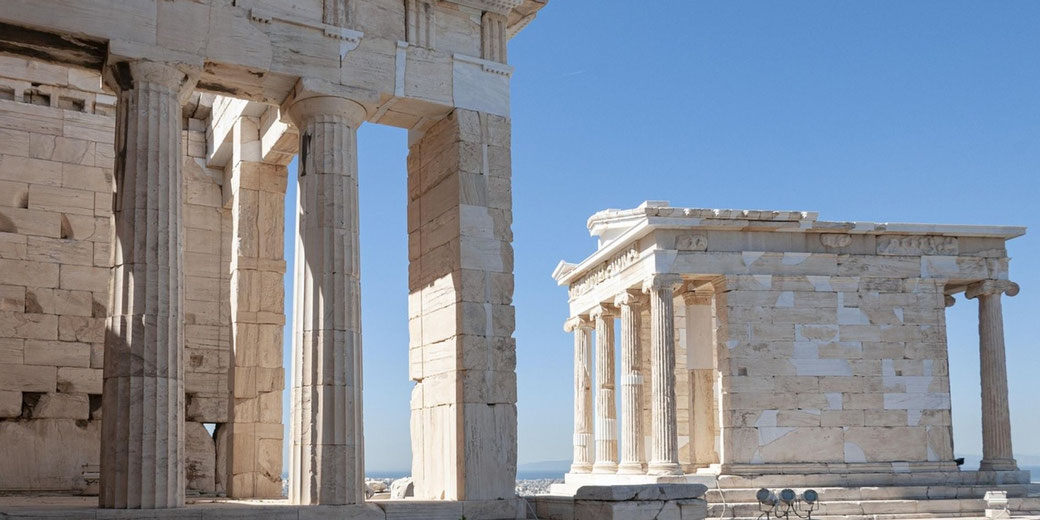
From the earliest migrations into the Greek mainland through to the rise of Athens, Sparta, and Alexander the Great, the history of ancient Greece developed through war, colonisation, trade, political reform, and fierce rivalry between independent city-states.
These historical sources examine how the ancient Greeks understood their own past, society, and political systems.
Source 1
Extract A
"For instance, it is evident that the country now called Hellas [the name that the ancient Greeks used for their own land — the Romans later called it 'Greece'] had in ancient times no settled population; on the contrary, migrations were of frequent occurrence, the several tribes readily abandoning their homes under the pressure of superior numbers. Without commerce, without freedom of communication either by land or sea, cultivating no more of their territory than the exigencies of life required, destitute of capital, never planting their land (for they could not tell when an invader might not come and take it all away, and when he did come they had no walls to stop him), thinking that the necessities of daily sustenance could be supplied at one place as well as another, they cared little for shifting their habitation, and consequently neither built large cities nor attained to any other form of greatness."
Extract B
"Indeed, they could not unite for this expedition till they had gained increased familiarity with the sea. And the first person known to us by tradition as having established a navy is Minos. He made himself master of what is now called the Hellenic sea, and ruled over the Cyclades [a group of islands in the Aegean Sea, between mainland Greece and the island of Crete], into most of which he sent the first colonies, expelling the Carians and appointing his own sons governors; and thus did his best to put down piracy in those waters, a necessary step to secure the revenues for his own use."
Extract C
"What enabled Agamemnon to raise the armament was more, in my opinion, his superiority in strength, than the oaths of Tyndareus, which bound the suitors to follow him. Indeed, the account given by those Peloponnesians who have been the recipients of the most credible tradition is this. First of all Pelops, arriving among a needy population from Asia with vast wealth, acquired such power that, stranger though he was, the country was called after him; and this power fortune saw fit materially to increase in the hands of his descendants. Eurystheus had been killed in Attica by the Heraclids. Atreus was his mother's brother; and to the hands of his relation, who had left his father on account of the death of Chrysippus, Eurystheus, when he set out on his expedition, had committed Mycenæ [the city on the Greek mainland that was the centre of the Mycenaean civilisation] and the government."
Extract D
"Even after the Trojan War, Hellas was still engaged in removing and settling, and thus could not attain to the quiet which must precede growth. The late return of the Hellenes from Ilium caused many revolutions, and factions ensued almost everywhere; and it was the citizens thus driven into exile who founded the cities. Sixty years after the capture of Ilium, the modern Boeotians were driven out of Arne by the Thessalians, and settled in the present Boeotia, the former Cadmeis; though there was a division of them there before, some of whom joined the expedition to Ilium. Twenty years later, the Dorians and the Heraclids became masters of Peloponnese [the large peninsula that forms southern mainland Greece]; so that much had to be done and many years had to elapse before Hellas could attain to a durable tranquillity undisturbed by removals, and could begin to send out colonies, as Athens did to Ionia and most of the islands, and the Peloponnesians to most of Italy and Sicily and some places in the rest of Hellas."
Extract E
"Not many years after the deposition of the tyrants, the battle of Marathon was fought between the Medes and the Athenians. Ten years afterwards, the barbarian returned with the armada for the subjugation of Hellas. In the face of this great danger, the command of the confederate Hellenes was assumed by the Lacedaemonians [the people of Sparta] in virtue of their superior power; and the Athenians, having made up their minds to abandon their city, broke up their homes, threw themselves into their ships, and became a naval people. This coalition, after repulsing the barbarian, soon afterwards split into two sections, which included the Hellenes who had revolted from the King, as well as those who had aided him in the war. At the end of the one stood Athens, at the head of the other Lacedaemon, one the first naval, the other the first military power in Hellas. For a short time the league held together, till the Lacedaemonians and Athenians quarrelled and made war upon each other with their allies, a duel into which all the Hellenes sooner or later were drawn, though some might at first remain neutral."
Contextual information:
Thucydides was an Athenian historian and general who wrote his History of the Peloponnesian War in the late fifth century BC, making him a contemporary of many of the events he described. In the opening chapters of Book 1, known as the "Archaeology," he examined the early history of Greece to provide background for the great war between Athens and Sparta. He used the term "Hellas" throughout his work, as this was the name Greeks used for their own country.
Bibliographical reference:
Thucydides. History of the Peloponnesian War (R. Crawley, Trans., 1874; Book I, Chs. 1–2, pp. 1–15). Longmans, Green and Co. (Original work written ca. 431–400 BC)
Copyright: Public domain.
Source 2
Extract A
"The name of Greece was not used by the inhabitants of the country. They called their land HELLAS, and themselves HELLENES. At first the word HELLAS signified only a small district in Thessaly [a region in northern mainland Greece], from which the Hellenes gradually spread over the whole country. The names of GREECE and GREEKS come to us from the Romans, who gave the name of GRAECIA to the country and of GRAECI to the inhabitants."
Extract B
"Minos, king of Crete [the large island to the south of mainland Greece — the earliest Greek civilisation grew up here], whose history is connected with that of Theseus, appears, like him, the representative of an historical and civil state of life. Minos is said to have received the laws of Crete immediately from Zeus; and traditions uniformly present him as king of the sea. Possessing a numerous fleet, he reduced the surrounding islands, especially the Cyclades, under his dominion, and cleared the sea of pirates."
Extract C
"Another colony was the one led from Asia by Pelops, from whom the southern peninsula of Greece derived its name of Peloponnesus. Pelops is represented as a Phrygian, and the son of the wealthy king Tantalus. He became king of Mycenae [the most powerful city on the Greek mainland during the Mycenaean period], and the founder of a powerful dynasty, one of the most renowned in the Heroic age of Greece. From him was descended Agamemnon, who led the Grecian host against Troy."
Extract D
"The Trojan war was the greatest of all the heroic achievements. It formed the subject of innumerable epic poems, and has been immortalised by the genius of Homer [the ancient Greek poet who composed the Iliad, the story of the Trojan War, and the Odyssey, the story of the return home]. Paris, son of Priam, king of Troy, abused the hospitality of Menelaus, king of Sparta, by carrying off his wife Helen, the most beautiful woman of the age. All the Grecian princes looked upon the outrage as one committed against themselves. Responding to the call of Menelaus, they assembled in arms, elected his brother Agamemnon, king of Mycenae, leader of the expedition, and sailed across the AEgean in nearly 1200 ships to recover the faithless fair one."
Extract E
"Few of the great characters of history have been so differently judged as Alexander. Of the magnitude of his exploits, indeed, and of the justice with which, according to the usual sentiments of mankind, they confer upon him the title of 'Great,' there can be but one opinion. His military renown, however, consists more in the seemingly extravagant boldness of his enterprises than in the real power of the foes whom he overcame. Yet on the whole his achievements, though they undoubtedly occasioned great partial misery, must be regarded as beneficial to the human race. By his conquests the two continents were put into closer communication with one another; and both, but particularly Asia, were the gainers. The language, the arts, and the literature of Greece were introduced into the East; and after the death of Alexander, Greek kingdoms were formed in the western parts of Asia, which continued to exist for many generations [historians today call this period the Hellenistic Age — the word comes from 'Hellas,' the Greek name for Greece]."
Extract F
"The physical features of the country exercised an important influence upon the political destinies of the people. Greece is one of the most mountainous countries of Europe. Its surface is occupied by a number of small plains, either entirely surrounded by limestone mountains or open only to the sea. Each of the principal Grecian cities was founded in one of these small plains; and, as the mountains which separated it from its neighbours were lofty and rugged, each city grew up in solitary independence. But at the same time it had ready and easy access to the sea, and Arcadia was almost the only political division that did not possess some territory upon the coast. Thus shut out from their neighbours by mountains, the Greeks were naturally attracted to the sea, and became a maritime people. Hence they possessed the love of freedom and the spirit of adventure, which have always characterised, more or less the inhabitants of maritime districts."
Contextual information:
William Smith was a British classical scholar and educator who published A Smaller History of Greece in 1871 as a secondary school textbook. The book was designed to introduce students to Greek history from the earliest myths through to the Roman conquest. Smith wrote for students of roughly the same age as Michael's Year 8 class, which makes his language well-suited to this activity.
Bibliographical reference:
Smith, W. (1871). A Smaller History of Greece (pp. 1–4, 10–12, 14–15, 54–56, 212–214). John Murray.
Copyright: Public domain.
Source 3
"Every state is a community of some kind, and every community is established with a view to some good; for mankind always act in order to obtain that which they think good. But, if all communities aim at some good, the state or political community, which is the highest of all, and which embraces all the rest, aims at good in a greater degree than any other, and at the highest good."
Contextual information:
Aristotle was an ancient Greek philosopher who studied under Plato and later tutored Alexander the Great. He wrote the Politics as a systematic study of the Greek city-state [the independent self-governing city, called a polis in Greek], opening with his famous argument that the political community is the highest form of human association. The work was composed in Athens in the fourth century BC.
Bibliographical reference:
Aristotle. Politics (B. Jowett, Trans., 1885; Book I, Part I, p. 1). Clarendon Press. (Original work written ca. 335–322 BC)
Copyright: Public domain.
Source 4
"Such, then, was his legislation concerning the magistracies. There are three points in the constitution of Solon [an Athenian statesman who reformed the law and government of Athens around 594 BC] which appear to be its most democratic features: first and most important, the prohibition of loans on the security of the debtor's person; secondly, the right of every person who so willed to claim redress on behalf of any one to whom wrong was being done; thirdly, the institution of the appeal to the jurycourts; and it is to this last, they say, that the masses have owed their strength most of all, since, when the democracy is master of the voting-power, it is master of the constitution. Moreover, since the laws were not drawn up in simple and explicit terms (but like the one concerning inheritances and wards of state), disputes inevitably occurred, and the courts had to decide in every matter, whether public or private."
Contextual information:
Aristotle was an ancient Greek philosopher who studied under Plato and later tutored Alexander the Great. He wrote the Athenian Constitution, a detailed account of the political history and institutions of Athens, probably in the 330s BC. In Part 9, he assessed the three most important features of Solon's reforms, identifying the popular courts as the foundation on which Athenian democracy rested.
Bibliographical reference:
Aristotle. The Athenian Constitution (F. G. Kenyon, Trans., 1891; Part 9, p. 33). G. Bell and Sons. (Original work written ca. 330s BC)
Copyright: Public domain.