
Historical sources on the life of Alexander the Great
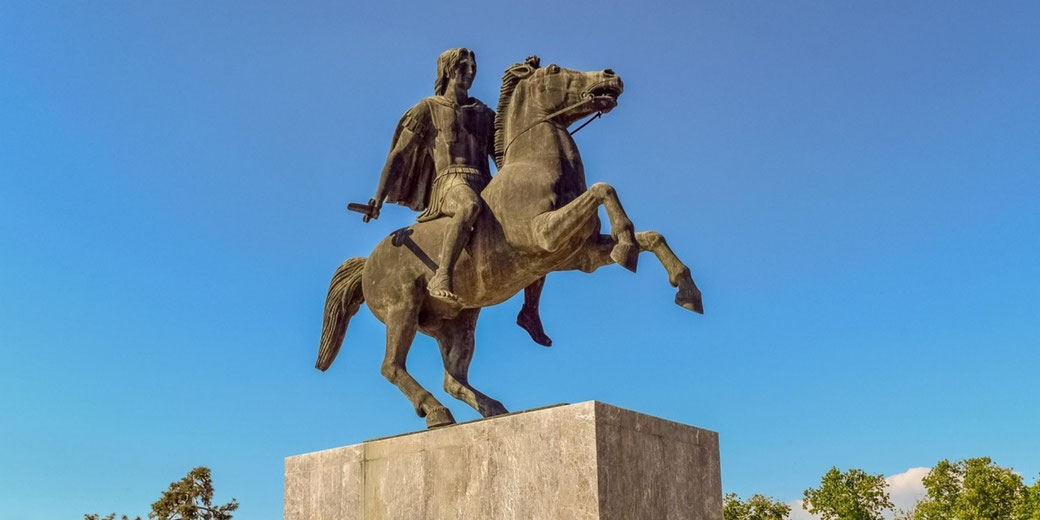
The following historical sources provide valuable evidence about the life and career of Alexander the Great, one of the most influential military leaders of the ancient world.
They describe Alexander’s victories at battles such as the Battle of the Granicus and his later campaigns in Egypt, Central Asia, and India, including the battle against Porus. In addition, the extracts provide evidence about the foundation of Alexandria and the division of Alexander’s empire after his death in 323 BCE.
Source 1
Extract A
"And since Philip saw that his son's nature was unyielding [stubborn] and that he resisted compulsion [being forced], but was easily led by reasoning into the path of duty, he himself tried to persuade rather than to command him; and because he would not wholly entrust the direction and training of the boy to the ordinary teachers of poetry and the formal studies, feeling that it was a matter of too great importance, and, in the words of Sophocles, 'A task for many bits and rudder-sweeps as well,' he sent for the most famous and learned of philosophers, Aristotle, and paid him a noble and appropriate tuition-fee [payment for teaching]. The city of Stageira, that is, of which Aristotle was a native, and which he had himself destroyed, he peopled again, and restored to it those of its citizens who were in exile or slavery. Well, then, as a place where master and pupil could labour and study, he assigned them the precinct [grounds] of the nymphs near Mieza, where to this day the visitor is shown the stone seats and shady walks of Aristotle."
Extract B
"Thus it was that at the age of twenty years Alexander received the kingdom, which was exposed to great jealousies, dire [terrible] hatreds, and dangers on every hand. For the neighbouring tribes of Barbarians [non-Greek peoples, using the Greek term of the time] would not tolerate their servitude [being ruled by another], and longed for their hereditary [passed down through their family] kingdoms; and as for Greece, although Philip had conquered her in the field, he had not had time enough to make her tame under his yoke [rule], but had merely disturbed and changed the condition of affairs there, and then left them in a great surge and commotion [disturbance], owing to the strangeness of the situation."
Extract C
"Arrived before Thebes, and wishing to give her still a chance to repent of what she had done, he merely demanded the surrender of Phoenix and Prothytes, and proclaimed an amnesty [a pardon] for those who came over to his side. But the Thebans made a counter-demand that he should surrender to them Philotas and Antipater, and made a counter-proclamation that all who wished to help in setting Greece free should range themselves with them; and so Alexander set his Macedonians to the work of war. On the part of the Thebans, then, the struggle was carried on with a spirit and valour [bravery] beyond their powers, since they were arrayed against an enemy who was many times more numerous than they; but when the Macedonian garrison also, leaving the citadel [fortress] of the Cadmeia, fell upon them in the rear, most of them were surrounded, and fell in the battle itself, and their city was taken, plundered, and razed to the ground [completely destroyed]. This was done, in the main, because Alexander expected that the Greeks would be terrified by so great a disaster and cower down in quiet, but apart from this, he also plumed himself [took pride] on gratifying the complaints of his allies; for the Phocians and Plataeans had denounced [formally accused] the Thebans."
Extract D
"Meanwhile the generals of Dareius [Darius III, the Persian king] had assembled a large force and set it in array at the crossing of the river Granicus, so that it was practically necessary to fight, as it were at the gates of Asia, for entrance and dominion [rule] there. But most of the Macedonian officers were afraid of the depth of the river, and of the roughness and unevenness of the farther banks, up which they would have to climb while fighting. Some, too, thought they ought to observe carefully the customary practice in regard to the month (for in the month of Daesius the kings of Macedonia were not wont [accustomed] to take the field with an army). This objection Alexander removed by bidding them call the month a second Artemisius; and when Parmenio, on the ground that it was too late in the day, objected to their risking the passage, he declared that the Hellespont would blush for shame [it would be embarrassing], if, after having crossed that strait, he should be afraid of the Granicus, and plunged into the stream with thirteen troops of horsemen."
Extract E
"Although he won a brilliant victory and destroyed more than a hundred and ten thousand of his enemies, he did not capture Dareius [Darius III], who got a start of four or five furlongs [about one kilometre] in his flight; but he did take the king's chariot, and his bow, before he came back from the pursuit. He found his Macedonians carrying off the wealth from the camp of the Barbarians, and the wealth was of surpassing [extraordinary] abundance, although its owners had come to the battle in light marching order and had left most of their baggage in Damascus; he found, too, that his men had picked out for him the tent of Dareius, which was full to overflowing with gorgeous servitors [servants] and furniture, and many treasures. Straightway [immediately], then, Alexander put off his armour and went to the bath, saying: 'Let us go and wash off the sweat of the battle in the bath of Dareius.'"
Contextual information:
Plutarch was a Greek historian and biographer who lived from around 46 to 120 CE. He wrote the Parallel Lives, a collection of paired biographies of famous Greeks and Romans, drawing on a wide range of earlier historical sources. His Life of Alexander is one of the most detailed ancient accounts of Alexander's reign, covering events from his childhood education through to his death.
Bibliographical reference:
Plutarch. Life of Alexander (B. Perrin, Trans., 1919; Vol. VII, pp. 237, 253, 255, 261, 263, 265). William Heinemann. (Original work written ca. 100 CE)
Copyright: Public domain.
Source 2
Extract A
"It is said that Philip died when Pythodemus was archon [chief magistrate] at Athens, and that his son Alexander, being then about twenty years of age, marched into Peloponnesus [the southern part of Greece] as soon as he had secured the regal power [royal authority]. There he assembled all the Greeks who were within the limits of Peloponnesus, and asked from them the supreme command of the expedition against the Persians, an office which they had already conferred upon [given to] Philip. He received the honour which he asked from all except the Lacedaemonians [Spartans], who replied that it was an hereditary custom of theirs, not to follow others but to lead them. The Athenians also attempted to bring about some political change; but they were so alarmed at the very approach of Alexander, that they conceded to him [gave in and granted him] even more ample public honours than those which had been bestowed upon Philip. He then returned into Macedonia and busied himself in preparing for the expedition into Asia."
Extract B — Chinnock's editorial footnote 3 to Book I, Chapter I
"Alexander the Great was the son of Philip II. and Olympias, and was born at Pella B.C. 356. In his youth he was placed under the tuition [teaching] of Aristotle, who acquired very great influence over his mind and character, and retained it until his pupil was spoiled by his unparalleled [never before seen] successes."
Extract C
"The settlement of Theban affairs was entrusted by Alexander to the allies who had taken part in the action. They resolved to occupy the Cadmea [the fortress of Thebes] with a garrison [troops stationed to defend a place]; to raze the city to the ground [completely destroy it]; to distribute among themselves all the territory, except what was dedicated to the gods; and to sell into slavery the women and children, and as many of the males as survived, except those who were priests or priestesses, and those who were bound to Philip or Alexander by the ties of hospitality or had been public agents of the Macedonians. It is said that Alexander preserved the house and the descendants of Pindar the poet, out of respect for his memory."
Extract D
"From Memphis he sailed down the river towards the sea, embarking [loading onto ships] the shield-bearing guards, the archers, the Agrianians [troops from Thrace serving as Alexander's light infantry], and of the cavalry the royal squadron of the Companions. Coming to Canobus, he sailed round the Marian lake, and disembarked where now is situated the city of Alexandria, which takes its name from him. The position seemed to him a very fine one in which to found a city, and he foresaw that it would become a prosperous one. Therefore he was seized by an ardent [passionate] desire to undertake the enterprise, and himself marked out the boundaries of the city, pointing out the place where the agora [the public marketplace] was to be constructed, where the temples were to be built, stating how many there were to be, and to what Grecian gods they were to be dedicated, and specially marking a spot for a temple to the Egyptian Isis. He also pointed out where the wall was to be carried round it."
Extract E
"Meantime Alexander was leading his army towards Mount Caucasus [the name the Greeks used for the Hindu Kush mountain range], where he founded a city and named it Alexandreia. Having offered sacrifice here to the gods to whom it was his custom to sacrifice, he crossed Mount Caucasus, after appointing Proëxes, a Persian, viceroy [governor ruling on behalf of the king] over the land, and leaving Neiloxenus son of Satyrus, one of the Companions, with an army as superintendent. According to the account of Aristobulus, Mount Caucasus is as lofty [very tall] as any in Asia, and most of it is bare, at any rate in that part where Alexander crossed it. This range of mountains stretches out so far that they say even that Mount Taurus, which forms the boundary of Cilicia and Pamphylia, springs from it, as do other great ranges which have been distinguished from the Caucasus by various names according to the position of each."
Extract F
"Of the Indians little short of 20,000 infantry [foot-soldiers] and 3,000 cavalry [soldiers on horseback] were killed in this battle. All their chariots were broken to pieces; and two sons of Porus were slain, as were also Spitaces, the governor of the Indians of that district, the managers of the elephants and of the chariots, and all the cavalry officers and generals of Porus's army. Of Alexander's forces, about 80 of the 6,000 foot-soldiers who were engaged in the first attack, were killed; 10 of the horse-archers, who were also the first to engage in the action; about 20 of the Companion cavalry, and about 200 of the other horsemen fell. When Porus, who exhibited great talent in the battle, performing the deeds not only of a general but also of a valiant [brave] soldier, observed the slaughter of his cavalry, and some of his elephants lying dead, others destitute of keepers [without their handlers] straying about in a forlorn [lost, helpless] condition, while most of his infantry had perished, he did not depart as Darius the Great King did, setting an example of flight to his men; but as long as any body of Indians remained compact in the battle, he kept up the struggle. But at last, having received a wound on the right shoulder, which part of his body alone was unprotected during the battle, he wheeled round."
Contextual information:
Arrian was a Greek historian and military commander who lived from around 86 to 160 CE. He wrote the Anabasis of Alexander using the eyewitness accounts of Ptolemy and Aristobulus, two of Alexander's own officers, which makes it one of the most reliable ancient sources on Alexander's campaigns. The work covers Alexander's military career from his accession to his death, including his battles in Persia, Egypt, Central Asia, and India.
Bibliographical reference:
Arrian. The Anabasis of Alexander; or, The History of the Wars and Conquests of Alexander the Great (E. J. Chinnock, Trans., 1884; Book I Ch. I fn. 3, Book I Ch. IX, Book III Ch. I, Book III Ch. XXVIII, Book V Ch. XVIII). Hodder and Stoughton. (Original work written ca. 150 CE)
Copyright: Public domain.
Source 3
"On his return, he divided the provinces among the chief men [known as the Diadochi], in order both to remove his rivals out of the way, and to make the gift of a prefectship [governorship] appear a favour from himself. In the first place Egypt, with part of Africa and Arabia, fell by lot to Ptolemy, whom Alexander, for his merit, had raised from the condition of a common soldier; and Cleomenes, who had built Alexandria, was directed to put the province into his hands. Laomedon of Mitylene was allotted Syria, which bordered on Ptolemy's province; Philotas, Cilicia; and Philo, Illyria. Atropatus was set over the Greater Media; the father-in-law of Perdiccas over the Less. Susiana was assigned to Scynus, and the Greater Phrygia to Antigonus, the son of Philip. Nearchus received Lycia and Pamphylia; Cassander, Caria; and Menander, Lydia. The Lesser Phrygia fell to Leonatus; Thrace, and the coasts of the Pontic sea, to Lysimachus; Cappadocia and Paphlagonia were given to Eumenes. The chief command of the camp fell to Seleucus the son of Antiochus. Cassander, the son of Antipater, was made commander of the king's guards and attendants. When this allotment, like a gift from the fates, was made to each, it was to many of them a great occasion for improving their fortunes; for not long after, as if they had divided kingdoms, not governments, among themselves, they became princes instead of prefects [governors], and not only secured great power to themselves, but bequeathed it [left it as an inheritance] to their descendants."
Contextual information:
Marcus Junianus Justinus was a Roman historian who probably lived in the second or third century CE. He wrote an Epitome, or condensed summary, of an earlier and much larger history by Pompeius Trogus, which covered the history of the ancient world from Assyria to Rome. Book XIII of the Epitome covers events immediately after Alexander's death in 323 BCE, including the meeting at Babylon where his generals agreed to divide his empire.
Bibliographical reference:
Justin. Epitome of the Philippic History of Pompeius Trogus (J. S. Watson, Trans., 1853; Book XIII, Ch. 4, p. 125). Henry G. Bohn. (Original work written ca. 2nd–3rd century CE)
Copyright: Public domain.