
Historical sources on New Kingdom Egypt
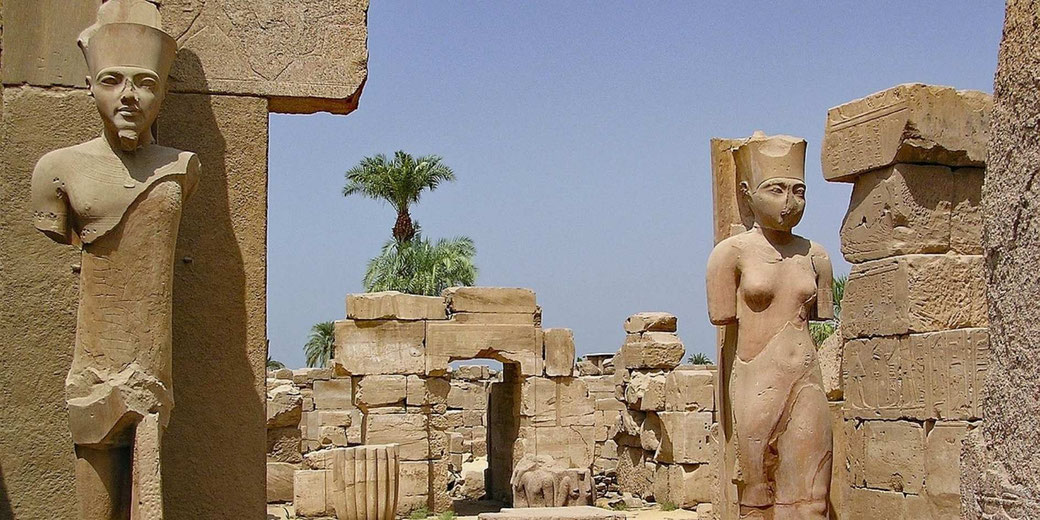
These historical sources on New Kingdom Egypt examine a period of warfare, imperial expansion, religious conflict, royal propaganda, and archaeological discovery.
They begin with the Hyksos invasion and the military changes that helped Egypt become an empire, before turning to major rulers such as Hatshepsut, Thutmose III, Akhenaten, and Ramses II.
The extracts also show how the god Amun became closely tied to royal power, how Akhenaten challenged traditional worship through his devotion to Aten, and how later discoveries such as Tutankhamun’s tomb renewed modern interest in Egypt’s New Kingdom.
Source 1
Extract A
"It is possible that they [the Hyksos invaders] owed this rapid victory to the presence in their armies of a factor [weapon and method of fighting] hitherto unknown to the African—the war-chariot—and before the horse and his driver the Egyptians gave way in a body. The invaders appeared as a cloud of locusts on the banks of the Nile. Towns and temples were alike pillaged, burnt, and ruined; they massacred all they could of the male population, reduced to slavery those of the women and children whose lives they spared, and then proclaimed as king Salatis, one of their chiefs."
Extract B
"From henceforth Hâtshopsîtû [Hatshepsut] adopts every possible device to conceal her real sex. She changes the termination of her name, and calls herself Hâtshopsîû, the chief of the nobles, in lieu of [instead of] Hâtshopsîtû, the chief of the favourites. She becomes the King Mâkerî, and on the occasion of all public ceremonies she appears in male costume. We see her represented on the Theban monuments with uncovered shoulders, devoid of breasts, wearing the short loin-cloth and the keffieh [a type of head cloth], while the diadem rests on her closely cut hair, and the false beard depends from her chin."
Extract C
"The descendants of Ahmosis had by their energy won for Thebes not only the supremacy [highest authority] over the peoples of Egypt and of the known world, but had also secured for the Theban deities pre-eminence [greatest importance] over all their rivals. The booty collected both in Syria and Ethiopia went to enrich the god Amon as much as it did the kings themselves; every victory brought him the tenth part of the spoil gathered on the field of battle, of the tribute levied on vassals [peoples who paid taxes to Egypt], and of the prisoners taken as slaves. When Thûtmosis III., after having reduced Megiddo, organised a systematic plundering of the surrounding country, it was for the benefit of Amon-Râ that he reaped the fields and sent their harvest into Egypt; if during his journeys he collected useful plants or rare animals, it was that he might dispose of them in the groves or gardens of Amon as well as in his own, and he never retained for his personal use the whole of what he won by arms, but always reserved some portion for the sacred treasury."
Extract D
"This immense domain [territory], which was a kind of State within the State, was ruled over by a single high priest, chosen by the sovereign from among the prophets [senior religious officials]. He was the irresponsible head of it, and his spiritual ambition had increased step by step with the extension of his material resources. As the human Pharaoh showed himself entitled to homage [deep respect] from the lords of the earth, the priests came at length to the conclusion that Amon had a right to the allegiance of the lords of heaven, and that he was the Supreme Being, in respect of whom the others were of little or no account, and as he was the only god who was everywhere victorious, he came at length to be regarded by them as the only god in existence. It was impossible that the kings could see this rapid development of sacerdotal [priestly] power without anxiety, and with all their devotion to the patron of their city, solicitude [concern] for their own authority compelled them to seek elsewhere for another divinity, whose influence might in some degree counterbalance that of Amon."
Extract E
"His worship assumes none of the severe and gloomy forms of the Theban cults: songs resound therein, and hymns accompanied by the harp or flute; bread, cakes, vegetables, fruits, and flowers are associated with his rites, and only on very rare occasions one of those bloody sacrifices in which the other gods delight. The king made himself supreme pontiff [chief priest] of Atonu [the god Aten, shown as the sun disk], and took precedence of [ranked higher than] the high priest. He himself celebrated the rites at the altar of the god, and we see him there standing erect, his hands outstretched, offering incense and invoking blessings from on high. Like the Caliph Hakim of a later age, he formed a school to propagate [spread] his new doctrines, and preached them before his courtiers: if they wished to please him, they had to accept his teaching, and show that they had profited by it. The renunciation [rejection] of the traditional religious observances of the solar house involved also the rejection of such personal names as implied an ardent devotion to the banished god; in place of Amenôthes, 'he to whom Amon is united,' the king assumed after a time the name of Khûniatonû, 'the Glory of the Disk,' and all the members of his family, as well as his adherents [followers] at court, whose appellations [names] involved the name of the same god, soon followed his example. The proscription [banning] of Amon extended to inscriptions, so that while his name or figure, wherever either could be got at, was chiselled out, the vulture, the emblem of Mût, which expressed the idea of mother, was also avoided."
Extract F
"Even when old age approached and threatened to abate [reduce] his vigour, he was upheld by the belief that his father Amon was ever at hand to guide him with his counsel and assist him in battle. 'I give to thee, declared the god, the rebels that they may fall beneath thy sandals, that thou mayest crush the rebellious, for I grant to thee by decree the earth in its length and breadth. The tribes of the West and those of the East are under the place of thy countenance, and when thou goest up into all the strange lands with a joyous heart, there is none who will withstand Thy Majesty, for I am thy guide when thou treadest them underfoot.'"
Extract G
"Ramses II. surrounded himself with a numerous family, and had as many as one hundred and eleven sons and fifty-nine daughters. He built throughout all parts of Egypt and Nubia, and each monument was on a scale corresponding with his immense power and resources. Karnak, Luxor, Abydos, Memphis, all bear witness to his activity; but his most original work was the two temples hewn in the rocky cliff of Abu-Simbel in Nubia, which he dedicated to Ptah, Harmakhis, Amon-Ra, and to his own deified self."
Contextual information:
Gaston Maspero was a French Egyptologist who held the position of Director General of the Egyptian Antiquities Service from 1881 to 1914. He published his multi-volume History of Egypt between 1895 and 1900 in French, and M. L. McClure translated it into English for The Grolier Society in the early 1900s. Maspero drew on decades of excavation and study of ancient Egyptian monuments and inscriptions.
Bibliographical reference:
Adapted from Maspero, G. (1903–1906). History of Egypt, Chaldæa, Syria, Babylonia, and Assyria (M. L. McClure, Trans.; Vols. IV–V). The Grolier Society.
Copyright: Public domain.
Source 2
"It was under the Hyksos and in the struggle with them that the conservatism [resistance to change] of millennia [thousands of years] was broken up in the Nile valley. The Egyptians learned aggressive war for the first time, and introduced a well organised military system, including chariotry, which the importation of the horse by the Hyksos now enabled them to do. Egypt was transformed into a military empire. In the struggle with the Hyksos and with each other, the old feudal families [powerful noble families who controlled land] perished, or were absorbed among the partisans [supporters] of the dominant Theban family, from which the imperial line sprang. The great Pharaohs of the Eighteenth Dynasty thus became emperors, conquering and ruling from northern Syria and the upper Euphrates, to the fourth cataract [waterfall] of the Nile on the south."
Contextual information:
James Henry Breasted was an American Egyptologist and historian at the University of Chicago. He published A History of Egypt from the Earliest Times to the Persian Conquest in 1905, drawing on his translations of ancient Egyptian texts and his own fieldwork in Egypt. Breasted was among the first scholars to systematically analyse the Egyptian New Kingdom as a period of empire-building.
Bibliographical reference:
Adapted from Breasted, J. H. (1905). A History of Egypt from the Earliest Times to the Persian Conquest (p. 217). Charles Scribner's Sons.
Copyright: Public domain.
Source 3
"Candle tests were applied as precaution against possible foul gases, and then, widening the hole a little, I inserted the candle and peered in, Lord Carnarvon, Lady Evelyn and Callender standing anxiously beside me to hear the verdict. At first I could see nothing, the hot air escaping from the chamber causing the candle flame to flicker, but presently, as my eyes grew accustomed to the light, details of the room within emerged slowly from the mist, strange animals, statues, and gold—everywhere the glint of gold. For the moment—an eternity it must have seemed to the others standing by—I was struck dumb with amazement, and when Lord Carnarvon, unable to stand the suspense any longer, inquired anxiously, 'Can you see anything?' it was all I could do to get out the words, 'Yes, wonderful things.'"
Contextual information:
Howard Carter was a British archaeologist who had worked in Egypt since the 1890s under the patronage of the Earl of Carnarvon. He discovered the tomb of Tutankhamun in the Valley of the Kings on 4 November 1922, and co-authored the first volume of his account with Arthur Cruttenden Mace in 1923. The discovery was the most significant archaeological find of the twentieth century.
Bibliographical reference:
Carter, H., & Mace, A. C. (1923). The Tomb of Tut·ankh·Amen (Vol. I, p. 96). Cassell and Company.
Copyright: Public domain.