
Historical sources on early Egyptian history
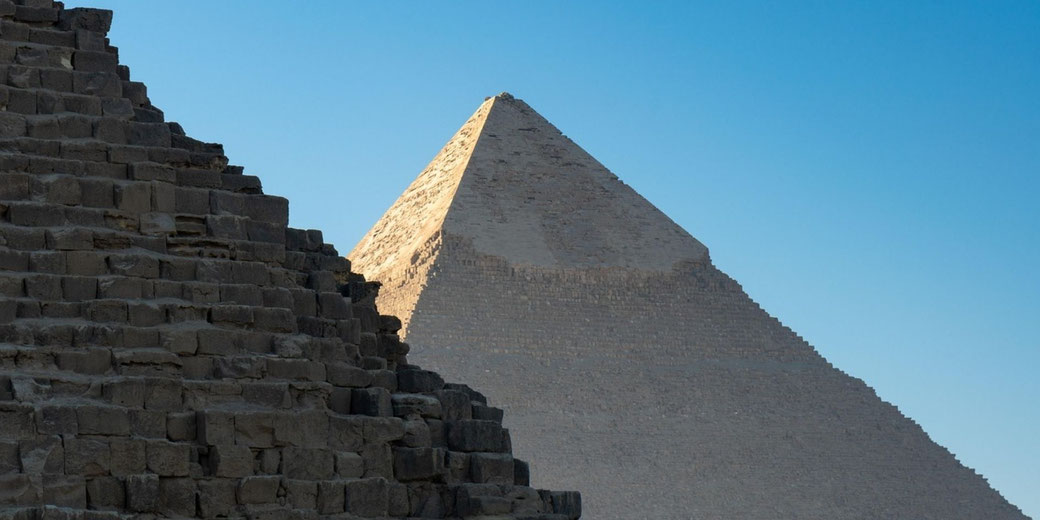
This collection of historical sources offers a detailed view of early Egyptian civilisation through the writings of ancient observers and later historians who attempted to reconstruct its past.
These sources allow you to analyse how knowledge of ancient Egypt developed over time, and to assess the reliability, purpose, and limitations of each account within its historical setting.
Source 1
Extract A:
"The first human king of Egypt, he said, was Min [‘Menes’ in Greek, or ‘Narmer’ in Egyptian]. In his time all Egypt save the Thebaic province was a marsh: all the country that we now see was then covered by water, north of the lake Moeris, which lake is seven days' journey up the river from the sea."
Extract B:
"For even though a man has not before been told it he can at once see, if he have sense, that that Egypt to which the Greeks sail is land acquired by the Egyptians, given them by the river — not only the lower country but even all the land to three days' voyage above the aforesaid lake."
Extract C:
"Beyond and above Heliopolis Egypt is a narrow land. For it is bounded on the one side by the mountains of Arabia, which bear from the north to the south, ever stretching southward towards the sea called the Red Sea. … On the side of Libya Egypt [the Sahara desert] is bounded by another range of rocky mountains, wherein are the pyramids; this is all covered with sand, and it runs in the same direction as those Arabian hills that bear southward."
Extract D:
"Therefore, as to Egypt, I believe those who so speak, and I am myself fully so persuaded; for I have seen that Egypt projects into the sea beyond the neighbouring land … it is a land of black and crumbling earth, as if it were alluvial deposit carried down the river from Aethiopia; but we know that the soil of Libya is redder and somewhat sandy, and Arabia and Syria are lands rather of clay and stones."
Extract E:
"Now, indeed, there are no men, neither in the rest of Egypt, nor in the whole world, who gain from the soil with so little labour; they have not the toil of breaking up the land with the plough, nor of hoeing, nor of any other work which other men do to get them a crop; the river rises of itself, waters the fields, and then sinks back again; thereupon each man sows his field and sends swine into it to tread down the seed, and waits for the harvest; then he makes the swine to thresh his grain, and so garners it."
Contextual information:
Herodotus was a Greek historian from Halicarnassus (in modern Turkey) who lived in the fifth century BCE and is often called "the Father of History." He travelled to Egypt around 450 BCE and recorded his observations and the accounts given to him by Egyptian priests in Book II of his Histories, which is the earliest surviving Greek prose account of Egyptian geography, customs, and kingship.
Bibliographical reference:
Herodotus. (1920). Histories (A. D. Godley, Trans.; Vol. I, Book II, §§4, 5, 8, 12, 14, pp. 279, 281, 283, 289, 289–291). William Heinemann. (Original work written ca. 440 BCE).
Copyright: Public domain.
Source 2
Extract A:
"Egypt had from the first a broad road driven through it from end to end—a road seven hundred miles long, and seldom much less than a mile wide—which allowed of ready and rapid communication between the remotest parts of the kingdom."
Extract B:
"Rivers, indeed, are of no use as arteries of commerce or vehicles for locomotion until men have invented ships or boats, or at least rafts, to descend and ascend them; but the Egyptians were acquainted with the use of boats and rafts from a very remote period, and took to the water like a brood of ducks or a parcel of South Sea Islanders. Thirty-two centuries ago an Egyptian king built a temple on the confines of the Mediterranean entirely of stone which he floated down the Nile for six hundred and fifty miles from the quarries of Assouan (Syêné); and the passage up the river is for a considerable portion of the year as easy as the passage down. Northerly winds—the famous 'Etesian gales'—prevail in Egypt during the whole of the summer and autumn, and by hoisting a sail it is almost always possible to ascend the stream at a good pace. If the sail be dropped, the current will at all times take a vessel down-stream; and thus boats, and even vessels of a large size, pass up and down the water-way with equal facility."
Extract C:
"The great wastes on either side of the Nile valley are in no sense Egypt, neither the undulating sandy [Sahara] desert to the west, nor the rocky and gravelly highland to the east, which rises in terrace after terrace to a height, in some places, of six thousand feet. Both are sparsely inhabited, and by tribes of a different race from the Egyptian."
Extract D:
"Specially characteristic of Egypt, though not altogether peculiar to it, were the papyrus and the lotus—the Cyperus papyrus and Nymphæa lotus of botanists. The papyrus was a tall smooth reed, with a large triangular stalk containing a delicate pith, out of which the Egyptians manufactured their paper. The fabric was excellent, as is shown by its continuance to the present day, and by the fact that the Greeks and Romans, after long trial, preferred it to parchment."
Extract E:
"The Egyptians themselves taught that the first man of whom they had any record was a king called M'na, a name which the Greeks represented by Mên or Menes. M'na was born at Tena (This or Thinis) in Upper Egypt, where his ancestors had borne sway before him. He was the first to master the Lower country, and thus to unite under a single sceptre the 'two Egypts'—the long narrow Nile valley and the broad Delta plain. Having placed on his head the double crown which thenceforth symbolized dominion over both tracts, his first thought was that a new capital was needed."
Contextual information:
George Rawlinson (1812–1902) was Camden Professor of Ancient History at the University of Oxford and one of the foremost British Assyriologists and ancient historians of the nineteenth century. His Ancient Egypt was published as part of the "Story of the Nations" series, a popular historical collection intended for an educated general readership.
Bibliographical reference:
Rawlinson, G. (1886). Ancient Egypt (10th ed., pp. 4–5, 12–13, 17, 48–49). T. Fisher Unwin.
Copyright: Public domain.
Source 3
"Papyrus then grows in the swamps of Egypt or else in the sluggish waters of the Nile where they have overflowed and lie stagnant in pools not more than about three feet in depth; it has a sloping root as thick as a man's arm, and tapers gracefully up with triangular sides to a length of not more than about 15 feet, ending in a head like a thyrsus; it has no seed, and is of no use except that the flowers are made into wreaths for statues of the gods. The roots are employed by the natives for timber, and not only to serve as firewood but also for making various utensils and vessels; indeed the papyrus itself is plaited to make boats, and the inner bark is woven into sail-cloth and matting, and also cloth, as well as blankets and ropes."
Contextual information:
Gaius Plinius Secundus (Pliny the Elder, 23–79 CE) was a Roman military commander, administrator, and natural philosopher who compiled the Natural History, a 37-volume encyclopaedia covering the natural world as known to the Romans. Book XIII deals with plants, and Pliny's account of papyrus is the most detailed surviving ancient description of how the plant was grown, harvested, and used along the Nile.
Bibliographical reference:
Pliny the Elder. (1855). The natural history (J. Bostock & H. T. Riley, Trans.; Vol. III, Book XIII, ch. 22, §§68–72). Henry G. Bohn. (Original work written ca. 77 CE).
Copyright: Public domain.
Source 4
Extract A:
"Manetho, an Egyptian priest of the early Ptolemaic age, wrote a history of his country in Greek, dividing the long succession of Pharaohs whom he found in the native records into thirty royal houses or dynasties, an arrangement which we still follow, although it is now known that it is often quite arbitrary."
Extract B:
"The history of Egypt thus falls into a series of well-marked periods. After the long and slow development of the prehistoric age there emerges, with the rise of the First Dynasty, the Old Kingdom, the age of the pyramid-builders, which closes with the Sixth Dynasty. There follows a dark period of disintegration [known as the First Intermediate Period], until at length the princes of Thebes restore the unity of the land and inaugurate the Middle Kingdom, the feudal age, of which the Twelfth Dynasty is the most brilliant epoch. Again the kingdom falls, this time before foreign invaders, the Hyksos; and only with their expulsion by the Theban Eighteenth Dynasty does Egypt enter upon her third great period, the [New Kingdom] Empire, the age of her widest dominion and her highest splendour."
Extract C:
"With the close of the Sixth Dynasty the strong central government of the Old Kingdom rapidly disintegrated. … There ensued a long period of weakness and obscurity [First Intermediate Period], during which the great office of Pharaoh was little more than a name, and the local nomarchs ruled their nomes as petty kings. Of this dark age between the fall of the Old Kingdom and the rise of the Middle Kingdom we know almost nothing; the monuments are silent, and the royal lists give us only a confused succession of ephemeral kings."
Contextual information:
James Henry Breasted (1865–1935) was an American archaeologist and historian at the University of Chicago who became the first professor of Egyptology in the United States. His A History of Egypt (1905) was the standard English-language textbook on Egyptian history for much of the early twentieth century, drawing on his own translations of hieroglyphic inscriptions and on Manetho's dynastic framework.
Bibliographical reference:
Breasted, J. H. (1905). A history of Egypt from the earliest times to the Persian conquest (pp. 14, 16–17, 147–148). Charles Scribner's Sons.
Copyright: Public domain.
Source 5
"It is the Thinite Menes, whom the Theban annalists point out as the ancestor of the glorious Pharaohs of the XVIII dynasty: it is he also who is inscribed in the Memphite chronicles, followed by Manetho, at the head of their lists of human kings, and all Egypt for centuries acknowledged him as its first mortal ruler."
Contextual information:
Gaston Maspero (1846–1916) was a French Egyptologist who served as Director-General of Excavations and Antiquities for the Egyptian government. His The Dawn of Civilization was a major scholarly work that synthesised archaeological findings and ancient textual records to reconstruct the earliest periods of Egyptian and Near Eastern history.
Bibliographical reference:
Maspero, G. (1894). The dawn of civilization: Egypt and Chaldæa (M. L. McClure, Trans.; A. H. Sayce, Ed.). Society for Promoting Christian Knowledge.
Copyright: Public domain.
Source 6
Extract A:
"It is said that the asp [snake] was brought with those figs and leaves and lay hidden beneath them, for thus Cleopatra had given orders, that the reptile might fasten itself upon her body without her being aware of it. But when she took away some of the figs and saw it, she said: 'There it is, you see,' and baring her arm she held it out for the bite. But others say that the asp was kept carefully shut up in a water jar, and that while Cleopatra was stirring it up and irritating it with a golden distaff it sprang and fastened itself upon her arm. But the truth of the matter no one knows; for it was also said that she carried about poison in a hollow comb and kept the comb hidden in her hair; and yet neither spot nor other sign of poison broke out upon her body."
Extract B:
"But Caesar, although vexed at the death of the woman, admired her lofty spirit; and he gave orders that her body should be buried with that of Antony in splendid and regal fashion. Her women also received honourable interment by his orders. When Cleopatra died she was forty years of age save one, had been queen for two and twenty of these, and had shared her power with Antony more than fourteen."
Contextual information:
Plutarch (c. 46–119 CE) was a Greek philosopher and biographer from Chaeronea in Boeotia. He wrote Parallel Lives, a series of paired biographies of famous Greeks and Romans, and his Life of Antony provides the most detailed surviving ancient account of Cleopatra VII's death in 30 BCE, which ended the Ptolemaic dynasty and brought Egypt under direct Roman rule.
Bibliographical reference:
Plutarch. (1920). Life of Antony (B. Perrin, Trans.; Vol. IX, §86). William Heinemann. (Original work written ca. 110 CE).
Copyright: Public domain.