
Historical sources on Hatshepsut
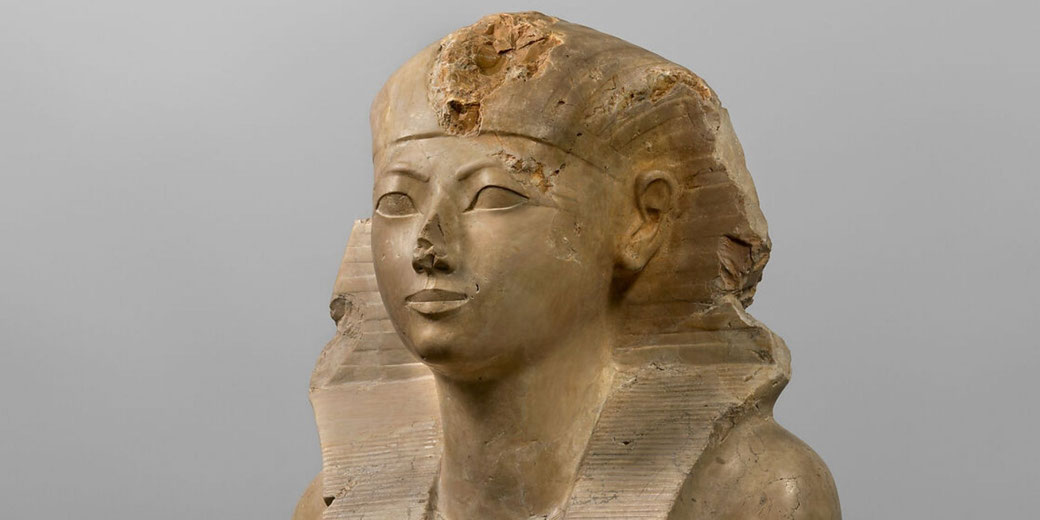
Hatshepsut was one of the most remarkable rulers of Egypt’s Eighteenth Dynasty, and the sources about her reign reveal how carefully she presented her right to power.
After the death of Thutmose II, she first managed royal affairs for the young Thutmose III, then took on the full titles and imagery of a pharaoh.
The inscriptions from her mortuary temple at Deir el-Bahri show how she used religious claims, especially her supposed birth from Amon, to justify her kingship, while other sources record her expedition to Punt, her major building projects, and the powerful officials who worked for her, such as Senmut.
Source 1
"He [Thutmose II] went forth to heaven in triumph, having mingled with the gods. His son stood in his place as king of the Two Lands, having become ruler upon the throne of the one who begat him. His sister the Divine Consort [the title held by the principal wife of the pharaoh, equivalent to what modern scholars call 'God's Wife of Amun'], Hatshepsut, settled the affairs of the Two Lands by reason of her plans. Egypt was made to labour with bowed head for her, the excellent seed of the god, which came forth from him."
Contextual information:
Ineni was an architect and official who held positions at the Egyptian court under four successive pharaohs of the Eighteenth Dynasty, from Amenhotep I through to the joint reign of Thutmose III and Hatshepsut. His autobiographical tomb inscription at Thebes records his own career and the major political transitions he witnessed, making it one of the few surviving accounts from someone who was actually present at the Egyptian court during this period. The inscription was carved on the wall of his tomb and was translated by American Egyptologist James Henry Breasted in 1906 as part of his landmark collection of Egyptian historical documents.
Bibliographical reference:
Ineni. Biography of Ineni: IV. Career under Thutmose III and Hatshepsut [Inscription, translated by J. H. Breasted]. In J. H. Breasted (Trans. & Ed., 1906), Ancient records of Egypt: Historical documents from the earliest times to the Persian conquest (Vol. II, §340, pp. 142-143). University of Chicago Press. (Original inscription carved ca. 1479-1457 BCE)
Copyright: Public domain.
Source 2
"He [the god Amon] made his form like the majesty of this husband, the King Okheperkere [Thutmose I]. Then he went to her immediately; he had intercourse with her. — — Then the majesty of this god did all that he desired with her — — She was glad when she beheld him — — His dew [a term used in ancient Egyptian to refer to the divine essence the god passed to the queen] flooded all her members."
"Words of Amon-Re [the king of the gods and chief deity of Thebes]: Khnemet-Amon-Hatshepsut [meaning 'United with Amon, the Foremost of Women'] shall be the name of this my daughter, whom I have placed in thy body, this saying which comes out of thy mouth. She shall exercise the excellent kingship in this whole land."
Contextual information:
This text records scenes carved on the walls of Hatshepsut's mortuary temple at Deir el-Bahri, on the west bank of the Nile opposite Thebes. The reliefs depict the god Amon visiting Queen Ahmose [Hatshepsut's mother and the wife of Thutmose I] in the form of Thutmose I himself, fathering Hatshepsut. Amon then declares her name and her future role as ruler. [Note: scholars today understand this as a political and religious declaration rather than a literal historical event; Hatshepsut used the story to justify her rule as pharaoh.] The inscription was translated by James Henry Breasted in his landmark collection of Egyptian historical documents.
Bibliographical reference:
Hatshepsut [inscription author]. The birth of Queen Hatshepsut: III. Amon with Queen Ahmose; IX. Presentation of the child to Amon [Wall reliefs, translated by J. H. Breasted]. In J. H. Breasted (Trans. & Ed., 1906), Ancient records of Egypt: Historical documents from the earliest times to the Persian conquest (Vol. II, §§196, 198, pp. 78-80). University of Chicago Press. (Original inscription carved ca. 1473-1458 BCE)
Copyright: Public domain.
Source 3
"The loading of the ships very heavily with marvels of the country of Punt; all goodly fragrant woods of God's-Land [the ancient Egyptian name for the region of Punt, believed to be located on the coast of East Africa or the Arabian Peninsula], heaps of myrrh-resin, with fresh myrrh trees, with ebony and pure ivory, with green gold of Emu, with cinnamon wood, khesyt wood [types of aromatic timber], with two kinds of incense, eye-cosmetics, with apes, monkeys, dogs, and with skins of the southern panther, with natives and their children. Never was brought the like of this for any king who has been since the beginning."
Contextual information:
This text is part of a series of reliefs carved on the walls of Hatshepsut's mortuary temple at Deir el-Bahri [her memorial temple, not her tomb; her actual tomb was cut into the rock of the Valley of the Kings nearby, in the site now known as KV20], and it records the expedition she sent to the land of Punt, most likely during around the ninth year of her reign. The expedition returned with luxury goods and exotic animals that Hatshepsut presented as offerings to the god Amon at Karnak. The inscription was translated by James Henry Breasted in his comprehensive collection of Egyptian historical documents.
Bibliographical reference:
Hatshepsut [inscription author]. The Punt reliefs: IV. Loading the vessels [Wall reliefs, translated by J. H. Breasted]. In J. H. Breasted (Trans. & Ed., 1906), Ancient records of Egypt: Historical documents from the earliest times to the Persian conquest (Vol. II, §§263-265, pp. 103-112). University of Chicago Press. (Original inscription carved ca. 1458 BCE)
Copyright: Public domain.
Source 4
"Hereditary prince [a high-ranking title in the Egyptian court], count, seal-bearer of the king of Lower Egypt, sole companion, great steward of the king, steward of Amon, chief steward of the queen [Hatshepsut], superintendent of the storehouse of Amon, overseer of the cattle of Amon, overseer of the garden of Amon, overseer of the works of Amon, overseer of the double granary of Amon, overseer of the fields of Amon, chief spokesman of the king in the whole land, who reports the affairs of the Two Lands — Senmut."
Contextual information:
Senmut was the most powerful official at Hatshepsut's court and accumulated an unusually long list of official titles during her reign, including steward of her personal estates and overseer of major royal building projects. This text is drawn from the inscriptions on a statue of Senmut discovered at Karnak, which records his many offices and titles in the Egyptian administration. The statue inscription, along with related inscriptions on a second statue now in Berlin, was translated by James Henry Breasted in his landmark collection of Egyptian historical documents.
Bibliographical reference:
Senmut [inscription author]. Inscriptions of Senmut: I. Inscriptions on the Karnak statue [Statue inscriptions, translated by J. H. Breasted]. In J. H. Breasted (Trans. & Ed., 1906), Ancient records of Egypt: Historical documents from the earliest times to the Persian conquest (Vol. II, §§349-358, pp. 144-148). University of Chicago Press. (Original inscription carved ca. 1479-1458 BCE)
Copyright: Public domain.
Source 5
"Thutmose I was thus the father of Hatshepsut, who was later to seize the throne; and these children of the chief queen were, of course, of pure royal blood on both sides, both father and mother being of the royal line. The heiress was Hatshepsut, and any man whom she married thereby became Pharaoh. Hence Thutmose I selected as his successor and as the husband of Hatshepsut, a son born to him by a secondary wife. This son, Thutmose II, therefore married his half-sister Hatshepsut and became Pharaoh."
"Hatshepsut was now obliged to assume the title of 'God's Wife,' which had gradually grown into a position of great influence in the Amon priesthood. Just as the Pharaoh was regarded as the son of the Sun-god, so the queen was his consort in a divine sense, and the position was one of great distinction and influence at the Theban court."
"The great temple of Amon at Karnak was the dominating sanctuary of the empire, the wealthiest and most powerful in the land. It lay on the east bank of the Nile, just north of the modern town of Luxor. Here were concentrated the richest offerings and tribute from every campaign of the conquering Pharaohs, and here the great priesthood of Amon wielded a power which eventually rivalled that of the Pharaoh himself."
"Thutmose III, who now became sole Pharaoh, could not forgive the woman who had so long excluded him from his inheritance. In revenge he endeavoured to obliterate every trace of her, and erased her name from all her monuments, inserted his own or that of Thutmose I or II in its place, and overthrew her statues. He did not remove her great obelisks at Karnak, but he walled them up in a massive masonry screen so that they could no longer be seen."
Contextual information:
James Henry Breasted (1865-1935) was an American Egyptologist and the first professor of Egyptology in the United States. He held the chair of Egyptology and Oriental History at the University of Chicago and was the founder of the Oriental Institute. His book A History of Egypt, first published in 1905, drew directly on his own translations of the original Egyptian inscriptions and remained the standard English-language account of ancient Egyptian history for many decades.
Bibliographical reference:
Breasted, J. H. (1905). A history of Egypt from the earliest times to the Persian conquest (pp. 268, 270, 344-345). Charles Scribner's Sons.
Copyright: Public domain.