
Historical sources on ancient Greek funerary practices
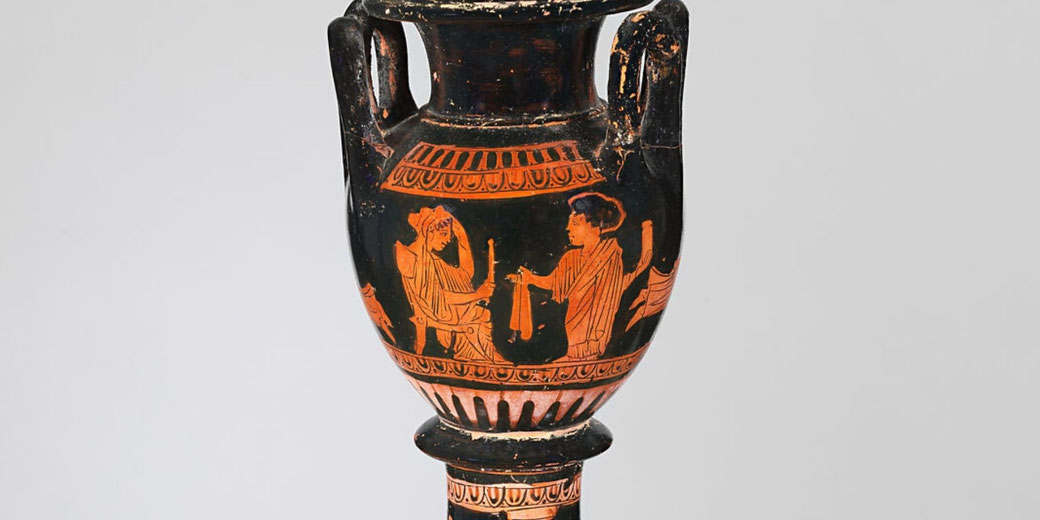
Ancient Greek funerals followed a series of customs that honoured the dead and prepared them for the journey into the underworld.
These sources examine beliefs about Charon, the ferryman who carried souls across the rivers of the underworld, as well as the idea of Elysium as a peaceful destination for certain individuals after death.
They also explore the Greek concept of the psyche, the separation of the soul from the body, and the main stages of an Athenian funeral, including the prothesis, the ekphora, and cremation on a funeral pyre.
Source 1
"(Χάρων [Charon]), a son of Erebos [a god of darkness], the aged and dirty ferryman in the lower world, who conveyed in his boat the shades of the dead — though only of those whose bodies were buried — across the rivers of the lower world. For this service he was paid by each shade with an obolus or danace [a small coin], which coin was placed in the mouth of every dead body previous to its burial. This notion of Charon seems to be of late origin, for it does not occur in any of the early poets of Greece. Charon was represented in the Lesche [meeting hall] of Delphi by Polygnotus [a famous Greek painter of the 5th century BCE].”
Contextual information:
William Smith was a British classical scholar who edited several major reference works on Greek and Roman civilisation in the mid-19th century. The Dictionary of Greek and Roman Biography and Mythology was published in three volumes in London between 1844 and 1849, with entries compiled by specialists drawing on ancient Greek and Roman sources. Smith produced the work to make classical knowledge accessible to English readers at a time of growing interest in ancient history.
Bibliographical reference:
Smith, W. (Ed.). (1849). A Dictionary of Greek and Roman biography and mythology (Vol. 1, entry "Charon"). John Murray.
Copyright: Public domain.
Source 2
"As for your own end, Menelaus, you shall not die in Argos, but the gods will take you to the Elysian plain, which is at the ends of the world. There fair-haired Rhadamanthus [a son of Zeus who became a judge in the underworld] reigns, and men lead an easier life than any where else in the world, for in Elysium there falls not rain, nor hail, nor snow, but Oceanus breathes ever with a West wind that sings softly from the sea, and gives fresh life to all men. This will happen to you because you have married Helen, and are Zeus' son-in-law."
[Note: In the wider Greek tradition, entry to Elysium was open to those who had lived virtuously or heroically, and was not limited to relatives of the gods. Homer here describes it as a blessed place of perfect weather and ease, set apart from the darker regions of the underworld.]
Contextual information:
Homer was an ancient Greek poet, traditionally dated to around the 8th century BCE, to whom the two great epic poems the Iliad and the Odyssey are attributed. The Odyssey describes the ten-year journey of the hero Odysseus after the fall of Troy. In this passage from Book IV, the sea-god Proteus delivers a prophecy about the fate of Menelaus, king of Sparta, after his death.
Bibliographical reference:
Homer. The Odyssey (S. Butler, Trans., 1900; Book IV). The Internet Classics Archive, MIT. (Original work composed ca. 8th century BCE)
Copyright: Public domain.
Source 3
"And what is that which is termed death, but this very separation and release of the soul from the body?"
"And what is purification but the separation of the soul from the body, as I was saying before; the habit of the soul gathering and collecting herself into herself, out of all the courses of the body; the dwelling in her own place alone, as in another life, so also in this, as far as she can; the release of the soul from the chains of the body?"
[Note: The Greek word for "soul" in this text is psyche (ψυχή). Plato wrote the Phaedo as a philosophical discussion in which Socrates argues that the soul is immortal and separates from the body at the moment of death.]
Contextual information:
Plato was an Athenian philosopher who lived from around 428 to 348 BCE and was a student of Socrates. The Phaedo records a conversation Socrates had with his friends on the day of his execution in 399 BCE, in which he argued for the immortality of the soul. Plato wrote the dialogue shortly after Socrates' death as both a philosophical argument and a tribute to his teacher.
Bibliographical reference:
Plato. Phaedo (B. Jowett, Trans, 1892.). In The Dialogues of Plato (3rd ed.). Oxford University Press. (Original work written ca. 360 BCE)
Copyright: Public domain.
Source 4
Extract A (Section 70: The Preliminaries of a Funeral [prothesis]; the obol)
"The customary obol [a small bronze coin, placed in the mouth of the deceased to pay the ferryman Charon for passage across the river to the underworld] is put in the mouth of the corpse, and the body is carefully washed in perfumed water, clothed in festal white; then woolen fillets [bands of cloth] are wound around the head, and over these a crown of vine leaves. So arrayed, the body is ready to be laid out on a couch in the front courtyard of the house, with the face turned toward the door so as to seem to greet everybody who enters."
[Note: This stage of the funeral, the laying-out of the body for mourners to pay their respects, was called the prothesis (πρόθεσις). It is the first formal stage of the Athenian funeral.]
Extract B (Section 72: The Funeral Procession [ekphora]; the lekythos)
"The day after the 'laying-out' comes the actual funeral. Normally it is held as early as possible in the morning, before the rising of the sun.... The youngest and stoutest of the male relatives carry the litter.... Ahead of the bier march the screaming flute players, earning their fees by no melodious din. Then comes the litter itself with the corpse arrayed magnificently for the finalities, a honey cake set in the hands, a flask of oil [a small vessel called a lekythos, used to hold perfumed olive oil for offerings to the dead] placed under the head. After this come streaming the relatives in irregular procession...."
[Note: This funeral procession from the house to the burial site was called the ekphora (ἐκφορά). It was the second formal stage of the Athenian funeral.]
Extract C (Section 73: The Funeral Pyre; cremation and the urn)
"Here the great funeral pyre of choice dry fagots [bundles of wood], intermixed with aromatic cedar, has been heaped. The bier is laid thereon.... A mighty blaze leaps up to heaven, sending its ruddy brightness against the sky now palely flushed with the bursting dawn.... As soon as these are cool enough for safety (a process hastened by pouring on water or wine) the charred bones of the deceased are tenderly gathered up to be placed in a stately urn."
[Note: This was the standard Athenian practice in the classical period. Burial in the ground was also practised at other times and in other regions of Greece.]
Contextual information:
William Stearns Davis was an American historian and Professor of Ancient History at the University of Minnesota. A Day in Old Athens was published in 1914 as a detailed reconstruction of daily life in ancient Athens around 360 BCE, drawing on ancient Greek literary sources. Davis wrote the book for students with a basic knowledge of ancient history, aiming to convey what the city would have looked and felt like to an ordinary inhabitant.
Bibliographical reference:
Davis, W. S. (1914). A day in old Athens: A picture of Athenian life (Chapter XI, Sections 70, 72, 73, pp. 84, 86, 87). Allyn and Bacon.
Copyright: Public domain.
Source 5
Extract A
"Another common use of the lekythos was to anoint the bodies of the dead. After the anointing had been performed, the vessels used were placed near the body during the laying out (πρόθεσις [prothesis]), and were then buried or burned with the corpse. Large numbers of lekythoi have been found in tombs or in a charred condition, in places where funeral-piles had been erected."
[Note: A lekythos (λήκυθος) was a small, narrow-necked jar used to hold olive oil or perfumed oil. In a funerary context, it was used to anoint the body of the deceased and was then placed with the body for burial or cremation.]
Extract B
"It was also the custom to bring offerings to the tomb on certain days in each year. Herodotus mentions that these annual sacrifices to the dead were called γενέσια [genesia] (4.26), from which it is inferred that they were offered on the birthday of the deceased. The name νεκύσια [nekusia, meaning rites for the dead] was also used in the same sense. The ceremonies which were performed at these stated intervals might be used at any other time, if for some reason it was necessary to appease [calm] the departed spirit."
[Note: The Genesia was an annual festival at Athens for honouring the dead. Herodotus, the ancient Greek historian writing in the 5th century BCE, is the earliest source to use this name.]
Contextual information:
William Smith edited A Dictionary of Greek and Roman Antiquities across several editions from 1842, with the final third edition published by John Murray in London in 1890. The dictionary compiled entries by specialist scholars and was designed as a comprehensive reference on the material culture and customs of ancient Greece and Rome. Smith based entries on ancient literary and archaeological evidence.
Bibliographical reference:
Smith, W. (Ed.). (1890). A Dictionary of Greek and Roman antiquities (3rd ed., entry "Ampulla," p. 93, 888). John Murray.
Copyright: Public domain.