
Historical sources on ancient Roman gladiators
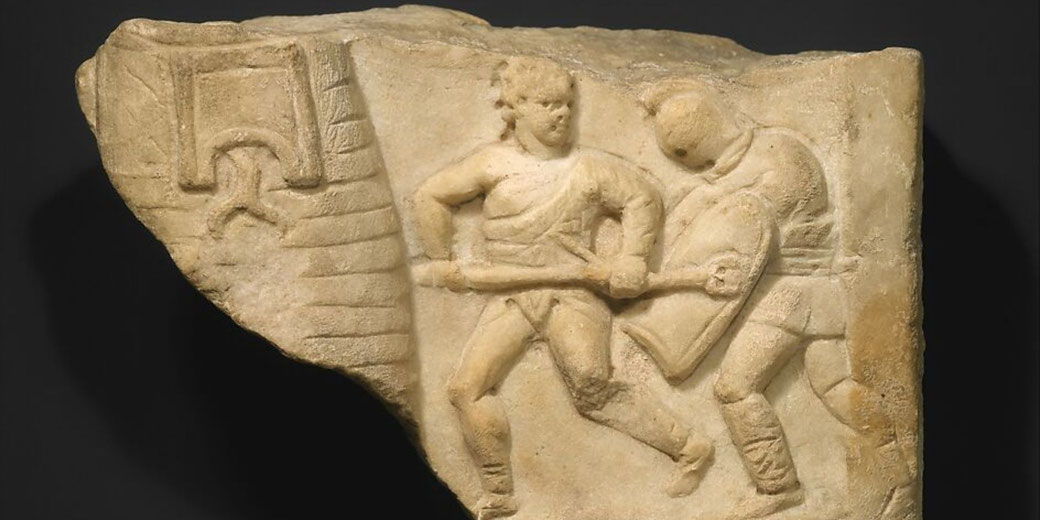
Gladiators are among the most famous figures from ancient Rome, but the historical sources show that their lives were tied to training, social status, public entertainment, violence, and imperial control.
These extracts help explain where gladiators fought, who became gladiators, how they were trained, what equipment they used, and how Roman crowds influenced the fate of defeated fighters.
Source 1
"No mere measures can give an adequate conception of this vast structure, the dimensions and arrangements of which were such as to furnish seats for 87,000 spectators [modern archaeological estimates put the figure at closer to 50,000], round an arena large enough to afford space for the combats of several hundred animals at once, for the evolutions of mimic sea-fights, and for the exhibition of artificial forests; with passages and staircases to give ingress and egress, without confusion, to the immense mass of spectators, and others for the attendants on the arena; dens for the thousands of victims devoted to destruction; channels for the rapid influx and outlet of water when the arena was used for a naumachia [a staged sea battle]; and the means for the removal of the carcasses, and the other abominations [disgusting activities] of the arena."
Contextual information:
William Smith was a British classical scholar who edited A Dictionary of Greek and Roman Antiquities, first published in 1842 and revised through several editions to 1875. The article on the amphitheatre was written by Philip Smith, a scholar at the University of London, drawing on ancient literary sources and the architectural evidence of the building itself. The Flavian Amphitheatre, now known as the Colosseum, was built by the emperors Vespasian and Titus and was dedicated in 80 CE.
Bibliographical reference:
Smith, W. (Ed.). (1875). A Dictionary of Greek and Roman Antiquities: Amphitheatrum (P. Smith, author; p. 84, 574-576). John Murray.
Copyright: Public domain.
Source 2
"Gladiators consisted either of captives [prisoners of war] (Vopisc. Prob. 19), slaves (Suet. Vitell. 12), and condemned malefactors [criminals], or of freeborn citizens who fought voluntarily. Of those who were condemned, some were said to be condemned ad gladium [to the sword], in which case they were obliged to be killed at least within a year; and others ad ludum [to the school], who might obtain their discharge at the end of three years. Freemen who became gladiators for hire were called auctorati [volunteers under contract], and their hire auctoramentum or gladiatorium. They also took an oath on entering upon the service, similar to that which is preserved by Petronius (117): 'In verba Eumolpi sacramentum juravimus, uri, vinciri, verberari, ferroque necari' [we swore an oath on the words of Eumolpus to be burned, chained, beaten, and killed by the sword]. Even under the republic free-born citizens fought as gladiators (Liv. 28.21), but they appear to have belonged only to the lower orders, and the profession was considered degrading, though to some it had many attractions. Under the empire, however, both equites [knights] and senators fought in the arena, and even women; a practice which was at length forbidden in the time of Severus."
"Gladiators were kept in schools (ludi [training grounds]), where they were trained by persons called lanistae [gladiatorial trainers and owners] (Suet. Jul. 26; Cic. pro Rosc. Amer. 40, 118; Juv. 6.216, 11.8). The whole body of gladiators under one lanista was frequently called familia [household] (Suet. Aug. 42). They sometimes were the property of the lanistae, who let them out to persons who wished to exhibit a show of gladiators; but at other times belonged to citizens, who kept them for the purpose of exhibition, and engaged lanistae to instruct them."
"When a gladiator was wounded, the people called out habet or hoc habet [he has it, i.e., he is struck]; and the one who was vanquished [defeated] lowered his arms in token of submission. His fate, however, depended upon the people, who turned up their thumbs if they wished him to be killed (Hor. Ep. 1.18, 66; Juv. 3.36), and ordered him to receive the sword (ferrum recipere [to receive the iron]), which gladiators usually did with the greatest firmness. If the life of a vanquished gladiator was spared, he obtained his discharge for that day, which was called missio [release]; and hence in an exhibition of gladiators sine missione [without release] (Liv. 41.20), the lives of the conquered were never spared. This kind of exhibition, however, was forbidden by Augustus (Suet. Aug. 45)."
"Dimachaeri appear to have been so called, because they fought with two swords (Artemid. 2.32; Orelli, Inscr. 2584.)"
"Hoplomachi appear to have been those who fought in a complete suit of armour [heavy military armour, similar to that of a Greek hoplite soldier]. (Suet. Cal. 35; Martial, 8.74; Orelli, 2566.) Lipsius considers them to have been the same with the Samnites, and that this name was disused under the emperors, and hoplomachi substituted for it."
"Retiarii carried only a three-pointed lance, called tridens or fuscina [a trident], a dagger, and a net (rete [a net]), which they endeavoured to throw over their adversaries, and then to attack them with the fuscina while they were entangled. The retiarius [net-fighter] was dressed in a short tunic, and wore nothing on his head. If he missed his aim in throwing the net, he betook himself to flight, and endeavoured to prepare his net for a second cast, while his adversary followed him round the arena in order to kill him before he could make a second attempt. His adversary was usually a secutor [pursuer] or a myrmillo [a heavily armed gladiator]. (Juv. 2.143, 8.203; Suet. Cal. 30, Claud. 34; Orelli, 2578.)"
"Samnites were so called because they were armed in the same way as that people [the Samnites, a warrior tribe from the mountains of central Italy who fought Rome in the fourth and third centuries BCE], with a helmet with a high crest (Juv. 6.256), and were particularly distinguished by the oblong scutum [a large rectangular shield]. (Cf. Overbeck's Pompeii, p. 164; Liv. 9.40; Cic. pro Sest. 64, 154.) [Note: The Samnite gladiatorial type was later replaced under the Roman Empire by the hoplomachus, as noted in the extract above.]"
Contextual information:
William Smith was a British classical scholar who edited A Dictionary of Greek and Roman Antiquities, first published in 1842 and revised through several editions to 1875. The article on gladiators draws on a wide range of ancient literary sources. The dictionary was a leading reference work on classical antiquity for several decades.
Bibliographical reference:
Smith, W. (Ed.). (1875). A Dictionary of Greek and Roman Antiquities: Gladiatores (pp. 574-576). John Murray.
Copyright: Public domain.
Source 3
"glădĭus ... I. a sword (syn. the poet. ensis, acc. to Quint. 10, 1, 11; cf. also: spatha, acinaces, sica, pugio)."
"glădiātor ... a swordsman, gladiator (one who fought with a sword in the arena for the amusement of the people)."
Contextual information:
Charlton T. Lewis and Charles Short compiled A Latin Dictionary, first published by Oxford's Clarendon Press in 1879, as a revised and expanded edition of an earlier work by Andrews based on Freund's German dictionary. It is a standard reference for classical Latin vocabulary. The entries for gladius and gladiator record the core meanings of the Latin words from which "gladiator" is derived.
Bibliographical reference:
Lewis, C. T., and Short, C. (1879). A Latin Dictionary: gladius; gladiator. Clarendon Press.
Copyright: Public domain.
Source 4
"In fine, he followed with his interest all classes of performers who took part in the public shows; maintained the privileges of the athletes and even increased them; forbade the matching of gladiators without the right of appeal for quarter [forbade contests in which a defeated gladiator could not beg for mercy from the crowd]; and deprived the magistrates [officials] of the power allowed them by an ancient law of punishing actors anywhere and everywhere, restricting it to the time of games and to the theatre."
Contextual information:
Gaius Suetonius Tranquillus was a Roman historian and biographer who worked as secretary to Emperor Hadrian in the early second century CE. He wrote The Twelve Caesars, a collection of biographies of Roman rulers from Julius Caesar to Domitian, drawing on earlier accounts. This passage comes from his life of Augustus (reigned 27 BCE to 14 CE) and records Augustus's reforms to the gladiatorial games, including his ban on exhibitions in which defeated fighters received no mercy.
Bibliographical reference:
Suetonius. The Lives of the Caesars: Life of Augustus. (1913, J. C. Rolfe, Trans.). (Vol. I, p. 199, §45.3). William Heinemann / G. P. Putnam's Sons. (Original work written ca. 121 CE).
Copyright: Public domain.