
Historical sources on the Gallic Wars
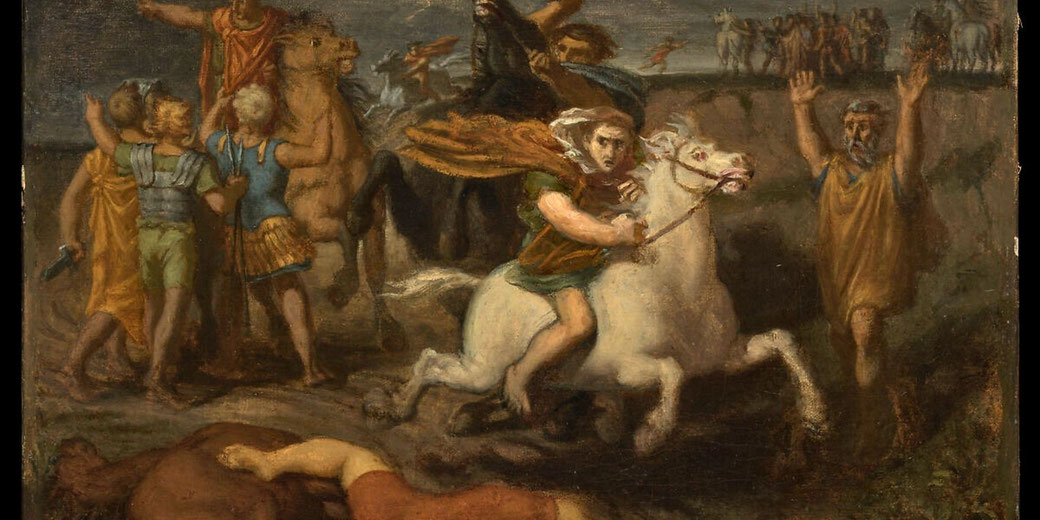
The Gallic Wars were fought between 58 and 50 BC under the command of Gaius Julius Caesar, which is one of the most thoroughly documented military campaigns of the ancient world.
However, our understanding of these events rests on a small group of surviving texts, each written for different purposes and audiences.
These following sources allow historians to examine not only the events of the Gallic Wars, but also the ways in which those events were recorded, interpreted, and used for political and cultural purposes.
Source 1
Extract A
I.2. "Among the Helvetii, Orgetorix was by far the most distinguished and wealthy. He, when Marcus Messala and Marcus Piso were consuls, incited by lust of sovereignty, formed a conspiracy among the nobility, and persuaded the people to go forth from their territories with all their possessions, [saying] that it would be very easy, since they excelled all in valor, to acquire the supremacy of the whole of Gaul."
Extract B
I.5. "After his death, the Helvetii nevertheless attempt to do that which they had resolved on, namely, to go forth from their territories. When they thought that they were at length prepared for this undertaking, they set fire to all their towns, in number about twelve — to their villages about four hundred — and to the private dwellings that remained; they burn up all the corn, except what they intend to carry with them; that after destroying the hope of a return home, they might be the more ready for undergoing all dangers."
Extract C
I.6. "Having provided every thing for the expedition, they appoint a day, on which they should all meet on the bank of the Rhone. This day was the fifth before the kalends of April [i.e. the 28th of March], in the consulship of Lucius Piso and Aulus Gabinius [B.C. 58.]"
Extract D
1.7. "When it was reported to Caesar that they were attempting to make their route through our Province he hastens to set out from the city, and, by as great marches as he can, proceeds to Further Gaul, and arrives at Geneva."
Extract E
1.26. "Thus, was the contest long and vigorously carried on with doubtful success. When they could no longer withstand the attacks of our men, the one division, as they had begun to do, betook themselves to the mountain; the other repaired to their baggage and wagons."
Extract F
I.27. "The Helvetii, compelled by the want of every thing, sent embassadors to him about a surrender. When these had met him on the way and had thrown themselves at his feet, and speaking in suppliant tone had with tears sued for peace..."
Extract G
I.28. "He ordered the Helvetii, the Tulingi, and the Latobrigi, to return to their territories from which they had come, and as there was at home nothing whereby they might support their hunger, all the productions of the earth having been destroyed, he commanded the Allobroges to let them have a plentiful supply of corn; and ordered them to rebuild the towns and villages which they had burned."
Extract H
I.33. "That, moreover, the Germans should by degrees become accustomed to cross the Rhine, and that a great body of them should come into Gaul, he saw [would be] dangerous to the Roman people, and judged, that wild and savage men would not be likely to restrain themselves, after they had possessed themselves of all Gaul, from going forth into the province and thence marching into Italy (as the Cimbri and Teutones had done before them)... Against which events he thought he ought to provide as speedily as possible."
Extract I
I.37. "At the same time that this message was delivered to Caesar, embassadors came from the Aedui and the Treviri; from the Aedui to complain that the Harudes, who had lately been brought over into Gaul, were ravaging their territories; that they had not been able to purchase peace from Ariovistus, even by giving hostages: and from the Treviri, [to state] that a hundred cantons of the Suevi had encamped on the banks of the Rhine, and were attempting to cross it; that the brothers, Nasuas and Cimberius, headed them."
Extract J
I.53. "Thereupon the engagement was renewed, and all the enemy turned their backs, nor did they cease to flee until they arrived at the river Rhine, about fifty miles from that place."
Extract K
I.54. "This battle having been reported beyond the Rhine, the Suevi, who had come to the banks of that river, began to return home, when the Ubii, who dwelt nearest to the Rhine, pursuing them, while much alarmed, slew a great number of them. Caesar having concluded two very important wars in one campaign, conducted his army into winter quarters among the Sequani, a little earlier than the season of the year required."
Extract L
IV.17. "Caesar, for those reasons which I have mentioned, had resolved to cross the Rhine; but to cross by ships he neither deemed to be sufficiently safe, nor considered consistent with his own dignity or that of the Roman people. Therefore, although the greatest difficulty in forming a bridge was presented to him, on account of the breadth, rapidity, and depth of the river, he nevertheless considered that it ought to be attempted by him, or that his army ought not otherwise to be led over."
Extract M
IV.19. "Caesar, having remained in their territories a few days, and burned all their villages and houses, and cut down their corn, proceeded into the territories of the Ubii... having spent altogether eighteen days beyond the Rhine, and thinking he had advanced far enough to serve both honor and interest, he returned into Gaul, and cut down the bridge."
Extract N
IV.20. "During the short part of summer which remained, Caesar, although in these countries, as all Gaul lies toward the north, the winters are early, nevertheless resolved to proceed into Britain, because he discovered that in almost all the wars with the Gauls succors had been furnished to our enemy from that country."
Extract O
V.1. "Lucius Domitius and Appius Claudius being consuls [54 B.C.], Caesar, when departing from his winter quarters into Italy, as he had been accustomed to do yearly, commands the lieutenants whom he appointed over the legions to take care that during the winter as many ships as possible should be built, and the old repaired."
Extract P
VII.4. "There in like manner, Vercingetorix the son of Celtillus the Arvernian, a young man of the highest power (whose father had held the supremacy of entire Gaul, and had been put to death by his fellow-citizens, for this reason, because he aimed at sovereign power), summoned together his dependents, and easily excited them."
Extract Q
VII.68. "All his cavalry being routed, Vercingetorix led back his troops in the same order as he had arranged them before the camp, and immediately began to march to Alesia, which is a town of the Mandubii, and ordered the baggage to be speedily brought forth from the camp, and follow him closely."
Contextual information:
Gaius Julius Caesar (100–44 BC) was a Roman general and politician who wrote his Commentaries on the Gallic War during and immediately after his military campaigns in Gaul between 58 and 50 BC. The work is written in the third person and functions both as a military report and as political propaganda intended for a Roman audience. It is one of the most important surviving primary sources for this period of Roman history.
Bibliographical reference:
Julius Caesar. Caesar's Gallic War (W. A. McDevitte & W. S. Bohn, Trans.; 1st ed., 1869). Harper & Brothers. (Original work written c. 50 BC).
Copyright: Public domain.
Source 2
Extract A
V.41. "As the Gauls were refreshed by a night's rest after a battle which had at no point been seriously contested, and as they were not now taking the City by assault or storm, their entrance the next day was not marked by any signs of excitement or anger. Passing the Colline gate, which was standing open, they came to the Forum and gazed round at the temples and at the Citadel, which alone wore any appearance of war. They left there a small body to guard against any attack from the Citadel or Capitol whilst they were scattered, and then they dispersed in quest of plunder through streets in which they did not meet a soul."
Extract B
V.41. "After this slaughter of the magnates, no living being was thenceforth spared; the houses were rifled, and then set on fire."
Contextual information:
Titus Livius (c. 59 BC – AD 17), known in English as Livy, was a Roman historian who wrote his monumental History of Rome during the reign of Emperor Augustus. Book 5 covers the period ending with the Gallic sack of Rome in 390 BC, an event that traumatised the Roman people and influenced their hostile attitudes toward the Gauls for centuries afterward.
Bibliographical reference:
Livy. History of Rome (Rev. Canon Roberts, Trans., 1912). E. P. Dutton and Co. (Original work written c. 27–9 BC).
Copyright: Public domain.
Source 3
Extract A
15. "Such, then, is said to have been the course of Caesar's life before his Gallic campaigns. But the period of the wars which he afterwards fought, and of the campaigns by which he subjugated Gaul, as if he had made another beginning and entered upon a different path of life and one of new achievements, proved him to be inferior as soldier and commander to no one soever of those who have won most admiration for leadership and shown themselves greatest therein...
For although it was not full ten years that he waged war in Gaul, he took by storm more than eight hundred cities, subdued three hundred nations, and fought pitched battles at different times with three million men, of whom he slew one million in hand to hand fighting and took as many more prisoners."
Extract B
27. "However, the most of the Barbarians who escaped at that time took refuge with their king in the city of Alesia. And while Caesar was besieging this city, which was thought to be impregnable by reason of the great size of its walls and the number of their defenders, there fell upon him from outside the city a peril too great for words to depict...
"Those who held Alesia, too, after giving themselves and Caesar no small trouble, finally surrendered. And the leader of the whole war, Vergentorix, after putting on his most beautiful armour and decorating his horse, rode out through the gate. He made a circuit round Caesar, who remained seated, and then leaped down from his horse, stripped off his suit of armour, and seating himself at Caesar's feet remained motionless, until he was delivered up to be kept in custody for the triumph."
Contextual information:
Plutarch (c. AD 46–120) was a Greek biographer and philosopher who wrote Parallel Lives, a series of paired biographies comparing famous Greeks with famous Romans. His Life of Caesar was written over a century after the Gallic Wars and draws on earlier sources, including Caesar's own commentaries. Plutarch's spelling "Vergentorix" follows a variant in the Greek manuscript tradition; this is the same person as Vercingetorix.
Bibliographical reference:
Plutarch. Caesar. In (B. Perrin, Trans., 1919), Plutarch's Lives (Vol. VII, pp. 443–609). Harvard University Press. (Original work written c. AD 100–120).
Copyright: Public domain.