
Historical sources on the First Triumvirate
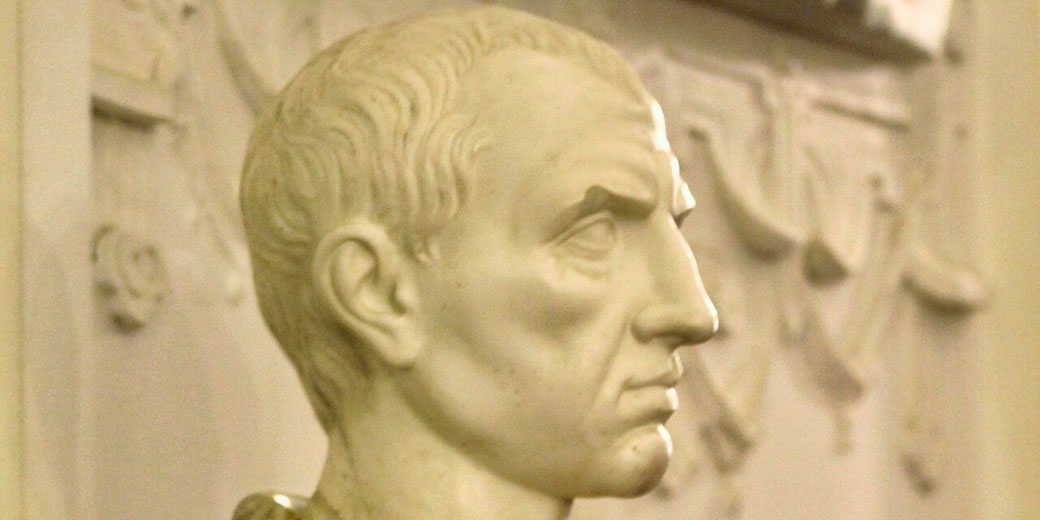
These five sources examine one of the most consequential political alliances in Roman history: the informal power-sharing arrangement between Julius Caesar, Pompey, and Marcus Crassus, known to historians as the First Triumvirate.
Formed around 60 BC, the alliance allowed three of Rome's most powerful men to dominate public life by pooling their military prestige, wealth, and popular support.
The sources presented here are drawn from the biographies of Plutarch and Suetonius and the historical writing of Appian, all working in the first and second centuries CE.
Together they offer overlapping and sometimes conflicting accounts of why the alliance was formed, how it operated, and why it eventually collapsed into civil war.
Source 1
11. "Immediately after his praetorship Caesar received Spain as his province, and since he found it hard to arrange matters with his creditors, who obstructed his departure and were clamorous, he had recourse to Crassus, the richest of the Romans, who had need of Caesar's vigour and fire for his political campaign against Pompey. And it was only after Crassus had met the demands of the most importunate and inexorable of these creditors and given surety for eight hundred and thirty talents, that Caesar could go out to his province...
13. "Now, since those who sued for the privilege of a triumph must remain outside the city, while those who were candidates for the consulship must be present in the city, Caesar was in a great dilemma, and because he had reached home at the very time for the consular elections, he sent a request to the senate that he might be permitted to offer himself for the consulship in absentiâ, through the agency of his friends. But since Cato began by insisting upon the law in opposition to Caesar's request, and then, when he saw that many senators had been won over by Caesar's attentions, staved the matter off by consuming the day in speaking, Caesar decided to give up the triumph and try for the consulship. So as soon as he entered the city he assumed a policy which deceived everyone except Cato. This policy was to reconcile Pompey and Crassus, the most influential men in the city. These men Caesar brought together in friendship after their quarrel, and by concentrating their united strength upon himself, succeeded, before men were aware of it, and by an act which could be called one of kindness, in changing the form of government. For it was not, as most men supposed, the quarrel between Caesar and Pompey that brought on the civil wars, but rather their friendship, since they worked together for the overthrow of the aristocracy in the first place, and then, when this had been accomplished, they quarrelled with one another. And Cato, who often foretold what was to come of their alliance, got the reputation of a morose and troublesome fellow at the time, but afterwards that of a wise, though unfortunate, counsellor..."
14. "Caesar, however, encompassed and protected by the friendship of Crassus and Pompey, entered the canvass for the consulship; and as soon as he had been triumphantly elected, along with Calpurnius Bibulus, and had entered upon his office, he proposed laws which were becoming, not for a consul, but for a most radical tribune of the people; for to gratify the multitude he introduced sundry allotments and distributions of land. In the senate the opposition of men of the better sort gave him the pretext which he had long desired, and crying with loud adjurations that he was driven forth into the popular assembly against his wishes, and was compelled to court its favour by the insolence and obstinacy of the senate, he hastened before it, and stationing Crassus on one side of him and Pompey on the other, he asked them if they approved his laws. They declared that they did approve them, whereupon he urged them to give him their aid against those who threatened to oppose him with swords. They promised him such aid, and Pompey actually added that he would come up against swords with sword and buckler too. [...] Pompey, however, immediately after his marriage, filled the forum with armed men and helped the people to enact Caesar's laws and give him as his consular province Gaul on both sides of the Alps for five years, together with Illyricum and four legions..."
23. "In Gaul he found letters which were about to be sent across to him. They were from his friends in Rome, and advised him of his daughter's death; she died in child-birth at Pompey's house. Great was the grief of Pompey, and great the grief of Caesar, and their friends were greatly troubled too; they felt that the relationship which alone kept the distempered state in harmony and concord was now dissolved. For the babe also died presently, after surviving its mother a few days."
Contextual information:
Plutarch was a Greek biographer and essayist who lived ca. 46–120 CE. He composed the Life of Caesar as part of his paired series of Greek and Roman biographies, drawing on earlier Roman historical accounts that are now lost. He wrote over a century after Caesar's death, but his access to earlier sources makes this one of the most detailed surviving accounts of Caesar's political career.
Bibliographical reference:
Plutarch. Life of Caesar (B. Perrin, Trans., 1919). In Plutarch's lives (Vol. 7, pp. 459–465, 469–493, 503–511). William Heinemann. (Original work ca. 100 CE)
Copyright: Public domain.
Source 2
2. "The Romans, it is true, say that the many virtues of Crassus were obscured by his sole vice of avarice; and it is likely that the one vice which became stronger than all the others in him weakened the rest. The chief proofs of his avarice are found in the way he got his property and in the amount of it. For at the outset he was possessed of not more than three hundred talents; then during his consulship he sacrificed the tenth of his goods to Hercules, feasted the people, gave every Roman out of his own means enough to live on for three months, and still, when he made a private inventory of his property before his Parthian expedition, he found that it had a value of seventy-one hundred talents. The greatest part of this, if one must tell the scandalous truth, he got together out of fire and war, making the public calamities his greatest source of revenue."
Contextual information:
Plutarch composed the Life of Crassus as a paired biography alongside the Life of Nicias, as part of the same series of parallel lives that produced the Life of Caesar. Marcus Licinius Crassus (ca. 115–53 BC) was the wealthiest man in Rome and one of the three members of the First Triumvirate; this passage comes from early in the biography where Plutarch establishes the source and scale of his fortune.
Bibliographical reference:
Plutarch. Life of Crassus (B. Perrin, Trans., 1916). In Plutarch's lives (Vol. 3, pp. 319–323). William Heinemann. (Original work ca. 100 CE)
Copyright: Public domain.
Source 3
47. "But Pompey was indignant that his acts in Asia were not ratified by the senate, while Crassus had not got what he wanted. Therefore Caesar, on his return from his province, brought about a reconciliation between them, — this was the policy that made him powerful. For by making them friends instead of enemies, as they wished to be, he concentrated in himself the power of both, and, with great sagacity, transformed what was not a democracy but an oligarchy into a monarchy. The senate and the optimates had not known how to use the power they possessed, and Caesar had made the citizens and the soldiers feel that their masters were the enemies of the people. Pompey declared that he would come against those who threatened him with swords, bringing both sword and shield..."
53. "The death of Julia also contributed to this. She had kept Pompey and Caesar in a relationship that was tolerably harmonious in spite of their differences of character and the jealousy of their partisans; but now the tie between them was removed which had been the greatest hindrance to the breaking out of civil war, for through fear of it both Pompey and Caesar had somehow or other continued to treat one another fairly. And presently the death of Crassus in Parthia also removed another obstacle to the civil war; for it had been the fear of him which kept both Pompey and Caesar in check."
Contextual information:
Plutarch wrote the Life of Pompey as a biography of Gnaeus Pompeius Magnus (106–48 BC), the celebrated Roman general whose military successes in the eastern Mediterranean made him one of the most powerful figures in Rome before the civil war. Chapters 47 and 53 deal respectively with the formation of the Triumvirate in 60 BC and the collapse of the alliance following the deaths of Julia and Crassus.
Bibliographical reference:
Plutarch. Life of Pompey (B. Perrin, Trans., 1917). In Plutarch's lives (Vol. 5, pp. 291–299, 317–323). William Heinemann. (Original work ca. 100 CE)
Copyright: Public domain.
Source 4
18. "Being allotted the province of Farther Spain after his praetorship, Caesar got rid of his creditors, who tried to detain him, by means of sureties and contrary both to precedent and law was on his way before the provinces were provided for; possibly through fear of a private impeachment or perhaps to respond more promptly to the entreaties of our allies for help. After restoring order in his province, he made off with equal haste, and without waiting for the arrival of his successor, to sue at the same time for a triumph and the consulship. But inasmuch as the day for the elections had already been announced and no account could be taken of Caesar's candidacy unless he entered the city as a private citizen, and since his intrigues to gain exemption from the laws met with general protest, he was forced to forgo the triumph, to avoid losing the consulship..."
19. "Of the two other candidates for this office, Lucius Lucceius and Marcus Bibulus, Caesar joined forces with the former, making a bargain with him that since Lucceius had less influence but more funds, he should in their common name promise largess to the electors from his own pocket. When this became known, the aristocracy authorized Bibulus to promise the same amount, being seized with fear that Caesar would stick at nothing when he became chief magistrate, if he had a colleague who was heart and soul with him. Many of them contributed to the fund, and even Cato did not deny that bribery under such circumstances was for the good of the commonwealth. So Caesar was chosen consul with Bibulus. With the same motives the aristocracy took care that provinces of the smallest importance should be assigned to the newly elected consuls; that is, mere woods and pastures. Thereupon Caesar, especially incensed by this slight, by every possible attention courted the goodwill of Gnaeus Pompeius, who was at odds with the senate because of its tardiness in ratifying his acts after his victory over king Mithridates. He also patched up a peace between Pompeius and Marcus Crassus, who had been enemies since their consulship, which had been one of constant wrangling. Then he made a compact with both of them, that no step should be taken in public affairs which did not suit any one of the three."
Contextual information:
Gaius Suetonius Tranquillus (ca. 69–122 CE) was a Roman historian and biographer who served as a secretary to the Emperor Hadrian, which gave him access to the imperial archives. The Life of Julius Caesar is the first of his twelve imperial biographies and covers Caesar's career from early life through to his assassination in 44 BC.
Bibliographical reference:
Suetonius. Life of Julius Caesar (J. C. Rolfe, Trans., 1913). In Suetonius: The lives of the twelve Caesars (Vol. 1, pp. 35–45). William Heinemann. (Original work ca. 121 CE)
Copyright: Public domain.
Source 5
II.9 "In the meantime Pompey, who had acquired great glory and power by his Mithridatic war, was asking the Senate to ratify numerous concessions that he had granted to kings, princes, and cities. Most Senators, however, moved by envy, made opposition, and especially Lucullus, who had held the command against Mithridates before Pompey, and who considered that the victory was his, since he had left the king for Pompey in a state of extreme weakness. Crassus co-operated with Lucullus in this matter. Pompey was indignant and made friends with Caesar and promised under oath to support him for the consulship. The latter thereupon brought Crassus into friendly relations with Pompey. So these three most powerful men pooled their interests. This coalition the Roman writer Varro treated of in a book entitled Tricaranus (the three-headed monster). The Senate had its suspicions of them and elected Lucius Bibulus as Caesar's colleague to hold him in check."
II.13 "He brought forward new laws to win the favour of the multitude, and caused all of Pompey's acts to be ratified, as he had promised him. The knights, who held the middle place in rank between the Senate and the plebeians, and were extremely powerful in all ways by reason of their wealth, had been asking the Senate for a long time to release them from a part of what they owed to the treasury. The Senate regularly shelved the question. As Caesar did not want anything of the Senate then, but was employing the people only, he released the publicans from the third part of their obligations."
11.17-9. "All things were now possible to Caesar by reason of his large army, his great riches, and his readiness to oblige everybody. Pompey and Crassus, his partners in the triumvirate, came also. In their conference it was decided that Pompey and Crassus should be elected consuls again and that Caesar's governorship over his provinces should be extended for five years more. Crassus took Syria and the adjacent country because he wanted a war with the Parthians, which he thought would be easy as well as glorious and profitable. [...] He perished in Parthia, together with his son of the same name and his army, not quite 10,000 of whom, out of 100,000, escaped to Syria. About this time the daughter of Caesar, who was married to Pompey, died in childbirth, and fear fell upon all lest, with the termination of this marriage connection Caesar and Pompey with their great armies should come into conflict with each other, especially as the commonwealth had been for a long time disorderly and unmanageable. The magistrates were chosen by means of money, and faction fights, with dishonest zeal, with the aid of stones and even swords."
Contextual information:
Appian of Alexandria (ca. 95–165 CE) was a Greek-speaking Roman historian who wrote a history of Rome organised by the peoples Rome conquered. The Civil Wars forms Books XIII–XVII of that history and covers the period of Rome's internal conflicts from the Gracchi to the death of Sextus Pompey. Book II focuses specifically on Julius Caesar.
Bibliographical reference:
Appian. The civil wars, Book II (H. White, Trans, 1913.). In Appian's Roman history (Vol. 3, pp. 243–249, 259–263, 275–285). William Heinemann. (Original work ca. 150 CE)
Copyright: Public domain.