
Historical sources on ancient Egyptian religion
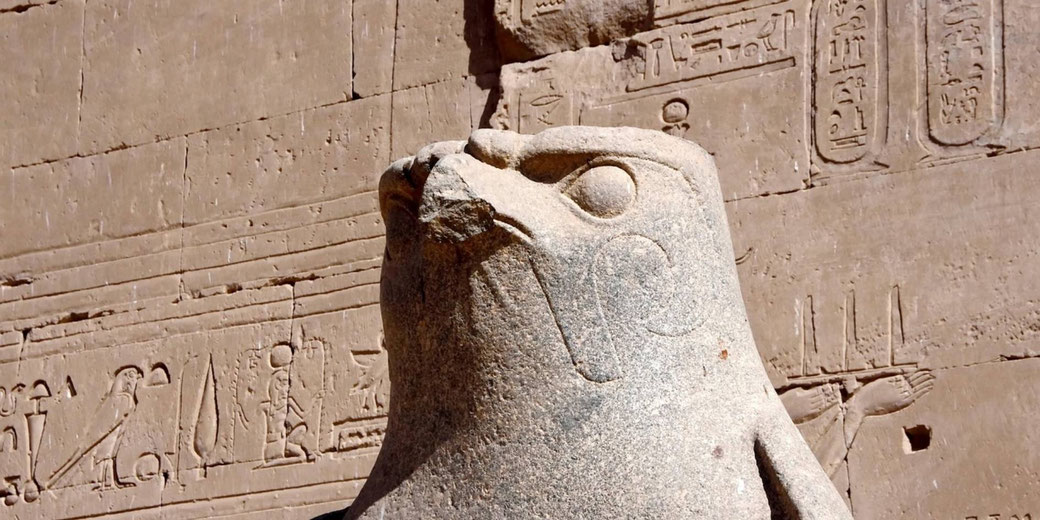
Religion was very important in ancient Egyptian society and had a significant influence on their ideas about kingship, death, morality, creation, and daily life.
These sources examine the beliefs and rituals that developed across thousands of years of Egyptian history, from local cults and temple worship to myths about gods such as Osiris, Isis, Horus, and Re.
These sources provide valuable evidence about how the ancient Egyptians understood the universe, the gods, and humanity’s place within the divine order.
Source 1
Extract A
"Thus in each larger town of Egypt and in the country surrounding it, religion assumed a special form. The principal gods are called by different names in the different provinces. They have different legends and distinctive forms of worship; besides this there is here and there a town with a special god of its own, not recognized elsewhere. So long as Egypt was divided politically, these religious differences intensified from century to century; but when she was united into one kingdom a peculiar process commenced. The religion of the town that was the royal residence became the official state religion; the temple was visited from all parts of the country, and its god recognized by all."
Extract B
"When the people of Bubastis learnt to worship the god Amon, because he was the deity of the royal house, they did not in the slightest degree abate their reverence for their goddess Bast, and when they began to realize that this ancient goddess is identical with Sekhmet and Isis, they did not on this account alter a fraction of their traditional conception of her, but simply added the new to the old."
Extract C
"Although he could not return to his former life on earth, yet he could enter upon a second existence, and from being king of men, become a king of the dead. But even upon earth he was to triumph, for him and the desolate Isis a champion was yet to arise."
Extract D
"It was at this tribunal, of which the scene is always designated as the great hall of Heliopolis, that, as the Egyptian texts constantly affirm, Osiris was in some way accused by Set and other enemies — but Thoth, god of wisdom, had adopted his cause, and had made Osiris true of voice; the gods declared that Set was defeated, and Osiris placed his foot on him. He then ascended into heaven and now reigns in the height, or — when we accept a subterranean kingdom of the dead — below in the depths, over the dead. He is the first of those who are in the West, i.e. the dead, while his son Horus as first of the living took over the government of the earth."
Extract E
"Another goddess must be mentioned of whom we may safely affirm that she owes her existence to no phenomenon of nature. She is entirely a product of human invention and is thus a pure abstraction. This is Maat, goddess of truth, whose priests were the supreme judges, and who was regarded as wife of the divine judge Thoth and daughter of the supreme god Re. As early as the Old Kingdom she ranked among the goddesses, nevertheless she is quite as much an artificial product as are the personifications of beauty or wisdom which we frequently find cited in poetry."
Extract F
"This, however, raises the question how it is possible for the sun which disappears every evening in the West to reappear in the morning in the East; a question usually solved by the Egyptians by imagining a second heaven under the earth, which the sun traverses by night. It is a dark place, inhabited by the dead, lighted at night by the sun when he sails through it in his bark."
Extract G
"These gods, who connect the beginning of the world with human times, had by this time become of great importance to the people of Heliopolis, as the immediate descendants of their great god, and they therefore grouped together this family of Re under a special name, the Ennead. This name quickly met with universal acceptance throughout Egypt, and forthwith it was felt necessary to accord a similar honour to the other gods. In addition to the Great Ennead a Lesser group was constructed composed of Horus, Thoth, Anubis and others. These two groups form the eighteen gods who figure even in the earliest texts. Later on, other great towns wished to possess enneads of their own, to compete with those of Heliopolis."
Extract H
"We have no knowledge of the original nature of Isis, the goddess who finally superseded almost all others, and appears before us as the sole goddess of Egypt. She has met with the same fate as her husband Osiris, her son Horus, her sister Nephthys and her brother Set; who lost all their original characteristics when they were interwoven in the Osiris myth. Although no goddess is so frequently mentioned as Isis, she appears before us only as the faithful wife of Osiris, and the devoted mother of Horus. She is merely an adjunct to her menfolk."
Extract I
"Come to thy house, come to thy house, oh god On! Come to thy house, thou who hast no enemies. Oh beautiful stripling, come to thy house that thou mayest see me. I am thy sister whom thou lovest; thou shalt not abandon me. Oh beauteous youth, come to thy house . . . I see thee not and my heart yearns for thee, mine eyes long for thee . . . Come to her who loves thee, who loves thee, Wennofre, thou blessed one. Come to thy sister, come to thy wife, thy wife, thou whose heart is still. Come to her who is mistress of thy house. I am thy sister, born of the same mother, thou shalt not be far from me. Gods and men turn their faces towards thee, and together they bewail thee . . . I call to thee and weep so that it is heard even to heaven, but thou dost not hear my voice, and yet I am thy sister whom thou lovedst upon earth! Thou lovedst none beside me, my brother, my brother!"
Extract J
"It was found that the word of Horus was true, there was given to him the property of his father, and he went forth crowned, according to the command of Keb. He took possession of the government of both lands, and the crowns rested upon his head…. With Horus the world of the present day began, for it is on his throne that the kings of Egypt sit as his successors."
Extract K
"Again, the king is compared to Horus, the son of Osiris, when he succeeded his father on the throne as Chief of the living. In this connection he is called Horus, the Lord of the Palace, and his palace itself is called the solitude because Horus grew up in solitude."
Extract L
"When the Egyptian named his temple the home of the god, the name was a literal expression of his belief: the deity dwelt in the temple, as a man lives in his house, and the priests, the servants of the god, who supplied him with food and attendance, were his household servants. This appears also in the religious ceremonies, and perhaps in the arrangement of the temple buildings — although in historical times this belief can have been little more than an obsolete idea."
Contextual information:
Adolf Erman was a German Egyptologist and professor at the University of Berlin, widely regarded as one of the most rigorous scholars of ancient Egyptian religion in the late nineteenth and early twentieth centuries. He published A Handbook of Egyptian Religion in German in 1904, drawing on decades of work with original Egyptian texts and artefacts. The English translation by A. S. Griffith appeared in 1907 and brought his findings to an international readership.
Bibliographical reference:
Erman, A. (1907). A Handbook of Egyptian Religion (A. S. Griffith, Trans.; pp. 2–3, 21, 26–27, 32–35, 37, 39). Archibald Constable & Co. (Original work published 1904).
Copyright: Public domain.
Source 2
Extract A
"Thereupon the priest and writer of books Tchatcha-em-ankh spake certain words of power (hekau), and having thus caused one section of the water of the lake to go up upon the other, he found the ornament lying upon a pot-sherd, and he took it and gave it to the maiden. Now the water was twelve cubits deep, but when Tchatcha-em-ankh had lifted up one section of the water on to the other, that portion became four and twenty cubits deep. The magician again uttered certain words of power, and the water of the lake became as it had been before he had caused one portion of it to go up on to the other."
Extract B
"The earliest name for the formulae found upon amulets is hekau, and it was so necessary for the deceased to be provided with these hekau, or 'words of power,' that in the XVIth century B.C., and probably more than a thousand years earlier, a special section was inserted in the Book of the Dead with the object of causing them to come to him from whatever place they were in, 'swifter than greyhounds and quicker than light.'"
Contextual information:
E. A. Wallis Budge was a British Egyptologist who worked as Keeper of Egyptian and Assyrian Antiquities at the British Museum from 1894 to 1924. He published Egyptian Magic in 1901 as part of the Books on Egypt and Chaldaea series, drawing on papyrus collections held at the British Museum. The work presented Egyptian magical texts, including the Westcar Papyrus, to a general educated audience.
Bibliographical reference:
Budge, E. A. W. (1901). Egyptian Magic (Books on Egypt and Chaldaea, Vol. II, pp. 9–10, 27). Kegan Paul, Trench, Trübner & Co.
Copyright: Public domain.
Source 3
Extract A
"In arranging his thoughts and their visible forms Khepera was assisted by the goddess Maat, who is usually regarded as the goddess of law, order, and truth, and in late times was held to be the female counterpart of Thoth, 'the heart of the god Ra.' In this legend, however, she seems to play the part of Wisdom, as described in the Book of Proverbs, for it was by Maat that he 'laid the foundation.'"
Extract B
"It seems also that a desire arose in him to create the world, and in order to do this he took upon himself the form of the god Khepera, who from first to last was regarded as the Creator, par excellence, among all the gods known to the Egyptians. When this transformation of Neb-er-tcher into Khepera took place the heavens and the earth had not been created, but there seems to have existed a vast mass of water, or world-ocean, called Nu, and it must have been in this that the transformation took place… Having described the coming into being of Khepera and the place on which he stood, the legend goes on to tell of the means by which the first Egyptian triad, or trinity, came into existence. Khepera had, in some form, union with his own shadow, and so begot offspring, who proceeded from his body under the forms of the gods Shu and Tefnut. According to a tradition preserved in the Pyramid Texts this event took place at On (Heliopolis)…"
Extract C
"There is a variant of the Heliopolitan tradition which is also worthy of notice. Here the god is said to have first appeared as the Benben stone in the house of the Phoenix. That he begat of himself may have appeared too incredible to many, and, therefore, from the minor name Yusau, by which the god was distinguished at this occurrence, the name of a consort of the god was formed, Yusas, who was actually worshipped at Heliopolis."
Contextual information:
E. A. Wallis Budge published Legends of the Gods in 1912 as a collection of translated Egyptian mythological texts with scholarly commentary. The volume brought together creation accounts and legends from papyri and tomb inscriptions that had not previously been available in accessible English translation. Budge compiled this work from his years of research into the British Museum's papyrus holdings.
Bibliographical reference:
Budge, E. A. W. (1912). Legends of the Gods: The Egyptian Texts, Edited with Translations (pp. lxvi–lxvii, 5–6). Kegan Paul, Trench, Trübner & Co.
Copyright: Public domain.
Source 4
Extract A
"Tum or Atemu, i.e., 'the closer,' was the great god of Annu, and the head of the great company of the gods of that place. It would seem that he usurped the position of Ra in Egyptian mythology, or at any rate that the priests of Annu succeeded in causing their local god, either separately or joined with Ra, to be accepted as the leader of the divine group. He represented the evening or night sun, and as such he is called in the XVth chapter of the Book of the Dead 'divine god,' 'self-created,' 'maker of the gods,' 'creator of men,' 'who stretched out the heavens,' 'the lightener of the [Duat] with his two eyes,' etc."
Extract B
"The pyramid texts afford scanty information about the fiends and devils with which the later Egyptians peopled certain parts of the [Duat], wherein the night sun pursued his course, and where the souls of the dead dwelt; for this we must turn to the composition entitled the 'Book of what is in the [Duat],' several copies of which have come down to us inscribed upon tombs, coffins, and papyri of the XVIIIth and following dynasties. The [Duat] was divided into twelve parts, corresponding to the twelve hours of the night; and this Book professed to afford to the deceased the means whereby he might pass through them successfully."
Contextual information:
E. A. Wallis Budge produced his translation of the Papyrus of Ani, known as The Book of the Dead, in 1895 under the auspices of the British Museum. The Papyrus of Ani is one of the best-preserved copies of the ancient Egyptian funerary text, dating to approximately 1250 BCE, and was acquired by the British Museum in 1888. Budge's edition included the complete hieroglyphic text alongside an English translation and an introduction covering Egyptian religious beliefs.
Bibliographical reference:
Budge, E. A. W. (1895). The Book of the Dead: The Papyrus of Ani in the British Museum (pp. cxlviii, clxxviii–clxxix, 252). British Museum / Longmans & Co.
Copyright: Public domain.