
Historical sources on Egyptian religion and the afterlife
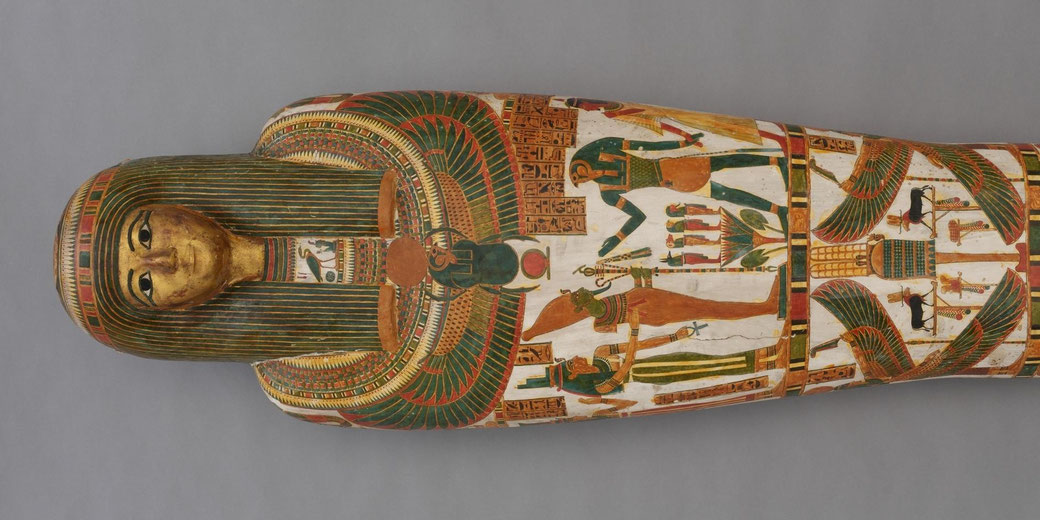
Drawing on a range of ancient and modern sources, the materials below offer a detailed view of Egyptian religion and beliefs about the afterlife across different periods.
They explain how deities such as Ra, Amun, Osiris, and Anubis were understood, how their importance shifted over time, and how religious ideas connected closely with political power.
At the same time, the sources provide clear descriptions of burial customs, including mummification and funeral rituals, which reveal how strongly Egyptians believed in life after death and the judgement of the soul
Source 1
Extract A
"The Egyptian of the Roman Period, like the Egyptian of the Early Empire, was content to think that his body would be received in the tomb by the jackal-headed Anubis; that the organs of his [decaying] body would be [watched] over and guarded by animal-headed gods: that the reading of the pointer of the Great Scales, [where] his heart was weighed, would be made known by an ape to the ibis-headed scribe of the gods, whom we know by the name of Thoth; and that the [blessed] dead would be introduced to the god Osiris by a hawk-headed god called Horus, son of Isis, who in many respects was the [equal] of the god Ḥeru-ur, the oldest of all the gods of Egypt, whose type and symbol was the hawk." (Vol. I, p. 9)
Extract B
"Rā is the name which was given by the Egyptians of the [royal] period to the god of the sun, who was regarded as the maker and creator of everything which we see in the visible world around us, and of the gods in heaven, as well as of heaven itself, and of the [underworld] and the beings [within it]; the original meaning of his name is unknown, but at one period of Egyptian history it seems to have been thought that the word rā indicated '[creative] power,' and that as a [title] it represented in meaning something like 'Creator.'" (Vol. I, p. 322)
Extract C
"The god Rā is usually [shown] with the body of a man and the head of a hawk, but sometimes he is represented in the form of a hawk; on his head he wears his symbol, [that is], the disk of the sun [surrounded] by the serpent khut." (Vol. I, p. 323)
Contextual information:
E. A. Wallis Budge (1857–1934) was an English Egyptologist who served as Keeper of Egyptian and Assyrian Antiquities at the British Museum. He was one of the most published scholars of his generation, producing translations of Egyptian religious texts, catalogues of the Museum's collections, and studies of Egyptian mythology over a career spanning more than forty years.
Bibliographical reference:
Budge, E. A. W. (1904). The gods of the Egyptians; or, studies in Egyptian mythology (Vol. 1, pp. 9, 322–323). Methuen & Co.
Copyright: Public Domain.
Source 2
Extract A
"As far as the evidence before us goes it appears not to have been very [widespread], and in fact, the only centre of it of any importance was the city of Thebes." (Vol. II, pp. 2–3)
Extract B
"As soon as the princes of Thebes had conquered their rival [challengers] to the [rule] of Egypt, and had succeeded in making their city a new capital of the country, their god Amen [also known as Amun] became a [leading] god in Upper Egypt." (Vol. II, p. 3)
Extract C
"Thus by these means the priests of Amen succeeded in making their god, both [in religion] and [in politics], the greatest of the gods in the country." (Vol. II, pp. 3–4)
Contextual information:
This is Volume II of the same work by Budge cited in Source 1. Budge wrote this volume while working at the British Museum, where he had direct access to thousands of Egyptian artefacts, inscriptions, and papyri that informed his analysis of individual deities and their cults.
Bibliographical reference:
Budge, E. A. W. (1904). The gods of the Egyptians; or, studies in Egyptian mythology (Vol. 2, pp. 2–4). Methuen & Co.
Copyright: Public Domain.
Source 3
Extract A
"As a rule a [middle ground] was [reached] in representing them, and the gods were shown in human form with the heads of their [matching] animals."
Extract B
"HORUS or HAR-AKHTE originally stood for the god, regarded as a bird of prey with blazing eyes, while KHEPRE [referred to] the god in the form of a beetle. Finally the evening sun was represented by ATUM in the form of an old man. The sun god is usually represented with the head of a sparrow-hawk [topped] by the sun; this is [surrounded by] its terrible servant, the fire-spitting serpent, who destroys his enemies."
Extract C
"The first of these were [imagined] as jackals, such as the ancient god of the dead, ANUBIS, who later [oversaw] the process of embalming [the preservation of bodies after death, also known as mummification], and the two gods WEPWAWET, the guides, a well-chosen name, as it was they who showed the dead the paths through their dark [kingdom]. It was perfectly natural that the jackal should be considered the animal of the god of the dead; in the desert where the dead were buried, these animals might be seen every evening, prowling about in the dusk."
Extract D
"Sekhmet is a terrible goddess of war and [conflict], and the question arises whether both these [gods] with [plain] names, She who is Bast and The mighty one, did not develop originally from such a sky goddess as we are already [familiar] with in Nut, Hathor and Neith."
Extract E
"This god is no other than AMON of Thebes, king of the gods of later Egypt. In the early times with which we are now dealing, no one could have [predicted] the importance that would one day [belong] to him. He was the [unknown] god of a small town."
Extract F
"His wife is Thoueris [also known as Taweret], the favourite of the people. Her name [means] merely 'the great one.' She is a hippopotamus standing on her hind feet. She holds the [Egyptian symbol for] protection, and thus shows what was expected of her [as the goddess who protected women during pregnancy and childbirth]."
Contextual information:
Adolf Erman (1854–1937) was a German Egyptologist who held the chair of Egyptology at the University of Berlin and founded what became the leading German school of Egyptian studies. He directed the compilation of the Wörterbuch der ägyptischen Sprache, a multi-volume dictionary of the ancient Egyptian language that took decades to complete and is still used by scholars today.
Bibliographical reference:
Erman, A. (1907). A handbook of Egyptian religion (A. S. Griffith, Trans., pp. 9–10, 13–15, 19, 69). Archibald Constable & Co.
Copyright: Public Domain.
Source 4
Extract A
II.86. "The mode of embalming [preserving the body after death, also known as mummification], according to the most perfect process, is the following:- They take first a crooked piece of iron, and with it draw out the brain through the nostrils, thus getting rid of a portion, while the skull is cleared of the rest by rinsing with drugs; next they make a cut along the [side] with a sharp Ethiopian stone, and take out the whole contents of the abdomen, which they then cleanse, washing it thoroughly with palm wine, and again frequently with [a mixture] of pounded [spices]. After this they fill the [body] with the purest bruised myrrh, with cassia, and every other sort of [spice] except frankincense, and sew up the opening. Then the body is placed in natrum [a natural salt used for drying] for seventy days, and covered entirely over. After the [end] of that [length] of time, which must not be [gone past], the body is washed, and wrapped round, from head to foot, with bandages of fine linen cloth, smeared over with gum, which is used generally by the Egyptians in the place of glue, and in this state it is given back to the [family], who enclose it in a wooden case which they have had made for the purpose, [carved] in the figure of a man."
Extract B
II. 42. "Such Egyptians as possess a temple of the Theban [Zeus, whom the Egyptians called Amun], or live in the [Theban district], offer no sheep in sacrifice, but only goats; for the Egyptians do not all worship the same gods [meaning that they were polytheistic, worshipping many different gods], excepting Isis and Osiris, the latter of whom they say is the [Greek god Dionysus]."
Extract C
II.58. "The Egyptians were also the first to introduce solemn assemblies, processions, and [prayers] to the gods; of all which the Greeks were taught the use by them. It seems to me a sufficient proof of this that in Egypt these practices have been established from [ancient] times, while in Greece they are only recently known. The Egyptians do not hold a single solemn assembly, but several in the course of the year."
Contextual information:
Herodotus (c. 484–425 BCE) was a Greek historian from the city of Halicarnassus in modern-day Turkey. He is often called "the Father of History" because his Histories is considered the first major work of historical writing in the Western tradition. He travelled widely across the ancient world, including to Egypt around 450 BCE, where he observed Egyptian religious customs and burial practices first-hand and recorded them in Book II of his work. George Rawlinson, an English scholar at the University of Oxford, produced this translation in 1858. Note that Herodotus used Greek names for Egyptian gods throughout his writing.
Bibliographical reference:
Herodotus. The history of Herodotus (G. Rawlinson, Trans., 1858, Book II, Chapters 42, 58, 86). John Murray. (Original work published ca. 440 BCE).
Copyright: Public Domain.