
Historical sources on ancient Egyptian pyramids
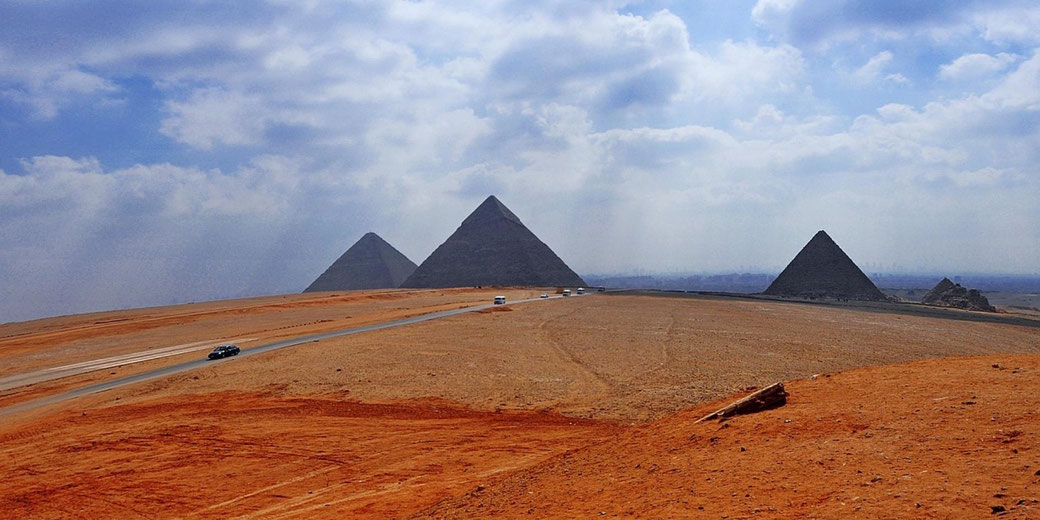
The following historical sources examine how ancient writers and later historians described the Egyptian pyramids, particularly those at Giza.
These accounts reveal both the scale of the monuments and the beliefs that surrounded their construction and purpose.
They allow you to investigate how historical interpretations of the pyramids changed over time and how historians evaluate the reliability of ancient evidence.
Source 1
"Down to the time when Rhampsinitos was king, they told me there was in Egypt nothing but orderly rule, and Egypt prospered greatly; but after him Cheops [also called Khufu] became king over them and brought them to every kind of evil: for he shut up all the temples, and having first kept them from sacrificing there, he then bade all the Egyptians work for him. So some were appointed to draw stones from the stone-quarries in the Arabian mountains to the Nile, and others he ordered to receive the stones after they had been carried over the river in boats, and to draw them to those which are called the Libyan mountains; and they worked by a hundred thousand men at a time, for each three months continually. Of this oppression there passed ten years while the causeway was made by which they drew the stones, which causeway they built, and it is a work not much less, as it appears to me, than the pyramid."
Contextual information:
Herodotus (c. 484–425 BC) was a Greek historian who travelled widely across the ancient world, including Egypt, where he interviewed priests and local guides. His Histories, Book II, is one of the oldest surviving written accounts of ancient Egypt by a foreign observer. His descriptions of the pyramids were written roughly 2,000 years after the Great Pyramid was built, so some of his figures, such as the number of workers, are likely exaggerated.
Bibliographical reference:
Herodotus. Histories (G. C. Macaulay, Trans., 1890; Vol. I, Book II, p. 124). Macmillan & Co. (Original work written c. 430 BC)
Copyright: Public domain.
Source 2
Extract A
"The eighth king, Chemmis [known to the Egyptians as Khufu] of Memphis, ruled fifty years and constructed the largest of the three pyramids, which are numbered among the seven wonders of the world. These pyramids, which are situated on the side of Egypt which is towards Libya, are one hundred and twenty stades [roughly 22 kilometres] from Memphis and forty-five from the Nile, and by the immensity of their structures and the skill shown in their execution they fill the beholder with wonder and astonishment. For the largest is in the form of a square and has a base length on each side of seven plethra [roughly 210 metres] and a height of over six plethra; it also gradually tapers to the top, where each side is six cubits long."
Extract B
"And though the two kings built the pyramids to serve as their tombs, in the event neither of them was buried in them; for the multitudes, because of the hardships which they had endured in the building of them and the many cruel and violent acts of these kings, were filled with anger against those who had caused their sufferings and openly threatened to tear their bodies asunder and cast them in despite out of the tombs. Consequently each ruler when dying enjoined upon his kinsmen to bury his body secretly in an unmarked place."
Contextual information:
Diodorus Siculus was a Greek historian who wrote in the first century BC. His Library of History, Book I, drew on earlier accounts by Greek writers who had visited Egypt. Note that the claim in Extract B is incorrect: modern archaeology has confirmed through the discovery of sarcophagi and human remains inside the pyramids that the pharaohs were indeed buried there.
Bibliographical reference:
Diodorus Siculus. Library of History (C. H. Oldfather, Trans., 1933; Vol. I, Book I, §§63–64, pp. 211–215). Harvard University Press. (Original work written c. 60–30 BC)
Copyright: Public domain.
Source 3
"On proceeding forty stadia [roughly 7 kilometres] from the city [Memphis], one comes to a kind of mountain-brow; on it are numerous pyramids, the tombs of kings, of which three are noteworthy; and two of these are even numbered among the Seven Wonders of the World, for they are a stadium [roughly 180 metres] in height, are quadrangular [four-sided] in shape, and their height is a little greater than the length of each of the sides; and one of them is only a little larger than the other. High up, approximately midway between the sides, it has a movable stone, and when this is raised up there is a sloping passage to the vault [the burial chamber inside]. Now these pyramids are near one another and on the same level; but farther on, at a greater height of the hill, is the third, which is much smaller than the two, though constructed at much greater expense; for from the foundations almost to the middle it is made of black stone, the stone from which mortars are made, being brought from a great distance, for it is brought from the mountains of Aethiopia; and because of its being hard and difficult to work into shape it rendered the undertaking very expensive."
Contextual information:
Strabo (c. 64 BC – c. 24 AD) was a Greek geographer who travelled to Egypt around 25 BC, shortly after Rome took control of the country. His Geography, Book XVII, records his own observations of the Giza plateau and its pyramids. He is one of the few ancient writers to have visited the site in person and left a detailed description.
Bibliographical reference:
Strabo. Geography (H. L. Jones, Trans., 1932; Vol. VIII, Book XVII, §33, p. 87). Harvard University Press. (Original work written c. 7 BC)
Copyright: Public domain.
Source 4
Extract A
"The monuments and remains of ancient Egypt preserved in the great museums of Europe and Egypt are chiefly of a sepulchral [burial] character, and we owe them entirely to the belief of the Egyptians that the soul would at some period revivify [bring back to life] the body, and to the care, consequent on this belief, with which they embalmed the bodies of their dead, so that they might resist the action of decay, and be ready for the return of the soul. The preservation of the embalmed body, or mummy, was the chief end and aim of every Egyptian who wished for everlasting life. For the sake of the mummy's safety tombs were hewn, papyri [scrolls] were inscribed with compositions, the knowledge of which would enable him to repel the attacks of demons, ceremonies were performed and services were recited; for the sake of the comfort of the mummy and his ka, or genius [spirit-double], the tombs were decorated with scenes which would remind him of those with which he was familiar when upon earth, and they were also provided with many objects used by him in daily life, so that his tomb might resemble as much as possible his old home."
Extract B
"Chufu [Khufu], or Cheops, the next king of Egypt, is more famous as the builder of the great pyramid of Gizeh than as a warrior, and little more is known of his military expeditions than that he continued the wars against the tribes of Sinai which his predecessor Seneferu had so ably begun. He appears to have built many towns, and the famous temple of Denderah is said to have been founded during his reign. As the pyramids were tombs, they will be described in the chapter relating to tombs."
Extract C
"Menkaura or Mykerinos is famous as the builder of the third pyramid at Gizeh. The fragments of his inner wooden coffin and a small fragment of his basalt sarcophagus [stone coffin] are preserved in the British Museum, together with the human body that was found inside the third pyramid at Gizeh. The reputation which this king left behind him is that of a good and just ruler."
Contextual information:
Sir Ernest Alfred Wallis Budge (1857–1934) was Keeper of Egyptian and Assyrian Antiquities at the British Museum. The Mummy was first published in 1893 and drew on Budge's knowledge of the British Museum's collection, as well as the broader scholarship of his era. It covers burial customs and tomb architecture in detail.
Bibliographical reference:
Budge, E. A. W. (1893). The mummy: Chapters on Egyptian funereal archaeology (pp. v, 12, 17). Cambridge University Press.
Copyright: Public domain.