
Historical sources on the decline of the Roman Empire
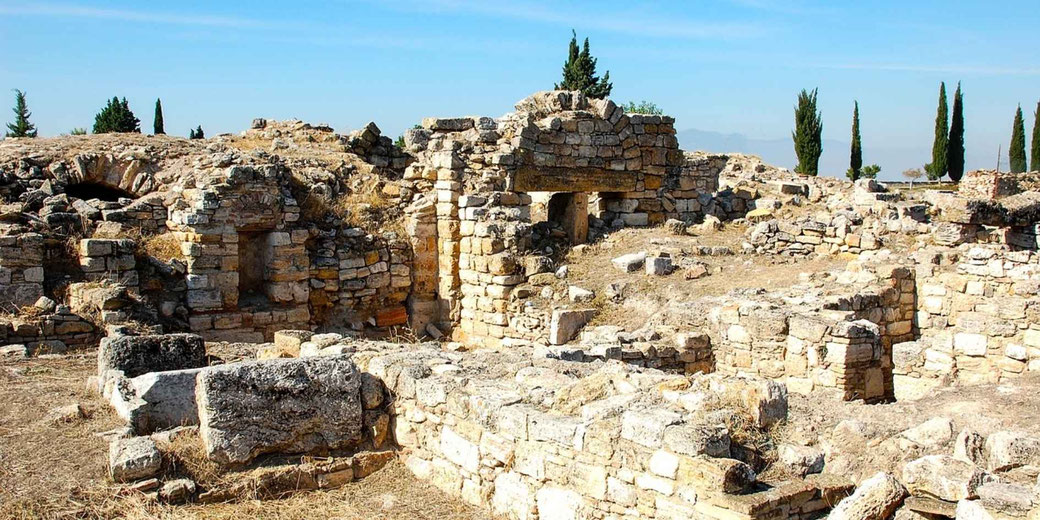
The sources on this page offer a range of ancient and modern perspectives on the decline and fall of the Roman Empire.
They span several centuries of Roman history, from the administrative reforms of Diocletian and the founding of Constantinople through to the catastrophic defeat at the Battle of Adrianople in AD 378.
Each source was produced in a specific historical context and for a particular audience, which means that careful analysis of their origins, motives, and reliability is essential before using them as historical evidence.
Source 1
"While Diocletian, that author of ill, and deviser of misery, was ruining all things, he could not withhold his insults, not even against God. This man, by avarice partly, and partly by timid counsels, overturned the Roman empire. For he made choice of three persons to share the government with him; and thus, the empire having been quartered, armies were multiplied, and each of the four princes strove to maintain a much more considerable military force than any sole emperor had done in times past. There began to be fewer men who paid taxes than there were who received wages; so that the means of the husbandmen being exhausted by enormous impositions, the farms were abandoned, cultivated grounds became woodland, and universal dismay prevailed."
Contextual information:
Lactantius (c. 250–c. 325 AD) was a Christian rhetorician who lived at the imperial court in Nicomedia during Diocletian's reign, making him a direct contemporary witness. He wrote De Mortibus Persecutorum ("On the Deaths of the Persecutors") around AD 313–315 as a polemical account of how emperors who persecuted Christians met terrible ends. Please note that the modern term "Tetrarchy" is not used by Lactantius or any ancient writer; he describes "the empire having been quartered" and "each of the four princes" without naming the system.
Bibliographical reference:
Lactantius. Of the manner in which the persecutors died (W. Fletcher, Trans., 1886). In A. Roberts & J. Donaldson (Eds.), Ante-Nicene Fathers (Vol. 7, Ch. 7, p. 303). Christian Literature Company. (Original work written c. 313–315 AD)
Copyright: Public domain.
Source 2
"Being unable to endure the curses of almost the whole city, [Emperor Constantine] sought for another city as large as Rome, where he might build himself a palace. Having, therefore, discovered a convenient site between Troas and old Ilium, he there accordingly laid a foundation, and built part of a wall to a considerable height, which may still be seen by any that sail towards the Hellespont. Afterwards changing his purpose, he left his work unfinished, and went to Byzantium, where he admired the situation of the place, and therefore resolved, when he had considerably enlarged it, to make it a residence worthy of an emperor, [a city called Constantinople]."
Contextual information:
Zosimus was a Greek pagan historian who served as an imperial treasury official in Constantinople around AD 490–518, writing his Historia Nova ("New History") roughly 150 years after the events it describes. As a committed pagan, he was openly hostile to Constantine and blamed the Christian emperor for the empire's subsequent decline, which explains the unflattering tone of this passage.
Bibliographical reference:
Zosimus. The history of Count Zosimus, sometime advocate and chancellor of the Roman Empire (Anonymous, Trans., (1814 ). Book 2, Ch. 30, pp. 53–54). W. Green & T. Chaplin. (Original work written c. 498–518 AD)
Copyright: Public domain.
Source 3
Extract A
"If, in the consideration of their armies, we pass from their discipline to their numbers, we shall not find it easy to define them with any tolerable accuracy. We may compute, however, that the legion, which was itself a body of six thousand eight hundred and thirty-one Romans, might, with its attendant auxiliaries, amount to about twelve thousand five hundred men. The peace establishment of Hadrian and his successors was composed of no less than thirty of these formidable brigades; and most probably formed a standing force of three hundred and seventy-five thousand men."
Extract B
"Instead of being confined within the walls of fortified cities, which the Romans considered as the refuge of weakness or pusillanimity, the legions were encamped on the banks of the great rivers, and along the frontiers of the barbarians. As their stations, for the most part, remained fixed and permanent, we may venture to describe the distribution of the troops. Eight legions were required on the Rhine and Danube for the defence of the former, and the latter: three were sufficient for Britain; the rest were stationed in the provinces of Spain, Africa, and the East."
Extract C
"They persisted in the design of maintaining the dignity of the empire, without attempting to enlarge its limits. By every honourable expedient they invited the friendship of the barbarians; and endeavoured to convince mankind that the Roman power, raised above the temptation of conquest, was actuated only by the love of order and justice. During a long period of forty-three years their virtuous labours were crowned with success; and if we except a few slight hostilities, that served to exercise the legions of the frontier, the reigns of Hadrian and the two Antonines offer the fair prospect of universal peace."
Extract D
"From the great secular games celebrated by Philip, to the death of the emperor Gallienus, there elapsed twenty years of shame and misfortune. During that calamitous period, every instant of time was marked, every province of the Roman world was afflicted, by barbarous invaders and military tyrants, and the ruined empire seemed to approach the last and fatal moment of its dissolution."
Extract E
"The joint government of the father and the son subsisted about seven, and the sole administration of Gallienus continued about eight, years. But the whole period was one uninterrupted series of confusion and calamity. As the Roman empire was at the same time, and on every side, attacked by the blind fury of foreign invaders, and the wild ambition of domestic usurpers, we shall consult order and perspicuity by pursuing not so much the doubtful arrangement of dates as the more natural distribution of subjects."
Contextual information:
Edward Gibbon (1737–1794) was an English historian whose six-volume The History of the Decline and Fall of the Roman Empire (published 1776–1789) is one of the most influential historical works ever written and synthesises hundreds of ancient sources. Gibbon wrote from a secular Enlightenment perspective and based his military figures on Tacitus, Cassius Dio, and Roman military inscriptions.
Bibliographical reference:
Gibbon, E. (1776). The history of the decline and fall of the Roman Empire (Vol. 1, Ch. 1, pp. 9, 11, 84, Ch. 10, pp. 260, 265). W. Strahan & T. Cadell.
Copyright: Public domain.
Source 4
Extract A
"To him succeeded Aurelius [Severus ] Alexander, a very young man, who was named caesar by the army, and Augustus by the Senate. Having undertaken a war with the Persians, he defeated their king Xerxes with great glory. He enforced military discipline with much severity, and disbanded whole legions that raised a disturbance. He had for his adviser, or secretary of state, Ulpian, the compiler of the law. He was also in great favor at Rome. He lost his life in Gaul, in a tumult of the soldiery, in the thirteenth year and eighth day of his reign."
Extract B
"When affairs were in this desperate condition, and the Roman Empire almost ruined, Postumus, a man of very obscure birth, assumed the purple in Gaul, and held the government with such ability for ten years, that he recruited the provinces, which had been almost ruined, by his great energy and judgment; but he was killed in a mutiny of the army, because he would not deliver up Mogontiacum, which had rebelled against him, to be plundered by the soldiers, at the time when Lucius Aelianus was endeavoring to effect a change of government."
Extract C
"After his death, Aurelian succeeded to the throne. He was born in Dacia Ripensis, and was a man of ability in war, but of an ungovernable temper, and too much inclined to cruelty. He defeated the Goths with great vigor, and extended the Roman Empire, by various successes in the field, to its former limits. He overthrew Tetricus at Catalauni in Gaul, Tetricus himself, indeed, betraying his own army, whose constant mutinies he was unable to bear; and he had even by secret letters entreated Aurelian to march towards him, using, among other solicitations, the verse of Virgil: 'Eripe me his, invicte, malis.' Unconquer'd hero, free me from these ills. He also took prisoner Zenobia, who, having killed her husband Odaenathus, was mistress of the east, in a battle of no great importance near Antioch, and, entering Rome, celebrated a magnificent triumph, as recoverer of the east and the west, Tetricus and Zenobia going before his chariot."
Contextual information:
Eutropius was a Roman historian who served as magister memoriae (secretary of state) to the Emperor Valens in the late 4th century and accompanied the Emperor Julian on his Persian campaign in AD 363. He wrote his Breviarium Historiae Romanae around AD 369 as a concise summary of Roman history commissioned by Valens, which makes it remarkably accessible for student readers. The phrase "a tumult of the soldiery" describes the military mutiny in AD 235; "assumed the purple" means claimed imperial power; and Aurelian's title "recoverer of the east and the west" translates the Latin Restitutor Orbis ("Restorer of the World"), marking his reunification of the empire by defeating both Tetricus (the Gallic Empire) and Zenobia (the Palmyrene Empire).
Bibliographical reference:
Eutropius. Abridgement of Roman history (J. S. Watson, Trans., (1886), Book 8, Ch. 23, p. 527; Book 9, Ch. 9, p. 532; Book 9, Ch. 13, p. 534). George Bell & Sons. (Original work written c. 369 AD)
Copyright: Public domain.
Source 5: Ammianus Marcellinus on the Battle of Adrianople, AD 378
Extract A (on the Roman rout):
"At last our columns were entirely beaten back by the overpowering weight of the barbarians, and so they took to disorderly flight, which is the only resource in extremity, each man trying to save himself as well as he could. While they were all flying and scattering themselves over roads with which they were unacquainted, the emperor, bewildered with terrible fear, made his way over heaps of dead, and fled to the battalions of the Lancearii and the Mattiarii, who, till the superior numbers of the enemy became wholly irresistible, stood firm and immovable. As soon as he saw him, Trajan exclaimed that all hope was gone, unless the emperor, thus deserted by his guards, could at least be protected by his foreign allies."
Extract B (on the death of the Emperor Valens):
"Just when it first became dark, the emperor being among a crowd of common soldiers, as it was believed—for no one said either that he had seen him, or been near him—was mortally wounded with an arrow, and, very shortly after, died, though his body was never found. For as some of the enemy roamed for a long time about the field in order to plunder the dead, none of the fugitives or of the inhabitants ventured to go to the spot."
Extract C (on the scale of the disaster):
"Scarcely one-third of the whole army escaped. Nor, except the battle of Cannae, is so destructive a slaughter recorded in our annals; though, even in the times of their prosperity, the Romans have more than once had to deplore the uncertainty of war, and have for a time succumbed to evil Fortune; while the well-known dirges of the Greeks have bewailed many disastrous battles."
Contextual information:
Ammianus Marcellinus (c. 330–c. 400 AD) was a Greek-born Roman soldier who served as an officer in the imperial bodyguard under Constantius II and Julian, giving him direct military experience of the late Roman army. He wrote his Res Gestae ("The Roman History") in Latin during the 390s AD as a continuation of Tacitus, covering the years 96–378; the work deliberately ends with the Battle of Adrianople, which Ammianus presents as the worst Roman military disaster since Cannae in 216 BC.
Bibliographical reference:
Ammianus Marcellinus. The Roman history of Ammianus Marcellinus during the reigns of the emperors Constantius, Julian, Jovianus, Valentinian, and Valens (C. D. Yonge, Trans., (1862), Book 31, Ch. 13, pp. 609, 610, 611). Henry G. Bohn. (Original work written c. 390 AD)
Copyright: Public domain.