
Historical sources on the Battle of Marathon
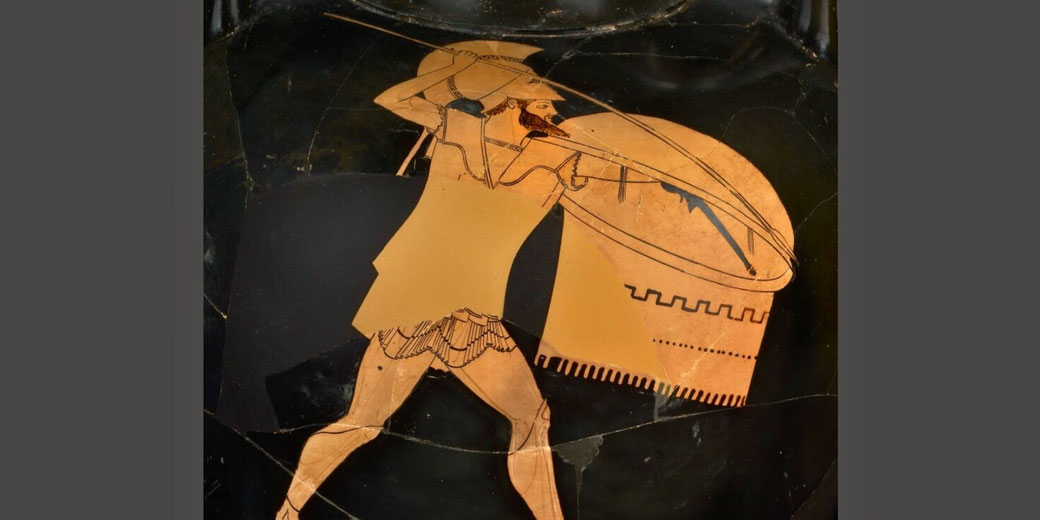
The Battle of Marathon in 490 BC was one of the most famous battles of the Greco-Persian Wars and a major victory for Athens against the Persian Empire.
The sources below examine the causes of the conflict, the Persian invasion of Greece, the decisions made by Athenian leaders, the course of the battle itself, and its immediate aftermath.
Written by both Greek and Roman authors, these accounts provide valuable evidence about how ancient writers understood the events at Marathon and why they regarded the battle as a turning point in Greek history.
Source 1
Extract A
"So the Athenians were at war with the Eginetans; and meanwhile the Persian was carrying forward his design, since he was put in mind ever by his servant to remember the Athenians, and also because of the sons of Peisistratos were near at hand and brought charges continually against the Athenians, while at the same time Dareios himself wished to take hold of this pretext and subdue those nations of Hellas which had not given him earth and water. Mardonios then, since he had fared miserably in his expedition, he removed from his command; and appointing other generals to command he despatched them against Eretria and Athens, namely Datis, who was a Mede by race, and Artaphrenes the son of Artaphrenes, a nephew of the king: and he sent them forth with the charge to reduce Athens and Eretria to slavery and to bring the slaves back into his presence."
Extract B
"While they had these thoughts and had been set at enmity with the Persians, at this very time Aristagoras the Milesian, ordered away from Sparta by Cleomenes the Lacedemonian, arrived at Athens; for this was the city which had most power of all the rest besides Sparta. And Aristagoras came forward before the assembly of the people and said the same things as he had said at Sparta about the wealth which there was in Asia, and about the Persian manner of making war, how they used neither shield nor spear and were easy to overcome. Thus I say he said, and also he added this, namely that the Milesians were colonists from the Athenians, and that it was reasonable that the Athenians should rescue them, since they had such great power; and there was nothing which he did not promise, being very urgent in his request, until at last he persuaded them: for it would seem that it is easier to deceive many than one, seeing that, though he did not prove able to deceive Cleomenes the Lacedemonian by himself, yet he did this to thirty thousand Athenians. The Athenians then, I say, being persuaded, voted a resolution to despatch twenty ships to help the Ionians, and appointed to command them Melanthios one of their citizens, who was in all things highly reputed. These ships proved to be the beginning of evils for the Hellenes and the Barbarians."
Extract C
"However at that time, the time namely when he said that Pan appeared to him, this Pheidippides having been sent by the generals was in Sparta on the next day after that on which he left the city of the Athenians; and when he had come to the magistrates he said: 'Lacedemonians, the Athenians make request of you to come to their help and not to allow a city most anciently established among the Hellenes to fall into slavery by the means of Barbarians; for even now Eretria has been enslaved, and Hellas has become the weaker by a city of renown.' He, as I say, reported to them that with which he had been charged, and it pleased them well to come to help the Athenians; but it was impossible for them to do so at once, since they did not desire to break their law; for it was the ninth day of the month, and on the ninth day they said they would not go forth, nor until the circle of the moon should be full."
Extract D
"Now the opinions of the generals of the Athenians were divided, and the one party urged that they should not fight a battle, seeing that they were too few to fight with the army of the Medes, while the others, and among them Miltiades, advised that they should do so: and when they were divided and the worse opinion was like to prevail, then, since he who had been chosen by lot to be polemarch [overall commander] of the Athenians had a vote in addition to the ten (for in old times the Athenians gave the polemarch an equal vote with the generals) and at that time the polemarch was Callimachos of the deme of Aphidnai, to him came Miltiades and said as follows: 'With thee now it rests, Callimachos, either to bring Athens under slavery, or by making her free to leave behind thee for all the time that men shall live a memorial such as not even Harmodios and Aristogeiton have left. For now the Athenians have come to a danger the greatest to which they have ever come since they were a people; and on the one hand, if they submit to the Medes, it is determined what they shall suffer, being delivered over to Hippias, while on the other hand, if this city shall gain the victory, it may become the first of the cities of Hellas. How this may happen and how it comes to thee of all men to have the decision of these matters, I am now about to tell. Of us the generals, who are ten in number, the opinions are divided, the one party urging that we fight a battle and the others that we do not fight. Now if we do not, I expect that some great spirit of discord will fall upon the minds of the Athenians and so shake them that they shall go over to the Medes; but if we fight a battle before any unsoundness appear in any part of the Athenian people, then we are able to gain the victory in the fight, if the gods grant equal conditions. These things then all belong to thee and depend on thee; for if thou attach thyself to my opinions, thou hast both a fatherland which is free and a native city which shall be the first among the cities of Hellas; but if thou choose the opinion of those who are earnest against fighting, thou shalt have the opposite of those good things of which I told thee.'"
Extract E
"And when they had been arranged in their places and the sacrifices proved favourable, then the Athenians were let go, and they set forth at a run to attack the Barbarians. Now the space between the armies was not less than eight furlongs [approximately one and a half kilometres]: and the Persians seeing them advancing to the attack at a run, made preparations to receive them; and in their minds they charged the Athenians with madness which must be fatal, seeing that they were few and yet were pressing forwards at a run, having neither cavalry nor archers. Such was the thought of the Barbarians; but the Athenians when all in a body they had joined in combat with the Barbarians, fought in a memorable fashion: for they were the first of all the Hellenes about whom we know who went to attack the enemy at a run, and they were the first also who endured to face the Median garments and the men who wore them, whereas up to this time the very name of the Medes was to the Hellenes a terror to hear."
Extract F
"In this fight at Marathon there were slain of the Barbarians about six thousand four hundred men, and of the Athenians a hundred and ninety and two. Such was the number which fell on both sides; and it happened also that a marvel occurred there of this kind: an Athenian, Epizelos the son of Cuphagoras, while fighting in the close combat and proving himself a good man, was deprived of the sight of his eyes, neither having received a blow in any part of his body nor having been hit with a missile, and for the rest of his life from this time he continued to be blind."
Extract G
"These then, I say, were sailing round Sunion [the southern tip of Attica]; and meanwhile the Athenians came to the rescue back to the city as speedily as they could, and they arrived there before the Barbarians came; and having arrived from the temple of Heracles at Marathon they encamped at another temple of Heracles, namely that which is in Kynosarges. The Barbarians however came and lay with their ships in the sea which is off Phaleron, (for this was then the seaport of the Athenians), they anchored their ships, I say, off this place, and then proceeded to sail back to Asia."
Contextual information:
Herodotus was a Greek historian born around 484 BC in Halicarnassus, on the western coast of Asia Minor. He is widely regarded as the first writer to treat history as a systematic inquiry into past events rather than a collection of myths and legends. The Histories, his only surviving work, records the causes and events of the Greco-Persian Wars. Herodotus gathered much of his information through personal travel and interviews with participants or their descendants, and he wrote within living memory of the events at Marathon.
Bibliographical reference:
Herodotus. The history of Herodotus (G. C. Macaulay, Trans., 1890; Vol. II, pp. from Book V ch. 97 and Book VI chs. 94, 106, 109, 112, 116, 117). Macmillan. (Original work written ca. 430 BC).
Copyright: Public domain.
Source 2
Extract A
"Darius, when he had returned from Asia into Europe, prepared, at the exhortation of his friends, in order to reduce Greece under his dominion, a fleet of five hundred ships, and appointed Datis and Artaphernes to the command of it, to whom he assigned two hundred thousand infantry and ten thousand cavalry; alleging as a reason for his enterprise, that he was an enemy to the Athenians, because, with their aid, the Ionians had stormed Sardis and put his garrison to death. These generals of the king, having brought up their fleet to Euboea, soon took Eretria, carried off all the citizens of the place, and sent them into Asia to the king. They then went to Attica, and drew up their forces in the plain of Marathon, which is distant from the city of Athens about ten miles. The Athenians, though alarmed at this sudden descent, so near and so menacing, sought assistance nowhere but from the Spartans, and despatched Phidippides, a courier of the class called hemerodromoi [long-distance runners], to Lacedaemon, to acquaint them how speedy assistance they needed. At home, meanwhile, they appointed ten captains to command the army, and among them Miltiades. Among these captains there was a great discussion, whether they should defend themselves within the walls, or march out to meet the enemy, and decide the contest in the field. Miltiades was the only one extremely urgent that a camp should be formed as soon as possible; 'for,' he said, 'if that were done, not only would courage be added to their countrymen, when they saw that there was no distrust of their valour, but the enemy, from the same cause, would be less bold, if they saw that the Athenians would venture to oppose them with so small a force.'"
Extract B
"In this crisis no state gave assistance to the Athenians, except that of Plataea, which sent them a thousand men. On the arrival of these, the number of ten thousand armed men was made up; a band which was animated with an extraordinary ardour to fight. Hence it happened that Miltiades had more influence than his colleagues, for the Athenians, incited by his authority, led out their forces from the city, and pitched their camp in an eligible place. The next day, having set themselves in array at the foot of the hills opposite the enemy, they engaged in battle with a novel stratagem, and with the utmost impetuosity. For trees had been strewed in many directions, with this intention, that, while they themselves were covered by the high hills, the enemy's cavalry might be impeded by the spread of trees, so that they might not be surrounded by numbers. Datis, though he saw that the ground was unfavourable for his men, yet, depending on the number of his force, was desirous to engage, and the rather, because he thought it of advantage to fight before the Spartans came to the enemy's assistance. He led into the field, therefore, a hundred thousand foot [infantry soldiers] and ten thousand horse, and proceeded to battle. In the encounter the Athenians, through their valour, had so much the advantage, that they routed ten times the number of the enemy, and threw them into such a consternation, that the Persians betook themselves, not to their camp, but to their ships. Than this battle there has hitherto been none more glorious; for never did so small a band overthrow so numerous a host."
Extract C
"For to this very Miltiades, who had saved Athens and the whole of Greece, such honour only was granted, that when the battle of Marathon was painted in the portico called Poecile, his figure was placed first in the number of the ten commanders, and he was represented as encouraging his men, and commencing the battle."
Contextual information:
Cornelius Nepos was a Roman biographer writing in the first century BC. His collection Lives of Eminent Commanders included a biography of the Athenian general Miltiades, drawing on earlier Greek sources now lost. Nepos wrote for a Roman readership with limited knowledge of Greek history, which is why his account explains terms and customs in more detail than a Greek author would have done.
Bibliographical reference:
Nepos, C. Life of Miltiades. In J. S. Watson (Trans., 1886), Lives of eminent commanders (pp. 311–313). George Bell and Sons. (Original work written ca. 35 BC).
Copyright: Public domain.