
War on tracks: How tanks revolutionized warfare in World War One
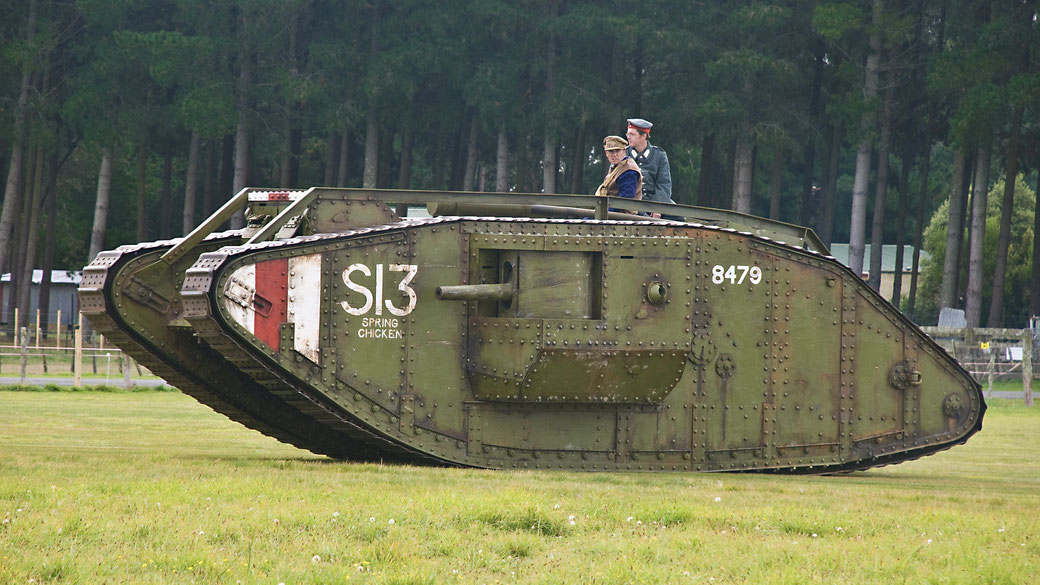
By 1916, infantry charges across the Western Front had resulted in terrible losses for very small territorial gains.
Repeated offensives across the Somme, Verdun, and Ypres, which involved mass infantry assaults, exposed the pointlessness of sending unprotected soldiers against entrenched machine guns and reinforced bunkers lined with rows of wire entanglements.
As traditional tactics failed to produce breakthroughs, British military planners and engineers began designing a vehicle that could survive direct fire and cross shattered terrain in order to restore movement to a battlefield dominated by artillery and mud.
Early concepts
Years before the war, a handful of inventors had already explored the idea of tracked vehicles for industrial or agricultural use, with caterpillar-track systems developed by firms such as Holt Manufacturing in California.
Some engineers imagined a military version of those machines, but senior officers dismissed them as impractical or unnecessary.
Once the trench systems had solidified into a fixed front line, however, the demand for a new mechanical solution revived earlier proposals that had been mostly ignored.
Early in 1915, the British Admiralty responded to this crisis by establishing the Landships Committee, which worked under the direction of Winston Churchill.
It brought together naval constructors and engineers from the agricultural machinery industry, along with selected army observers who reported on battlefield needs.
Initially, the design teams worked with few earlier examples and relied on trial and error.
To preserve secrecy, they called the new machines "tanks," a term selected to suggest they were mobile water containers destined for the Middle East.
As a result, factory workers and railway staff involved in transporting parts remained unaware of the vehicle's true nature.
First effective tanks
The first prototype was known as "Little Willie", and it proved underpowered and unable to cross trenches of standard width.
Constructed by William Foster & Co. in September 1915, it used a 105-horsepower engine, which allowed a maximum speed of just over 3 km/h.
It required a crew of six and lacked sufficient ground clearance. In response, designers created a larger, long, boxy model with angled sides that incorporated a full-length track system around the hull and mounted side sponsons for weaponry.
This improved version was named "Mother", and it set the basic blueprint for the British Mark I tank.
It was armed with a 6-pounder naval gun and several Hotchkiss machine guns. Its battlefield debut occurred during the Battle of the Somme on 15 September 1916, when thirty-two tanks advanced in support of infantry.
Of those, only eighteen were able to begin the attack due to mechanical failures, while others broke down en route or became stuck before deployment.
To some extent, the initial use of tanks at the Somme showed what they could do.
Although mechanical failures and poor terrain, combined with inadequate tactics, limited their success, a few tanks reached enemy lines and crossed trenches, then shattered wire defences.
German infantry, unprepared for such machines, in some sectors panicked and retreated from positions that had appeared secure.
The psychological effect was greater than their actual success in battle, so commanders increased funding and pushed for further development.
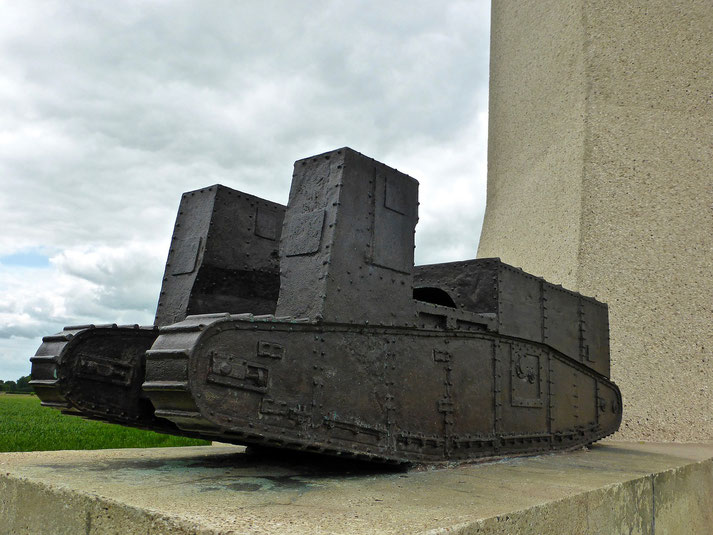
WW1 tanks at Cambrai
Over the following year, British engineers improved the tanks' reliability and armour, as well as their armament.
By 1917, the Mark IV had entered production, offering thicker protection and internal fuel storage, along with the option of male or female variants, depending on their weapons.
During the Battle of Cambrai in November 1917, nearly 400 tanks supported a surprise attack that broke through the Hindenburg Line.
British forces also employed 1,000 artillery pieces and 300 aircraft during the carefully planned attack.
For the first time, planners coordinated tanks with artillery fire and infantry movements to achieve fast advances across the flat ground.
Although a German counterattack later recaptured much of the ground, Cambrai proved that tanks could lead modern assaults when used in concentration.
At the same time, French military leaders recognised the need for their own mechanised vehicles.
Led by Colonel Jean-Baptiste Estienne, French designers developed the Schneider CA1, which first saw action during the very costly Nivelle Offensive in April 1917.
The Schneider tanks often performed poorly due to a short track base and poor weight distribution, which created a high risk of fire from internal fuel placement.
However, the experience influenced later designs. Importantly, the French shifted their focus to lighter, more mobile tanks that could support infantry rather than work as heavy breakthrough vehicles.
Renault FT versus German A7V tanks
By mid-1918, French forces had fielded the Renault FT, which had introduced a new design that changed later tank construction.
It placed the engine in the rear and carried a rotating turret on top, a layout that required only two crew members.
Over 3,000 had been produced before the war ended, and its layout set the standard for future tank design throughout the twentieth century.
The FT's agility, combined with simplicity and low cost, allowed mass production and rapid deployment.
Deployed in large numbers during the Allied offensives of late 1918, Renault FTs supported infantry attacks across broken ground, and they advanced under fire where horses and wheeled vehicles had failed.
Meanwhile, German commanders did not prioritise tank development during the war.
They built just twenty A7V tanks, each an awkward steel box with poor ability to move over rough ground.
It required a crew of up to eighteen men and mounted a 57mm cannon along with several machine guns.
Its crew included a commander, driver, mechanics, and gunners, who worked in a vehicle that was difficult to steer and had poor visibility.
During the engagement at Villers-Bretonneux on 24 April 1918, an A7V fought against British Mark IV tanks in history's first tank-on-tank combat.
However, most German tank operations relied on captured Allied vehicles repainted and used again by their own crews.
American tank warfare experience
When the United States entered the war in 1917, it lacked a domestic tank industry and relied on foreign designs.
American forces adopted the British Mark V and French Renault FT, both of which they used in combat during the Meuse-Argonne campaign.
Although the American-built M1917, a modified version of the FT, did not arrive at the front before the war ended due to production and shipping delays, it signified the beginning of postwar mechanisation for the U.S. Army.
American crews had trained alongside French instructors at the tank school in Bourg, France, and they then had their first experience with armoured warfare under battlefield conditions.
Conditions inside First World War tanks were often more dangerous than those faced in the trenches.
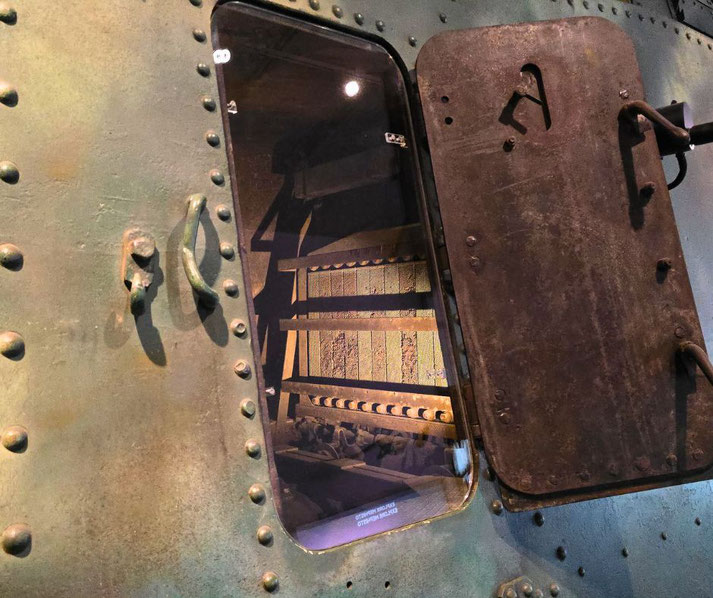
Crews operated in darkness, surrounded by engine fumes and ammunition, as extreme heat built up inside the hull.
Visibility was limited to narrow slits in the armour, which were vulnerable to bullet splash and shrapnel.
Noise from the engine and guns made verbal commands difficult to hear, so some crews resorted to hitting the hull with their fists or to loud shouts above the din.
Temperatures inside the vehicle could regularly reach over 50°C, particularly during summer offensives.
Carbon monoxide poisoning and heatstroke became frequent hazards for many crews.
Life in the tank corps
In British heavy tanks like the Mark IV, the crew included a driver and gearsmen to control steering and transmission, with gunners stationed in each sponson.
Coordination required constant physical effort, and the lack of suspension meant every jolt or shell impact shook the occupants violently.
Mechanical breakdowns often occurred, as tanks sank into soft ground or broke their tracks under strain.
Airflow inside the tank stayed poor, and carbon monoxide levels could rise to deadly levels during long periods in action.
Many soldiers still volunteered for the Tank Corps, which had been officially established on 28 July 1917, because they believed that steel protection offered better odds than crawling across open ground.
Despite the risks, tank crews earned reputations for determination and mechanical skill.
Their presence on the battlefield disrupted enemy lines, even when only a handful reached their objectives.
The British press, eager to highlight innovation, portrayed tanks as "wonder weapons," and tank units soon adopted insignia and camouflage patterns for identification.
Tanks increasingly forced generals to reconsider the balance between firepower and movement.
The capacity of tanks to cross trenches and crush wire under direct fire altered the structure of defence planning and led to new ways for infantry, artillery, and tanks to work together.
Tactical gains remained inconsistent, and technical problems persisted throughout the war, yet the promise of armoured warfare had become very clear by 1918.
Within two decades, the machines that had first crawled across the mud of the Somme would come to dominate future wars.
Theories developed in the interwar years by figures like J.F.C. Fuller and Heinz Guderian drew heavily on these early tank experiences, and this work laid the foundations for mechanised blitzkrieg and armoured doctrine in the Second World War.