
Manipulating the masses: How propaganda was used during World War I
When war erupted in Europe in August 1914, governments faced a very serious challenge: they needed to recruit millions of soldiers, maintain civilian morale, justify severe restrictions on personal freedoms, and fund the growing costs of industrial conflict.
To achieve these aims, state authorities directed a powerful campaign of propaganda that framed the war as a just cause in the hopes that it would transformed public attitudes, and, ultimately, control the flow of information.
From posters that stirred emotional responses to newspaper articles that silenced doubt, propaganda became a primary weapon of psychological warfare that reached into nearly every aspect of daily life.
What is 'propaganda'?
Historically, the term ‘propaganda’ originated from the Latin propagare, which meant “to spread.”
First used by the Catholic Church in 1622 to describe the work of the Congregatio de Propaganda Fide, the word came to mean the planned spread of ideas aimed at promoting a particular belief or course of action.
However, during World War I, the meaning had shifted from religious outreach to state-directed persuasion.
By design, propaganda usually promoted one perspective while excluding or dismissing alternatives.
Governments often framed selected facts, suppressed conflicting information, and used repetition to reinforce public belief in official narratives.
As a result, messages were crafted to persuade rather than to inform. This often meant that writers shortened sentences and simplified slogans so that visual symbols carried messages to broad audiences quickly and clearly.
Importantly, propaganda generally did not rely solely on lies. Instead, it often used real events and twisted them to create an exaggerated and one-sided account.
For example, isolated enemy actions might be presented as typical behaviour, while one nation’s hardships were framed as noble sacrifices.
Authorities made these techniques appear natural by building them into regular news, school lessons, and community life.
How countries used propaganda
At the start of the war, Britain moved quickly to bring much of its messaging under central control.
The War Propaganda Bureau operated from Wellington House and was established in 1914 under the Foreign Office, and it pulled together efforts across newspapers, books, posters, and speeches.
Charles Masterman invited over twenty of Britain’s most respected writers, such as Rudyard Kipling, Arthur Conan Doyle, and John Buchan, who would craft convincing material.
Through stories and poems, these writers described the war as a moral duty and used essays to depict German aggression as a threat to civilisation.
Similarly, French officials put emotional appeals first and, given that large sections of French territory had fallen under German occupation, propaganda often highlighted the need for unity and sacrifice.
Posters depicted peasant women who mourned sons lost at the front, while newspapers described heroic stands in battles such as Verdun, which raged from February to December 1916.
Writers such as Maurice Barrès contributed patriotic stories that supported national resolve.
Officials avoided detailed casualty reports and instead praised soldiers’ endurance.
In contrast, German propaganda was more tightly controlled from the very start.
The Kriegspresseamt was formed in 1914 and was connected to the German General Staff, and it controlled media content and organised the production of patriotic material.
Officials framed Germany’s role as one of defence against encirclement, while also portraying its armies as disciplined and humane.
Illustrated magazines like Illustrierte Kriegszeitung carried these themes to civilian audiences.
At the same time, German leaflets dropped behind Allied lines sought to undermine enemy morale with messages that emphasised futility and loss.
By 1917, the United States had entered the war and immediately established the Committee on Public Information, known as the CPI, which was led by George Creel and founded in April that year.
The committee organised a network of public speakers and writers, along with selected artists.
Public venues became platforms for patriotic messages delivered by ‘Four-Minute Men,’ who gave short speeches that urged people to support the war.
The CPI’s Division of Pictorial Publicity commissioned artists and illustrators, while its publications such as the Official Bulletin sent out over 75 million pamphlets and about 7 million posters.
Posters and school texts promoted themes of American unity and the need to crush the ‘Hun menace,’ and films reinforced the same message for cinema audiences.
Common types of WWI propaganda
One of the most effective tools used by all major powers was the propaganda poster.
These large, brightly coloured images appeared on public buildings and trams, as well as on prominent billboards.
In Britain, the image of Lord Kitchener pointing at the viewer with the phrase “Your Country Needs YOU,” which debuted in 1914, became a recruiting icon.
Over 2.5 million men volunteered in Britain before conscription was introduced in 1916, many influenced by such visual appeals.
Australia produced similar designs, which often showed bronzed soldiers as they marched off heroically or carried messages that were designed to create guilt, like “Will you fight, or wait to be called?”
To influence women, posters encouraged them to support enlistment and to join wartime labour, with a constant emphasis on maintaining morale at home.
Some used guilt or shame, such as one that showed a woman who turned away from a man in civilian clothes with the caption “Is your ‘best boy’ wearing khaki?”
Others portrayed women in uniform or factory gear, reinforcing their role as vital contributors to national victory.
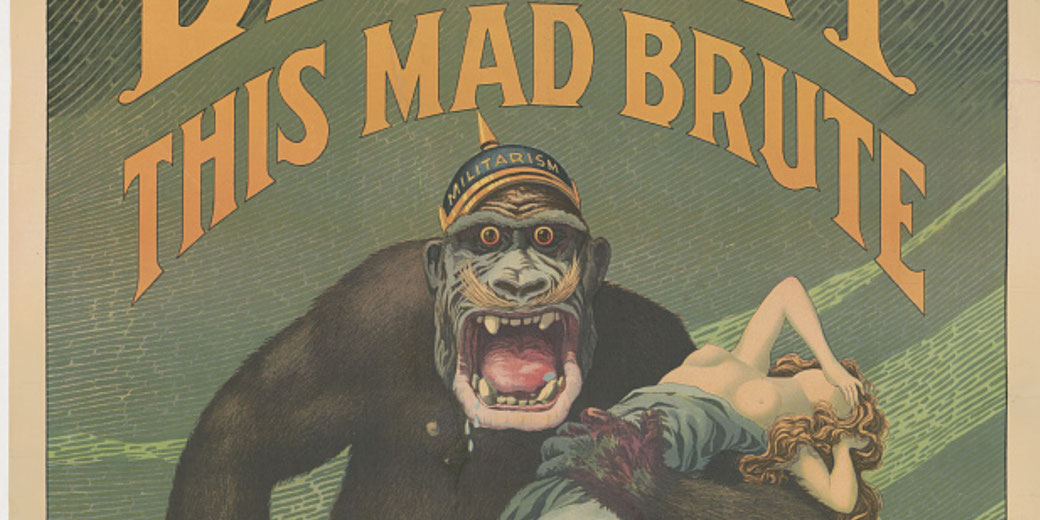
Portraying the enemy as monsters became a standard feature of wartime propaganda in many countries, as many Allied nations regularly described German troops as uncivilised brutes.
Newspapers claimed that German soldiers mutilated civilians and committed atrocities in Belgium.
In May 1915, the British government released the Bryce Report, which had compiled alleged German atrocities based on witness statements.
Stories often relied on unchecked rumours yet were widely accepted by the public and affected neutral countries, especially the United States.
Posters showed the Kaiser as a blood-soaked tyrant or German soldiers depicted as monstrous, helmeted figures that loomed over helpless victims.
To gain influence in neutral countries, both the Allies and Central Powers circulated pamphlets and translated speeches, alongside carefully crafted diplomatic statements.
Their aim focused on shaping foreign opinion and encouraging sympathy or eventual intervention.
Often, such material downplayed military failures while stressing moral righteousness.
The impact on society
Across the nations at war, propaganda often influenced how citizens understood their roles and their enemies, and it gave them a particular explanation of the conflict.
From childhood classrooms to public meeting halls, people encountered images and slogans that explained the war as a necessary and noble effort.
Patriotism became tied to compliance. Those who questioned official messages often risked being labelled unpatriotic or, in some cases, traitorous.
To control the spread of information, most governments imposed censorship laws.
For example, Britain passed the Defence of the Realm Act (DORA) in August 1914, which allowed authorities to ban newspapers and inspect personal mail, with power to imprison those who published ‘damaging’ information.
Under this law, even seemingly trivial offences, such as reporting troop movements or spreading defeatist rumours, could be prosecuted.
This censorship operated alongside propaganda, which meant that citizens received only the version of events that authorities wanted them to believe.
Suspicion of dissenters increased as propaganda encouraged communities to monitor each other’s behaviour.
In Australia, people who had German surnames faced harassment, and government censorship operated through the Chief Censor, while the Australian War Records Section contributed to managing public stories by collecting and selecting materials for official publication.
During the 1916 and 1917 conscription referendums, propaganda efforts saturated newspapers and posters with warnings of national peril.
In the United States, German language instruction largely vanished from public schools, and many German-Americans responded to intense social pressure by purchasing war bonds or publicly demonstrating loyalty.
As such, propaganda helped normalise these acts by presenting loyalty as total and unquestioning.
After the war, many veterans expressed anger at the gap between propaganda and the reality of trench warfare.
Books like All Quiet on the Western Front and memoirs by British poets such as Siegfried Sassoon exposed the trauma, horror, and sense that the fighting had no purpose that wartime messages had ignored.
For many survivors, propaganda had misled them and had cost them their youth, health, or friends.
In 1928, Edward Bernays, a former CPI employee, published Propaganda, which had examined the techniques used during the war and their growing influence on advertising and public relations.
The crucial role of artists and designers
State propaganda would probably not have succeeded without the contribution of visual artists and designers.
It was them that transformed broad political goals into images that sparked emotion and encouraged action, images that stayed fixed in public memory.
These artists often had training in advertising, and they understood how to use striking lettering and strong composition, together with carefully limited colour palettes, to grab attention.
In Britain, Alfred Leete’s design for the Kitchener poster drew influence from commercial advertising, particularly its use of a direct gaze and strong contrast.
French artists such as Abel Faivre and Jules Abel created prints that depicted soldiers who defended villages and farmers who ploughed fields under enemy fire, and they also produced further images of mothers who clutched children near ruins.
Their work combined artistic skill with a clear political message.
Likewise, American illustrators such as James Montgomery Flagg created some of the war’s most recognisable images.
His “I Want YOU for U.S. Army” poster, adapted from Leete’s earlier British version, used clean lines and striking colours to deliver its message quickly.
Meanwhile, Flagg also contributed to posters that promoted war bonds and warned workers not to strike, and these posters often presented national service as a moral and public duty.
Howard Chandler Christy produced equally powerful images, such as “Gee!! I Wish I Were a Man,” which targeted women’s involvement and support.
Visual artists supported not only posters but also propaganda films. British war films such as The Battle of the Somme (1916) mixed real battlefield footage with staged scenes to create a carefully managed emotional response.
French and American filmmakers followed similar approaches, and they used music and narration alongside dramatic imagery to show strength and sacrifice and to suggest eventual victory.
The war gave artists a new level of public attention and state funding, as their work reached millions and often influenced expectations, and it sometimes directed behaviour in ways that continued after the armistice.
While some continued their careers in advertising or commercial design after the armistice, others grew bitterly disappointed with how their art had been used, yet their influence lasted, and their work helped to start the era of modern state propaganda as a permanent feature of warfare.