
How the Wright Brothers were able to achieve the first powered flying aircraft
At the turn of the twentieth century, flight still remained one of the most difficult goals in modern engineering. Glider crashes in Germany and engine fires in France, along with failed launches across the United States, had all ended in disappointment.
Yet in 1903, two brothers from Dayton, Ohio, who had no university degrees or formal aeronautical training, succeeded where others had failed.
They were the very first to lift a man into the air under power and maintain control until he touched the ground.
Their lives before flight
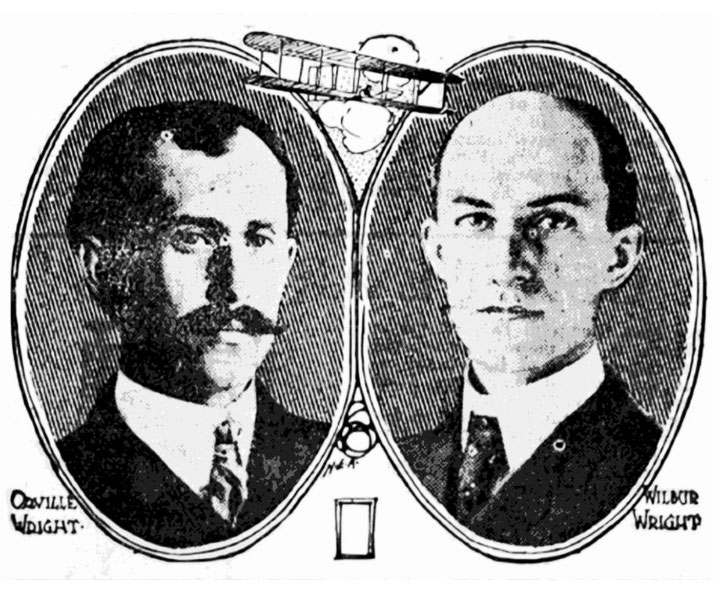
Wilbur and Orville Wright had lived in a home where love of learning and interest in practical experiments received consistent encouragement.
Their father was Milton Wright, who worked as a bishop in the Church of the United Brethren in Christ, and his frequent travels exposed the boys to a wide range of ideas and experiences.
Their mother was Susan Koerner Wright.
Unlike many of their peers, the brothers had relied on independent learning rather than official schooling.
They reportedly often spent hours in the family library studying science and engineering as well as history.
During his teenage years, Wilbur suffered a severe facial injury while he skated on ice, an injury that confined him to the house for months.
During this time, he had read extensively. Meanwhile, Orville had already displayed a strong early interest in mechanical systems and built a printing press from salvaged parts to start a local newspaper with Wilbur’s help.
By 1892, they had opened the Wright Cycle Company in Dayton, at the height of the bicycle craze.
Their work demanded very careful attention and a clear understanding of how to manage speed and weight, along with balance across moving parts.
As a result, their experience with bicycles became directly useful for aircraft design, especially in how they later managed control surfaces and weight distribution, along with structural reinforcement.
Their initial experiments
After they had studied the published research of aviation pioneers like Otto Lilienthal and Octave Chanute, the Wright brothers concluded that prior failures had stemmed from poor control mechanisms rather than inadequate lift or power.
In 1899, Wilbur wrote to the Smithsonian Institution to request aeronautical documents, and he began to experiment with a small biplane kite that used wing-warping to manipulate roll.
This simple but innovative system soon became the foundation of their flight control method.
Over the next three years, the brothers tested full-scale gliders on the sand dunes of Kill Devil Hills, near Kitty Hawk.
They chose the site largely for its steady winds and relatively soft landings in an isolated location.
Their 1900 glider produced disappointing lift that failed to match predicted values based on Lilienthal’s tables, a failure that prompted a return to Dayton and a new look at accepted aerodynamic theories.
They had built a wind tunnel in 1901 that measured approximately 1.8 metres long and 40 centimetres square.
They had also constructed their own balance to measure lift and drag with far greater accuracy than anything previously recorded.
They had tested over 300 different wing shapes, and they had gathered precise lift and drag data for the first time.
Eventually, they applied these experimental findings to their 1902 glider, which incorporated both a vertical rear rudder and their original wing-warping system.
Unlike previous gliders, this version allowed pilots to steer with confidence and adjust for drift so that they could land without veering off course.
The brothers now believed they had solved the problem of control and could proceed to develop a powered aircraft.
The first powered flight
By late 1903, the Wright brothers had constructed their Flyer with a 12-horsepower engine built by their mechanic, Charlie Taylor, that used lightweight aluminium for the crankcase and had hand-carved wooden propellers.
Taylor had worked as a mechanic at the Wright Cycle Company and managed to build an engine light and powerful enough to meet the strict weight limits the Flyer required.
The aircraft spanned approximately 12.3 metres and weighed over 270 kilograms.
It relied on a system of pulleys and chains to synchronise the twin propellers. After a failed launch on 14 December damaged the machine, they repaired it over the next three days and prepared for another attempt.
On 17 December, as freezing winds blew across the dunes, Orville climbed onto the lower wing and gripped the controls.
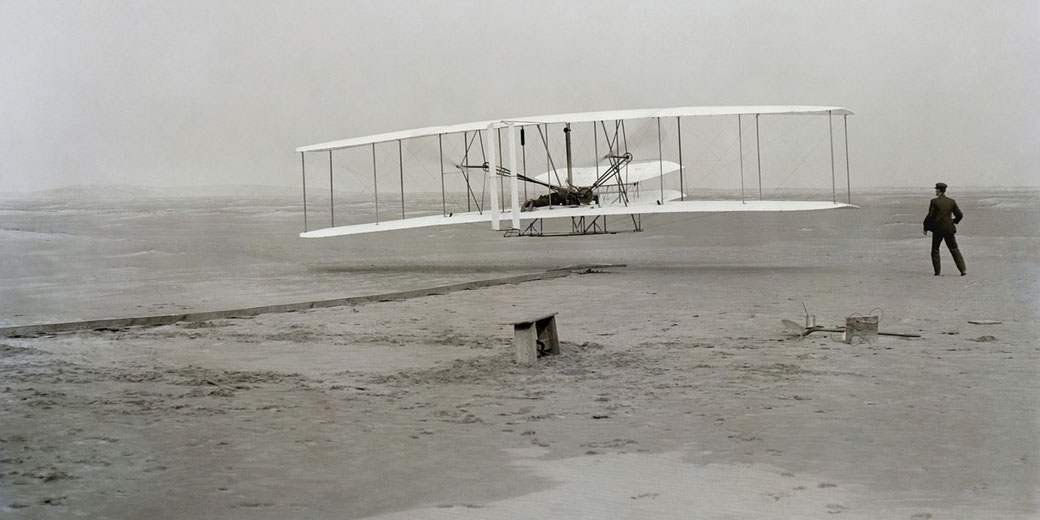
At 10:35 a.m., the Flyer lifted off its track and stayed in the air for 12 seconds, and it covered 36.5 metres.
Three more flights followed that morning. Wilbur’s final flight lasted 59 seconds and travelled 260 metres before the aircraft crashed into the sand.
Moments later, a sudden gust lifted the damaged Flyer and slammed it to the ground, which ended its flying life.
Nevertheless, the goal had been achieved. The Wrights had demonstrated controlled and powered flight that could be sustained in a heavier-than-air machine.
The event was witnessed by five men from the nearby U.S. Life-Saving Service, and a camera captured the precise moment Orville left the ground.
That single photograph became powerful visual proof of an achievement that would soon change the world.
Only weeks before, on 7 October and 8 December 1903, the U.S. government-funded Langley Aerodrome had twice crashed into the Potomac River, which highlighted the contrast between government funding and the Wrights’ modest success.
How the Wright Brothers became famous
Initially, the brothers returned to Dayton and resumed flight tests without public announcement, as they believed their invention still required improvement and that publicity too early might encourage theft of their design.
During 1904 and 1905, they flew from Huffman Prairie, just outside Dayton, where they tested longer flights with the improved Flyer II and Flyer III.
By the end of 1905, they had achieved flights over 30 minutes long with full turns and repeated landings, though few believed their claims due to a lack of press coverage and visual proof.
As a result, American newspapers remained sceptical. Only after securing patent protection and contract negotiations did the Wrights begin public demonstrations.
In 1908, Wilbur travelled to France, where he astonished large crowds at Le Mans as he flew figure-eights and circled past the audience before he landed with pinpoint accuracy.
French aviation pioneer Louis Blériot praised the flights as “greater than anything yet attempted,” while Le Figaro declared the Wrights had “conquered the skies with American discipline.”
His flights convinced the European aviation community that the Wrights had accomplished what others had only promised.
In the same year, Orville demonstrated the Flyer to the U.S. Army at Fort Myer, where he conducted successful tests that satisfied military officials.
After several flights, the Signal Corps agreed in 1909 to purchase a Wright Model A, which is considered to be the beginning of military aviation in the United States.
By 1909, the brothers had become famous global figures, praised in scientific journals and honoured at public events.
What began as a private experiment had now become a recognised technological revolution.
The growing legal battles over patents
After receiving U.S. Patent No. 821,393 in 1906 for their system of three-axis control, the Wright brothers began to use legal action to block competing aircraft builders.
Their patent described the use of wing-warping combined with a moveable rudder to maintain stability, and they argued that ailerons, which were used by rivals such as Glenn Curtiss, had the same purpose.
Soon after, they filed lawsuits against Curtiss and others, because they wanted to prevent use of their system without permission.
These legal disputes consumed much of their time and drew criticism from parts of the aviation community, who viewed the lawsuits as too limiting.
Curtiss responded by challenging whether the patent was valid, and the resulting court battles dragged on for years, which created uncertainty across the American aviation industry.
After Wilbur died of typhoid in 1912, Orville continued the lawsuits but later grew tired of the conflict.
In 1915, he sold his interest in the Wright Company and retired from commercial aviation.
Eventually, in 1917, under pressure from the U.S. government during wartime mobilisation, American aircraft manufacturers entered into a patent pool.
This agreement allowed companies to produce aircraft without further legal complications and ended the patent war that had once dominated the industry.
Why the Wright Brothers were so significant
Thanks to the fact that they solved the problem of controlled flight, the Wright brothers laid much of the foundation for modern aviation.
Their decision to approach the problem through experimentation, rather than speculation or imitation, allowed them to gather reliable data and improve their designs step by step.
Unlike others who had focused only on lift or power, they understood that control was the element that turned a flying machine into a practical invention.
Also, they used wind tunnel testing and mechanical skill, along with patient trial-and-error, to develop a repeatable process for sustained flight.
The Wright Flyer, though very simple by later standards, contained all three essential control surfaces, including an elevator and rudder, plus a roll mechanism, and its design influenced generations of aircraft that followed.
After 1903, aviation in many countries moved rapidly from easily damaged wood-and-cloth machines to metal aircraft that could cross oceans and conduct warfare at high altitudes.
Within ten years of the Wrights’ first flight, aircraft had reached speeds over 160 kilometres per hour and altitudes above 3,000 metres, a rate of technological progress never seen before in human history.
None of this would probably have happened without the Wright brothers’ methods and their insistence on the solution of each technical problem in turn.