
Rise and fall of the Red Baron, Germany's greatest WWI fighter ace
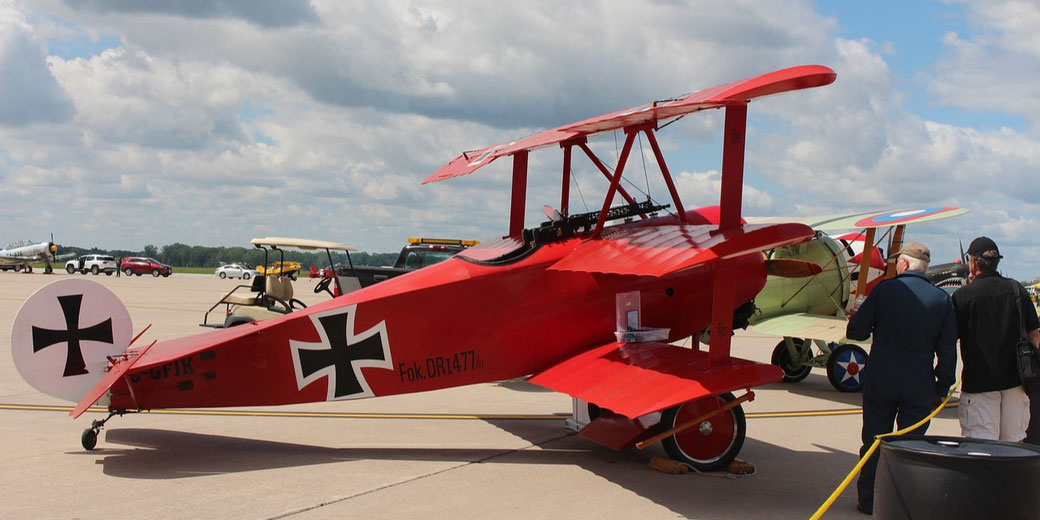
Above the Western Front’s muddy wastelands filled with shell craters, as British and French infantry faced machine-gun fire and artillery barrages on the ground, a different kind of combat raged in the sky.
German fighter pilot Manfred von Richthofen was nicknamed the 'Red Baron' and became famous because he shot down eighty enemy aircraft during the war, more than any other ace.
With his bright red Fokker triplane and strict tactical discipline, he became a symbol of deadly efficiency until a single bullet ended his life near the Somme in April 1918.
Who was the Red Baron?
Manfred Albrecht Freiherr von Richthofen was born on 2 May 1892 in Breslau, then part of the German Empire, into a noble Prussian family that held long military traditions.
After he had received his early education at cadet schools in Wahlstatt and Lichterfelde, he embraced the life of a soldier and received a commission in the 1st Uhlans cavalry regiment in 1911.
At the outbreak of war in August 1914, he deployed to both the Eastern and Western Fronts, where his regiment’s mounted tactics quickly lost relevance.
Barbed wire and machine guns, reinforced by trench systems, made cavalry charges no longer possible. Like many junior officers, Richthofen wanted a more active role.
He transferred to the Imperial German Army Air Service in May 1915.
Initially, he flew as an observer in two-seater reconnaissance planes, where he handled the rear-facing machine gun and gathered intelligence from behind enemy lines.
After he had completed several months of observation missions, he enrolled in pilot training, first in Cologne and then at Johannisthal, where he learned to master increasingly advanced aircraft.
By March 1916, he had qualified as a pilot and received his first posting to a bomber unit.
Soon after, he joined Jagdstaffel 2, a new fighter squadron led by Oswald Boelcke, who was an early expert in air combat tactics and one of Germany’s first celebrated flying aces.
Under Boelcke’s guidance, Richthofen learned disciplined dogfighting techniques that emphasised careful positioning and coordination, with strict attention to timing.
On 17 September 1916, he shot down his first enemy aircraft and saw the beginning of a career that would bring him international fame.
Before long, he had begun to lead missions independently and quickly distinguished himself as a calm and focused pilot.
After Boelcke’s death in October 1916, Richthofen rose to command his own unit.
This allowed him to apply Boelcke's principles with complete control over tactics and operations.
The art of dogfighting in WWI
By 1915, air combat had shifted significantly due to the addition of forward-firing machine guns, which turned scouts and reconnaissance planes into deadly fighters.
Close-range dogfights became increasingly common, often fought at altitudes under 10,000 feet, where visibility and engine power often determined the outcome, along with the turning speed of each aircraft.
Planes were built from wood and fabric, which often made them dangerously vulnerable to gunfire and engine fires, as well as sudden breaks in the structure.
Also, pilots flew without parachutes, and many died from mechanical breakdowns or mid-air fires caused by exposed fuel lines.
To improve survival, experienced pilots relied on careful planning and execution.
Oswald Boelcke’s Dicta Boelcke outlined essential rules such as an attack carried out with the sun behind the aircraft and a clear effort to stay away from enemy formations, and it insisted that pilots must keep the element of surprise.
German pilots trained extensively under these principles. Richthofen committed himself to mastering every element.
After joining Jagdstaffel 2, he flew several Albatros models, including the Albatros D.II and D.III, before transitioning to the Fokker Dr.I triplane in early 1917.
While the Dr.I lacked the speed of French SPADs or British SE.5s, it offered excellent climb performance and agility, particularly at lower altitudes.
Its design was inspired by the British Sopwith Triplane, and it used a rotary engine that provided tight turning control.
Eventually, he had it painted entirely red, both as a mark of confidence and as a weapon that affected the enemy’s morale.
When he took command of Jagdstaffel 11 and later Jagdgeschwader 1, he led from the front, and he often flew multiple missions per day.
His unit was officially named Jagdgeschwader 1 but nicknamed “The Flying Circus” for its vivid aircraft colours and frequent relocations by rail, and it became one of the most feared fighter wings on the Western Front.
Under his leadership and tactical control, the unit maintained control of the air over key areas during 1917.
Whenever it was possible, Richthofen stayed at high altitude and used gravity to generate speed during attacks, so he could dive on distracted or isolated enemies and then break off rather than continue long chases.
He discouraged aerial heroics and stunts, insisting instead on teamwork and focus.
As a result, his squadrons achieved consistently high kill-to-loss ratios.
Why was the Red Barton so deadly?
Unlike many Allied aces who chased glory through dramatic manoeuvres or solo duels, such as Georges Guynemer or Albert Ball, Richthofen prioritised efficiency.
He fired only when certain of a hit and trained his men to follow the same disciplined approach.
Over time, his tally grew because he avoided unnecessary risks and always flew with the advantage.
German confirmation procedures required very careful records, which contained witness reports and enemy crash site checks, and this requirement made Richthofen’s eighty victories particularly well-substantiated.
Due to his growing fame, German newspapers and propaganda posters began portraying him as a knight of the sky.
In January 1917, he received the Pour le Mérite, Germany's highest military honour at the time, after he had reached sixteen confirmed victories.
As recognition spread across Europe, his personal narrative became central to Germany’s effort to keep up Germany’s spirits.
He even published Der Rote Kampfflieger, a memoir that described his early life and his guiding principles in combat, and it also recounted his experience as a squadron leader, though it underwent editing to suit wartime propaganda.
During “Bloody April” of 1917, he shot down 21 aircraft in a single month, and this effort contributed heavily to the disastrous British losses that spring.
Soon after, on 6 July 1917, he suffered a head injury during a mission that fractured his skull and left him temporarily unconscious in the air.
The bullet, which was likely fired by Canadian pilot Donald Cunnell, entered behind his right ear and exited above his left eye, and it left him with long-term symptoms that included nausea and confusion, along with severe headaches.
Despite medical concerns and repeated requests to ground him, he returned to combat within weeks.
He remained determined to lead and continued to fly regularly. By April 1918, he had achieved 80 confirmed victories, a figure no Allied pilot would match before the end of the war.
What happened to the Red Baron?
On 21 April 1918, his patrol flew above the Somme River near Vaux-sur-Somme under his leadership, and they entered a dogfight with members of No. 209 Squadron of the Royal Air Force.
During the engagement, he spotted and pursued Canadian pilot Lieutenant Wilfrid “Wop” May, who had broken formation and appeared unaware of the danger behind him.
As he followed May at low altitude across enemy lines, Captain Arthur “Roy” Brown, another Canadian pilot, attempted to intervene and fired at Richthofen’s triplane from above.
At the same time, Australian ground troops from the 24th and 53rd Batteries, who were positioned along the ridge, opened fire with machine guns as the red Fokker flew within range.
Moments later, Richthofen’s aircraft slowed and descended rapidly, eventually landing in a field near Vaux-sur-Somme.
When Allied troops reached the crash site, they found him dead with a single bullet wound that had entered his right side and passed through his chest.
A medical examination after his death showed that the shot had most likely been fired from the ground.
While British authorities credited Brown with the kill, later investigations, based on a study of the bullet’s path and eyewitness accounts, pointed to Australian machine-gunners, particularly Sergeant Cedric Popkin, as the most probable source of the fatal shot.
However, the official record remained unchanged.
Out of respect for his skill and reputation, British officers buried Richthofen with full military honours at Bertangles Cemetery.
A wooden cross was placed over his grave, and Australian airmen carried the coffin.
In 1925, his body was returned to Germany and later reinterred in Berlin before being moved to a family plot in Wiesbaden’s Südfriedhof Cemetery in 1975.
By the time of his death, Manfred von Richthofen had become, in the view of many contemporaries, Germany’s most effective pilot and a symbol of strict control in a war increasingly defined by mechanical slaughter.