
The eerily abandoned 17th century streets that still survive, hidden underneath Edinburgh
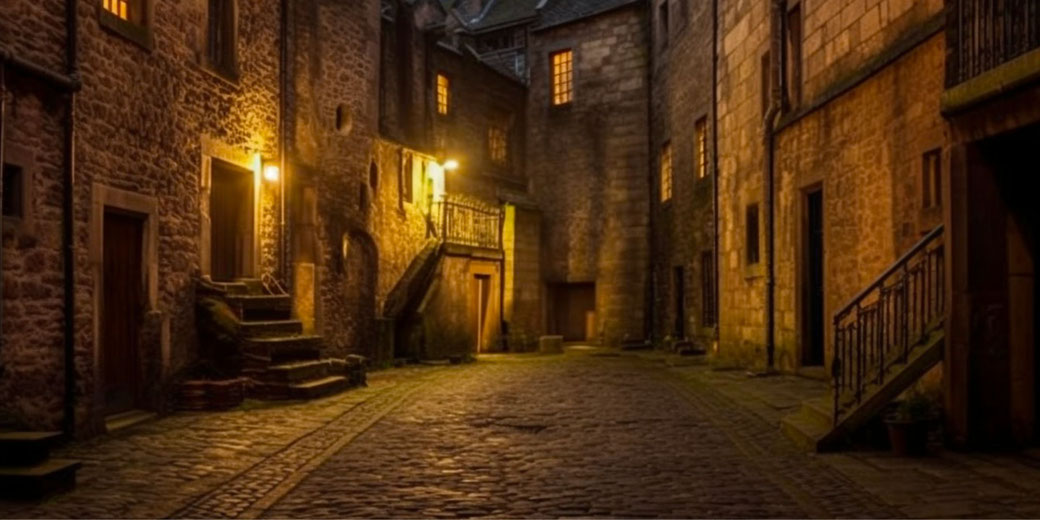
Beneath Edinburgh’s Royal Mile, sealed in stone and shadow, an entire section of the 17th century city has largely been preserved and shut off from the light.
At the heart of this forgotten space lies Mary King’s Close, once a busy street often packed with tradesmen, merchants, and families who lived and worked among the cramped tenements.
Now buried beneath the City Chambers, its walls still contain soot from hearths long extinguished, and the silence in its narrow corridors continues to raise questions about the lives lost and the history of the plague concealed beneath the present.
Early history of Edinburgh’s closes
During the early modern period, the physical limits of Edinburgh’s fortified walls forced residents to build upwards and to stack homes and workshops along steep alleyways that were known as closes and wynds.
Because these narrow passages extended from the central spine of the Royal Mile, they became vital arteries of daily life, where multi-storey buildings often stood shoulder to shoulder and could rise as high as fourteen storeys in some places.
As families lived above, below, and beside each other in tight proximity, the street level had grown darker and more crowded.
Faecal waste often trickled down central gutters, food scraps frequently piled in corners, and household smoke usually drifted between windows.
Within this dense network, Mary King’s Close took its name from a textile merchant named Mary King, who, by 1635, appeared in Edinburgh’s city records as a burgess and property holder with full voting rights.
Born into a well-connected family, she had inherited property from her deceased husband and used it to establish her commercial position within the city.
Her status as a voting citizen and trader made her an unusual figure, since very few women in 17th century Scotland occupied positions of recognised economic authority.
Before long, her name became attached to one of the city’s most populated closes, which included artisans, minor professionals, and householders who operated shops from the ground floors of the same buildings in which they slept.
Shared water sources, outdoor privies, and open refuse channels made sanitation difficult, and living conditions, though typical for the time, often placed health at risk.
Plague, quarantine, and the horrors of 1645
At the height of the summer of 1645, the plague descended on Edinburgh, spread rapidly through overcrowded closes, and killed as many as ten thousand residents in a matter of weeks, which likely amounted to around a quarter or a third of the city’s population at the time.
As symptoms appeared in one household after another, the council authorised strict quarantine measures that sealed entire families inside their homes.
Infected buildings received marks, and food deliveries were left at doors that no one dared to open.
Inside Mary King’s Close, the disease spread very quickly because within cramped rooms connected by narrow stairs and shared landings, infected residents passed the plague to neighbours before city officials could isolate them.
Waste overflowed from privies, clean water ran short, and despair spread faster than the rats that carried the fleas believed to cause the outbreak.
Accounts from later periods described a plague doctor figure often referred to as George Rae, who supposedly entered the close in a long coat, wide-brimmed hat, and bird-like mask packed with dried flowers.
His name does not appear in any known 17th-century records and likely originated in later Victorian storytelling or modern promotional material.
Nevertheless, the plague doctor image became central to the site’s identity, and replicas of his outfit now greet visitors who descend into the underground remains.
Meanwhile, outside the close, bodies piled in carts that were bound for mass graves in the South Leith burial ground and established cemeteries such as Greyfriars Kirkyard.
Residents whispered stories of entire households supposedly locked inside until the last inhabitant had died.
Over time, these tales became tangled with ghost stories, and Mary King’s Close became known as a place where the dead never left.
Urban development and the burial of the streets
By the middle of the 18th century, Edinburgh’s city authorities had committed to improving the overcrowded Old Town, and they had begun building projects that updated how the city worked and looked.
In 1753, work began on the Royal Exchange, a grand new public building that was designed by architect John Adam to support commercial activity and improve the city’s status.
Completed in 1760, the structure showed a major change in Edinburgh’s buildings and public identity as a city.
Instead of clearing the entire site, engineers retained the lower levels of several closes and simply built over them, and this sealed rooms, stairwells, and entire alleyways beneath vaulted ceilings and newly poured foundations.
Over time, the upper levels of the close had vanished from view, while the street below had remained largely structurally intact.
Rather than face demolition, many rooms were enclosed behind walls and left to fall into darkness.
Although official plans documented the presence of old chambers, public awareness faded, and few outside the council understood that a network of buried streets remained beneath the City Chambers.
Eventually, informal stories of mysterious noises and chill air surfaced among workers and residents.
Some believed that forgotten rooms had survived intact, but without clear access or public interest, no one made a serious effort to investigate.
Yet under the weight of the new city above, the structures endured.
Rediscovery and modern public access
During the late 20th century, renewed interest in Edinburgh’s architectural past led historians and archaeologists to examine forgotten structures beneath the Old Town.
By the 1980s, surveyors confirmed that several closes had survived under the City Chambers, and this group included Mary King’s, with many rooms still generally safe and stable.
Since soot still blackened fireplaces and marks covered some of the stone doorways, which may have included graffiti or later additions, researchers had uncovered preserved artefacts and original flooring that had not seen daylight in over two centuries.
Eventually, after careful preservation, the site reopened in 2003 as a heritage attraction that was named ‘The Real Mary King’s Close’.
Because of this, tourists now walk through dimly lit corridors and hear stories of plague and of families who later abandoned the close as the city changed around them, which helps keep visitor numbers high and places the site among Edinburgh’s most visited attractions.
Guides in period costume lead visitors into rooms where original beams and stone walls are still unchanged, and this gives a clearer picture of a world that survived by chance rather than design.
Recovered artefacts, such as fragments of ceramic bowls, rusted keys, a child’s shoe, and remnants of tools, help historians to reconstruct parts of daily life that written records had long neglected.
Some rooms feature recreated furnishings based on typical 17th-century probate inventories and descriptions written at the time from similar households, while others are bare, and their walls have begun to fall apart and now lie exposed as a reminder of the site’s age.
Occasionally, visitors report unexplained sounds or cold drafts, and some leave small toys in “Annie’s Room,” said to belong to the ghost of a child who died during the plague and whose spirit stays unsettled.
Though such tales lack documentary support, their emotional power helps sustain the close’s role as a site of memory and storytelling.
Why these hidden streets still matter
Today, Mary King’s Close continues to act as a valuable historical resource and a rare physical survival of early modern urban life in Scotland.
Few cities in Europe contain fully intact examples of 17th-century streets that are preserved beneath later buildings, though some comparisons can be made with underground ruins in Naples or the layers of ruins beneath Rome.
Even fewer places still allow the public to walk through those spaces, and the accidental preservation caused by 18th-century construction methods has turned the site into a time capsule, and this has locked away the physical traces of lives lived long ago.
Within its stone walls, evidence of disease, poverty, trade, and community interaction largely stays frozen in place, and since this evidence survives in that form, the close offers archaeological material and also provides a way to study public health, social structure, and civic responses to crisis for historians.
Each crack in the wall and soot-darkened beam still carries meaning, and this shows how past generations adapted to daily hardship.
For those who enter the close, the experience often stays with them long after they return to street level because the weight of the air, the uneven floor beneath their feet, and the knowledge that entire families once lived and died in silence beneath the city above, turns a visit into something more than a simple look around.
It becomes an encounter with the past that can feel too real to ignore.