
The unsolved Mary Celeste mystery: A real ghost ship found sailing without a crew
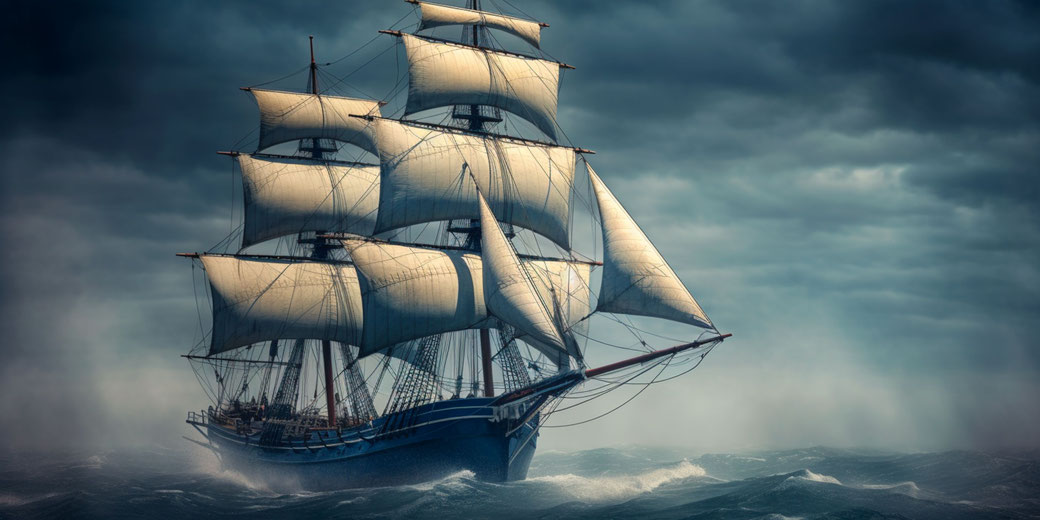
In December 1872, sailors aboard the British brigantine Dei Gratia came across a ghostly sight that would puzzle many investigators for generations.
Roughly 600 kilometres west of Portugal, near the Azores, they found the Mary Celeste drifting with her sails partially raised, her hull intact, her cargo untouched, and no one on board.
With food still in the galley, personal effects neatly stored, and the lifeboat missing, the vessel appeared recently abandoned under mysterious circumstances that no official inquiry ever managed to explain fully.
How was the Mary Celeste built?
Originally constructed in 1861 at Spencer’s Island, Nova Scotia, the ship launched under the name Amazon and soon developed an unlucky reputation.
Her early career had involved a series of incidents that included a collision and the death of her first captain, and that had led to multiple changes in ownership.
By 1869, the vessel had been thoroughly repaired and altered and renamed Mary Celeste, and she now had a reinforced hull and modified rigging that improved her speed and reliability.
At the time of her final voyage, she measured just over 30 metres in length, weighed 282 gross tons, and carried a full brigantine sail plan.
Her new owner and captain was Benjamin Spooner Briggs, and he had built a reputation as a sober, devout seaman, which made the events of that voyage seem all the more puzzling.
What we know about the fateful voyage
For the trip to Italy, Briggs departed New York on 7 November 1872, accompanied by his wife Sarah, their two-year-old daughter Sophia, and a crew of seven men.
The ship’s manifest listed over 1,700 barrels of industrial methanol that were intended for delivery in Genoa.
According to the logbook, the voyage had continued without any recorded trouble for over two weeks, with the final entry recorded on 25 November, which had placed the ship near the Azores.
That entry described moderate weather conditions and a sighting of Santa Maria Island.
After that point, no further notes appeared in the record. When Captain David Morehouse of the Dei Gratia spotted the strange movement of the vessel on 4 December, he already knew Briggs personally, and he ordered his crew to board and inspect it.
Mary Celeste investigation
Once aboard, the sailors found no bodies or signs of violence and discovered nothing that clearly explained the evacuation.
The sails had torn in places, though reports did not consistently specify which ones, and the ship remained stable.
Several barrels, nine in total, had been found empty, likely due to seepage from the red oak planks that let liquid seep out, and charts in the captain’s cabin showed signs of water damage.
Although the lifeboat had vanished, all cargo apart from the damaged casks remained in place.
More importantly, the crew’s clothing, valuables, and even a sewing machine still sat in their proper places, which suggested no robbery had occurred.
Meals in the galley appeared untouched. The ship’s clock had stopped, and the compass lay broken, yet the vessel drifted with no water in the hold.
First Mate Oliver Deveau led the inspection and reported that the vessel seemed abandoned in haste, and the crew had stayed calm rather than panicking.
As required by maritime law, the Dei Gratia towed the Mary Celeste to Gibraltar, where Vice-Admiralty Attorney Frederick Solly-Flood conducted a formal inquiry.
At first, he suspected foul play, so he closely examined the salvage crew’s actions, guessed that insurance fraud might be involved, and suggested mutiny or violence as potential causes.
The inquiry began on 17 December 1872 and involved detailed statements from both crews.
However, the inquiry found no proof that Morehouse or his men had interfered with the vessel.
Briggs had enjoyed the clear confidence of shipping agents, and the crew had apparently been handpicked for their experience.
In the end, authorities granted salvage payment to the Dei Gratia crew, though at a somewhat reduced rate, which showed ongoing doubts even though there was no evidence.
Mary Celeste mystery theories
During the decades that followed, some maritime historians examined the broken barrels and proposed that alcohol fumes might have created a potentially dangerous build-up of gas.
Under such conditions, any spark could have triggered an explosion, prompting Briggs to evacuate temporarily.
According to this theory, a rope may have attached the lifeboat to the main vessel and then snapped, separating the crew permanently.
Others turned to events in nature, such as rogue waves and waterspouts, which might have struck the ship without leaving major damage.
A few speculated about piracy, but the presence of valuable goods and intact belongings made that scenario unlikely.
In recent years, researchers such as Dr. Andrea Sella have set off methanol gas explosions in laboratory tests, and the results showed that such an event could produce a blast force strong enough to frighten a crew without leaving scorch marks, even when simulated with butane rather than methanol.
By the late nineteenth century, the ship’s reputation as a cursed vessel had taken root.
After she had been sold multiple times, the Mary Celeste came to her final end in January 1885 when her then-owner, G. C. Parker, deliberately grounded her near Port-au-Prince in a failed insurance scam.
Parker had loaded the ship with a worthless cargo and exaggerated its value in insurance claims, though investigators quickly uncovered the fraud.
Though the scheme failed, the ship’s name survived, made very well known in a bad way by the events of 1872 and by popular literature.
In January 1884, Arthur Conan Doyle published in The Cornhill Magazine a made-up version of the story that was titled J. Habakuk Jephson’s Statement, without giving his name, which renamed the ship and fabricated a violent ending.
It was this version that influenced public imagination for decades to come.
Has modern science helped find the answer?
In more recent times, researchers have approached the case with scientific methods, so some have re-examined the chemical behaviour of methanol and concluded that fumes from the cargo could have escaped and created a short-term danger.
Experts also explored ocean current models to determine how long a lifeboat might drift before it could no longer be found.
Despite those efforts, no solid evidence has appeared to confirm any one hypothesis, and the lack of physical remains, combined with the loss of firsthand accounts, has left the mystery firmly in the area of educated guesses.
Today, the Mary Celeste is still perhaps one of the most mysterious maritime cases ever recorded, as historians have reviewed thousands of pages of testimony, examined every believable explanation, and yet still find themselves unable to answer the most pressing question.
Why would a capable captain, his family, and a trusted crew suddenly abandon a ship that remained seaworthy, properly provisioned, and only days from port?
The silence of the Atlantic has never answered.