
Voyages of despair: The harsh reality of life aboard 18th century convict ships to Australia

During the final decades of the 18th century, the British penal system struggled increasingly to contain its growing convict population, with prisons overcrowded and crime rates increasing in urban centres such as London, Bristol, and Liverpool.
After the American colonies had stopped receiving prisoners in 1783, British officials searched for a distant alternative and identified the eastern coast of Australia as a suitable destination.
As a result, thousands of men, women, and children sentenced to transportation boarded convict ships that carried them over 24,000 kilometres of open ocean, where they faced illness, starvation, confinement, and cruelty long before they reached the penal colonies that awaited them.
Between 1788 and 1868, approximately 164,000 convicts were transported to Australia, and many endured voyages that lasted from three to six months, a length which varied according to the route and the weather conditions at sea.
Welcome aboard, prisoner...
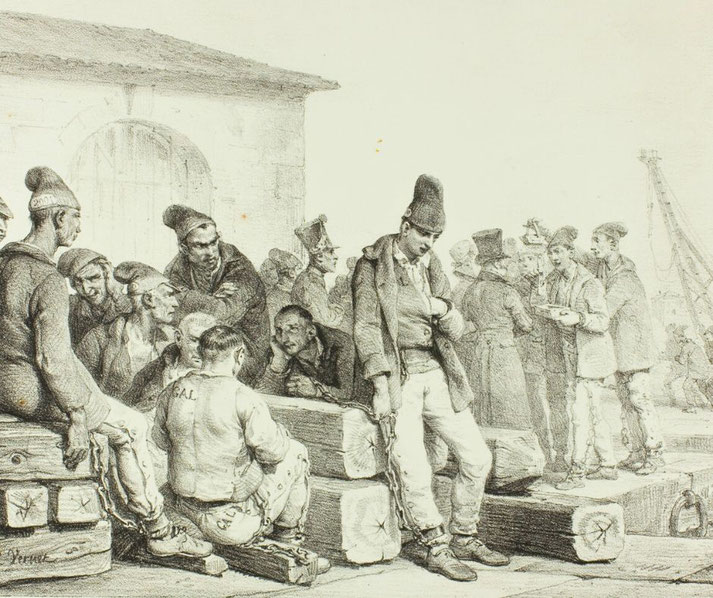
At the start of the journey, prisoners left behind cramped, disease-ridden gaols and marched in chains to the wharves, where naval vessels or merchant ships waited in the docks.
Many had been held in grim, overcrowded prisons such as Newgate or Southwark, where typhus and poor sanitation had already taken a toll.
Once aboard, they came under the command of the ship’s captain and, when assigned, a naval surgeon whose authority over prisoner health could overrule even the master of the vessel.
During the First Fleet of 1787, some convicts remained confined below deck for weeks before departure, as the ships had had problems getting supplies, had gone through inspections, and had waited for orders from the Admiralty.
During this time, poor ventilation and limited access to fresh water allowed disease to take hold before the ships had even left English waters.
Below deck, conditions often quickly got worse, as space had been measured by cubic foot rather than human needs, and sleeping platforms or hammocks often forced men to lie shoulder to shoulder in stifling darkness.
Early in the voyage, prisoners often remained chained together, and the lack of movement caused sores, infections, and respiratory illnesses to spread rapidly.
On some ships, water supplies became unsafe to drink within the first month, and buckets used for sanitation overflowed during heavy seas.
For example, the Neptune in the Second Fleet left 146 convicts dead by the time it arrived in Sydney in 1790, with many more extremely thin, diseased, or permanently injured.
In fact, the Neptune became notorious for its cruelty, with a mortality rate of nearly 30 percent.
In comparison, on the Alexander, eleven convicts died during its 1787 voyage, which people at the time saw as a successful crossing.
Food distribution usually followed a strict ration system. Prisoners usually received salted pork or beef, hard biscuit, and occasionally dried peas or oatmeal.
However, weevils infested the flour and biscuits on many voyages, and mould ruined meat supplies in humid conditions.
Also, when provisions ran low, convicts lost access to enough food to stay healthy, and scurvy became widespread among those unable to digest the limited diet.
In many cases, female convicts received even less protection. Aboard the Lady Juliana in 1789, many of the female convicts reported sexual abuse, and some officers formed informal arrangements with prisoners during the crossing, which officials later failed to investigate.
In most cases, the crew viewed female prisoners as part of the voyage’s inconvenience, and their treatment rarely met any basic standard of care.
Clothing for both men and women often consisted of reused or ill-fitting garments, which offered little protection from the cold or damp.
When weather allowed, prisoners sometimes accessed the deck for brief periods of exercise.
During those hours, guards supervised drills intended to keep bodies moving and reduce the spread of disease.
However, heavy seas often forced captains to keep prisoners below deck for days or even weeks, which led to suffocation, outbreaks of lice, and violent fights among desperate men.
At times, convicts died in their sleep and remained undiscovered until morning.
Although naval officers held better quarters with windows, fresh provisions, and sleeping cabins, their contact with the lower decks was limited, and few ever descended to inspect the prison holds.
While surgeons recorded the deaths of prisoners and the illnesses and punishments that afflicted them, their authority depended entirely on the captain’s willingness to cooperate.
How bad were the conditions?
Under the system used throughout the First and Second Fleets, shipowners whom the government hired often prioritised profit over survival.
In theory, captains received payment based on the number of prisoners landed alive.
However, this system failed when bribes, fake records, and the lack of proper checks allowed owners to cut costs on food, water, and medical supplies.
The private shipping firm Camden, Calvert & King operated many of the Second Fleet vessels and eventually became well-known for their horrible treatments of the people.
On the Britannia, reports later showed that rations had been reduced so much that prisoners fought over scraps, and evidence suggested that surplus food had already been sold for profit upon arrival in the colony.
In practice, contractors delivered convicts in barely living condition, and the penal system took on the cost of care once the ships had docked in Sydney Cove.
Reports by colonial officials such as David Collins in his 1798 Account of the English Colony in New South Wales condemned the brutality and greed of transport operators.
From 1801 onwards, British authorities had attempted to improve standards by requiring that every convict transport carry a qualified naval surgeon.
Those surgeons recorded detailed daily logs, which included notes on prisoner health and behaviour, along with counts of deaths.
Some surgeons, such as Dr William Redfern, enforced better hygiene and introduced routines for washing clothing and thoroughly cleaning bedding to kill germs.
By the 1820s, many ships had begun to carry lemon juice to prevent scurvy, and captains received instructions to permit daily access to the deck for physical activity, when possible.
Even so, improvements remained inconsistent, as ship design had not prioritised prisoner health, and ventilation in the lower decks remained inadequate on many vessels.
Medical supplies were often not enough, especially during outbreaks of fever or when storms delayed port access.
Some surgeons kept strict control and enforced hygiene orders, yet others recorded that they had been ignored or overruled by captains concerned with preserving authority.
Surgeons such as Dr John White, who sailed on the Charlotte, noted the difficulty of applying standards without cooperation from the rest of the crew, especially during long crossings where tension between officers and crew sometimes turned into open hostility.
By the 1830s, improved ship construction, better routing through ports like Rio de Janeiro or the Cape of Good Hope, and shorter travel times reduced the number of deaths during transportation, as stopovers allowed for medical evacuation, resupply, and fresh provisions.
However, conditions still varied between voyages, as success depended heavily on the character and discipline of those in charge.
On poorly managed ships, prisoners could continue to experience starvation and neglect, along with brutal punishments for minor offences.
Daily life for convicts often remained filled with physical pain and recurring illness, along with the constant fear of dying without ceremony and being cast into the sea without notice.
On some voyages, convicts were listed in records only by number, not by name, which reinforced their status as dehumanised cargo.
Attempts to improve things
Over time, pressure from reformers and critical reports in newspapers and books led to political action in Britain, as reports of high death tolls and shipboard mistreatment prompted MPs and reform societies to call for tighter government control.
Religious groups, particularly Quaker organisations, published pamphlets describing the horror of convict voyages and demanded that transportation adopt the standards expected in military or naval transport.
In response, the Admiralty expanded the role of surgeons, set up clear inspection procedures before departure, and required reports to be submitted after each voyage for official review.
In 1815, the Colonial Office established a Transportation Board to oversee the use of new policies.
Many of the most effective changes appeared to have come from reforms implemented by naval surgeons who witnessed suffering firsthand.
After he had returned to civilian life, Redfern submitted recommendations to the Governor of New South Wales that became standard for later voyages.
His proposals included regulated air circulation, regular cleaning routines, and provisions for medical segregation of the sick.
Meanwhile, officials in London issued new instructions to transport captains, which specified maximum occupancy for holds and required a minimum level of food and clothing.
As those measures were put into practice, often later than planned, they reduced mortality and increased prisoner recovery rates once ships docked.
For example, the Hougoumont (the last every convict ship) carried 280 convicts in 1868, among them 62 Irish political prisoners known as Fenians, and had a full medical team, religious personnel such as Father Bernard Delany, and office staff who enforced proper treatment throughout the voyage.
As a result, the final decades of transportation showed clear improvement, since between 1850 and 1868 fewer convicts died during passage, and fewer arrived permanently disabled by disease.
Better design, stricter rationing schedules, regular medical inspections, and improved discipline helped convert transportation from a floating death sentence into a brutal but survivable relocation.
Although transportation ended, the impact of the voyages endured, as survivors of early convict ships described the journey as a descent into horror, where the isolation of the voyage and the enforced confinement, combined with persistent neglect, reduced them to desperation.
For many, the ocean crossing remained the most punishing stage of their sentence, and even those who eventually secured their freedom in Australia carried memories of suffering that no pardon could erase.
Their stories in letters, diaries, and official records still continue to show the cruelty of a penal policy that treated human life as disposable cargo.
In fact, the testimonies from former convicts such as Mary Wade and Frederick Bicknell later helped to inform debates on the ethics of transportation and the cost of imperial punishment.