
The incredible Inca fortress of Sacsayhuamán that defied conquerors and time
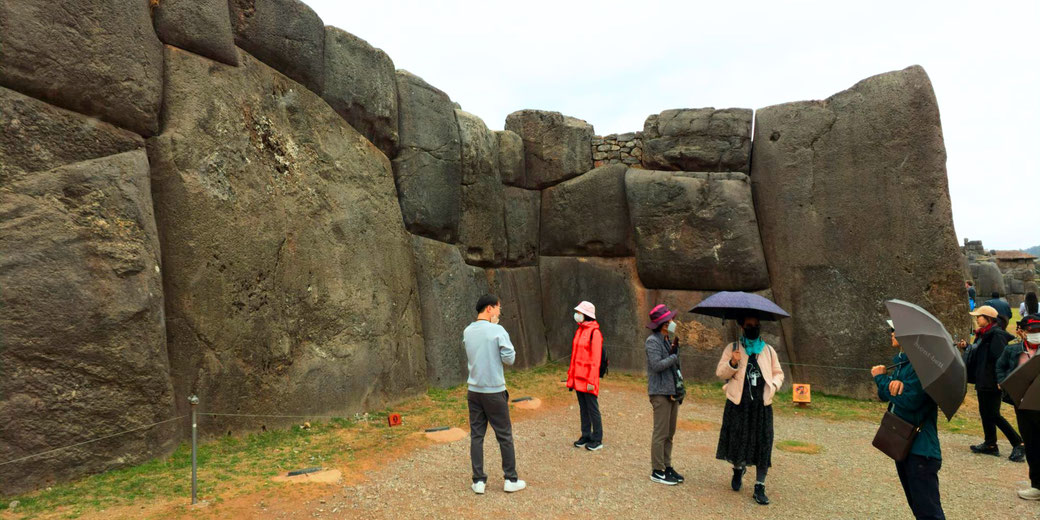
High above the city of Cusco, where the Andes met steep ridges and sacred peaks, the large fortress of Sacsayhuamán dominated the surrounding land and showed the power of the Inca state.
Built from stones that weighed up to 120 tonnes and locked together very precisely, the structure combined ceremonial scale with a practical military purpose.
Even after partial damage by colonial forces, the remaining walls kept enough of their original strength and accuracy to survive earthquakes and the passing of time, which offered clear evidence that the Inca organised workers and built planned stone works.
Why military expansion was important to the Inca
By the early 1200s, Quechua-speaking leaders had begun to increase control in the Cusco Valley by using alliances, threats, and targeted attacks to bring neighbouring communities under their control.
Then, during the reign of Pachacuti Inca Yupanqui from around 1438, expansion became organised.
He reorganised the Inca state to support ongoing conquest, as provincial governors, military officers, and ritual specialists were sent across newly acquired regions to secure them for the Sapa Inca.
As expansion accelerated, conquered regions typically provided tribute such as food, gold, textiles, and labour.
For example, the mit’a system allowed the state to draw on large numbers of conscripted workers when required for construction, farming, and military service.
Regional leaders, once brought under Inca control, generally supplied resources and fighters, while imperial roads and administrative centres allowed close control.
As a result, fortified sites like Sacsayhuamán became vital to keeping order, as they offered high platforms for observation, defences against rebellion, and ceremonial spaces where the emperor's sacred status could be shown again.
Who built Sacsayhuamán?
According to early chroniclers such as Pedro Cieza de León and Garcilaso de la Vega, the fortress began under the orders of Pachacuti, who had already changed Cusco’s city layout and temple precincts.
Túcpac Inca Yupanqui was Pachacuti's son and he had continued construction and had extended the original plan into a very large project that required decades of labour.
Under their command, thousands of workers from across the empire had gathered to shape and move stone, with chroniclers like Garcilaso de la Vega estimating that as many as 20,000 to 30,000 labourers may have taken part at different stages.
Each group must have fulfilled its duties under the rotating labour duty that formed the basis of state infrastructure.
Engineers chose quarries, some of which were more than 20 kilometres from the site, such as Rumicolca and Yuraq Rumi.
They had selected diorite and andesite, which generally resisted erosion yet could be worked with pounding stones and bronze chisels.
Since the Inca lacked wheels and work animals, the blocks had to be pulled, lifted, and guided with wooden sledges, ropes, and a coordinated human force.
Once on site, each stone had been shaped to match its neighbours very precisely.
To do this, workers had trimmed and adjusted edges until no mortar was required, and teams had rotated through shifts to meet quotas set by imperial supervisors.
The astonishing architecture of Sacsayhuamán
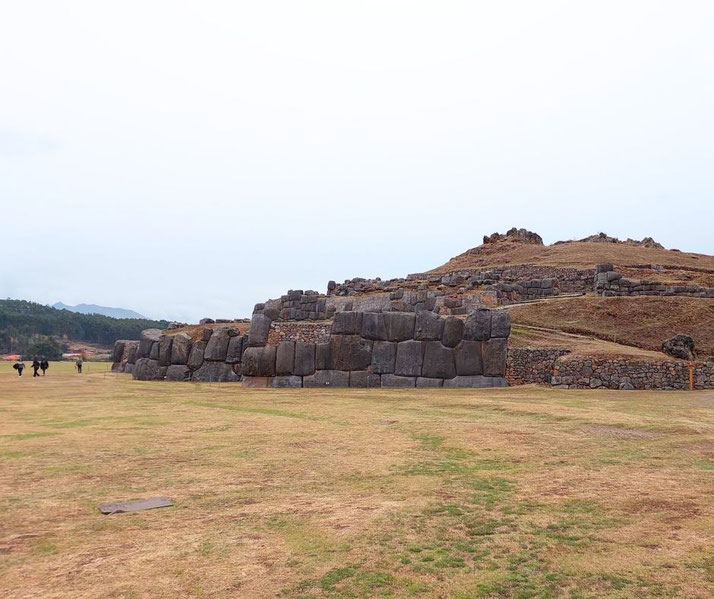
Built on a steep rise to the north of Cusco, Sacsayhuamán was both a fortress and a ceremonial site.
Its three large outer walls formed a stepped zigzag shape that slowed enemy movement and helped absorb earthquakes.
Each stone had been carved to fit together precisely with the stones around it.
One famous example is the 12 angled stone in a Cusco wall, which shows the same masonry method but is not part of Sacsayhuamán.
Even today, joints between the blocks remain so tight that a knife blade cannot slip through the seams.
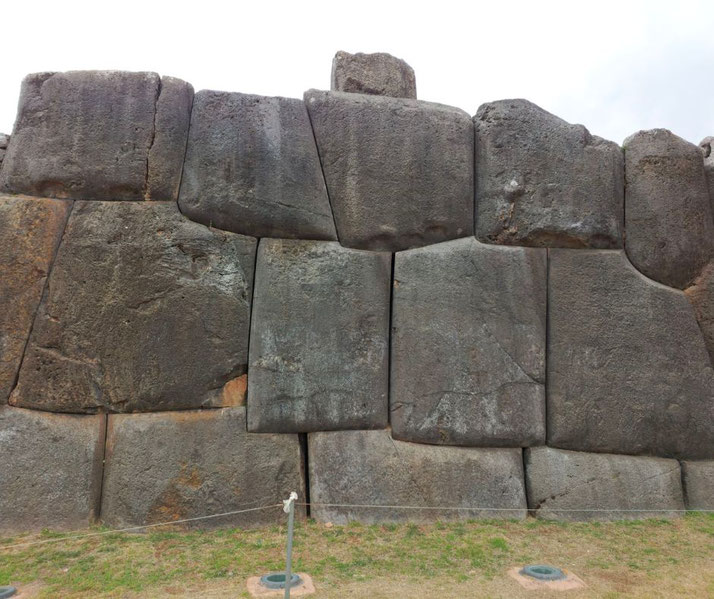
Each tier of the wall stepped inward, spreading weight and making collapse less likely.
Engineers angled the blocks in multiple directions, forming many-sided shapes that reduced pressure on weak points and made the wall more flexible under force.
Builders also carved staircases, platforms, drains, and underground channels into the natural bedrock, and they used the natural rock and ground as part of the fortress layout.
Carvers shaped natural outcrops into ceremonial thrones and smoothed surfaces into ritual slides and steps.
The most important surviving features of the ruins
Today, the most notable features that remain are the three large defensive walls, each of which stretched over 400 metres in length and rose up to 6 metres in height, anchored by stones that weigh as much as 120 tonnes.
Since Spanish colonists removed many of the smaller blocks, the surviving sections now show only the fortress’s lower layers.
Even so, their engineering still impresses. Many stones appear to have between 8 and 12 angled sides, allowing each to rest securely among its neighbours while spreading force in many directions.
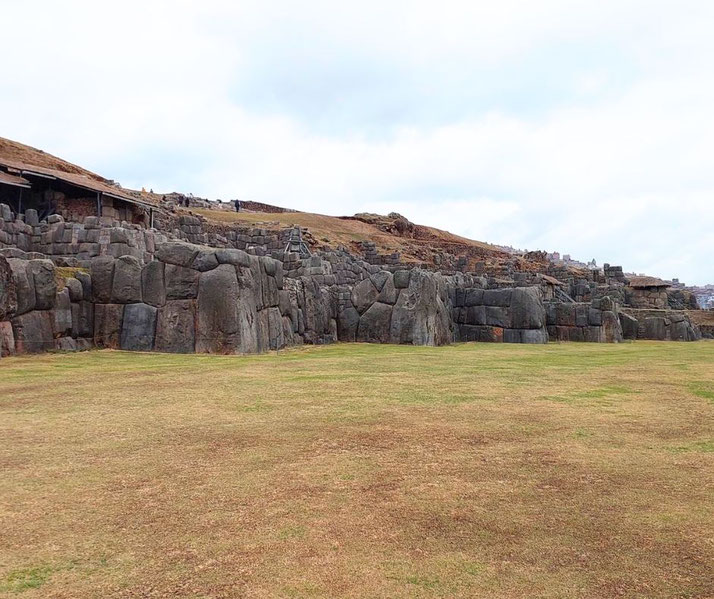
Nearby, the remains of the central towers, Muyuq Marka, Sallac Marka, and Paucarmarca, indicate what once served as command posts, ceremonial areas, or places used to observe the sky.
Only the foundations of Muyuq Marka survive in any substantial way, but chroniclers wrote about a circular, multi-tiered tower that had underground chambers and a water reservoir.
Around it, smaller features like the Rodadero and the Inca Throne still show deliberate shaping of bedrock for ritual use.
Beneath the surface, tunnels, drains, and carved channels extended through the hill, which showed a level of planning that combined lookout points and sturdy defences with platforms designed for ritual use.
Archaeological surveys have also identified solar alignments among several key features, which suggested that Sacsayhuamán likely worked as a place for observing the sky.
From its high platforms, priests could track the sun during solstices and equinoxes, which helped to explain why the site was so large.
When the Spanish attacked Sacsayhuamán
Following the taking of Cusco in 1533 and the execution of Atahualpa, Spanish control in the Andes remained unstable.
So in 1536, Manco Inca Yupanqui launched a major rebellion and he reportedly fielded tens of thousands of warriors against a Spanish force in Cusco that numbered only a few hundred, seizing control of Sacsayhuamán.
From its heights, Inca forces threw sling stones, shot arrows, and dropped burning projectiles onto Spanish positions below.
The fortress became the centre of the fighting and its thick walls provided protection from Spanish gunfire and cavalry.
To end the siege, Francisco Pizarro sent Juan Pizarro to lead a direct assault on the fortress.
Using ladders, grappling hooks, and native auxiliaries, the Spanish forces fought up the terraces under heavy fire.
For several days, the battle surged between levels, and the Inca retreated to the upper towers and made a final stand.
During the assault, Juan Pizarro suffered a fatal head injury and later died from it in 1536.
Several Spanish accounts wrote about the desperate resistance of Inca defenders who reportedly fought to the death or leapt from the heights rather than surrender.
Once the Spanish regained control of Sacsayhuamán, the rebellion weakened and Cusco came under European rule.
What happened to the fortress after the Inca?
Soon after the conquest, Spanish authorities began tearing down large parts of the fortress.
Since many colonial churches and government buildings needed stone, smaller blocks from Sacsayhuamán were taken and moved into the city.
Over time, the three towers were completely taken down, and only the base stones survived.
Spanish officials allowed the reuse of these materials partly to reduce the chance of the site becoming a meeting place for resistance.
During the colonial era, Sacsayhuamán became a space for public gatherings and Christian festivals, which included processions that reused its ceremonial platforms.
Yet it no longer worked as a strategic or sacred site. Local stories kept its importance alive and Andean communities continued to visit the ruins and often included them in seasonal rituals and local history.
By the 20th century, Peruvian scholars and archaeologists began to dig at the site, and they restored paths, found ceremonial features, and protected the site from further damage.
Today, the fortress hosts the annual Inti Raymi festival on June 24, which Pachacuti had established in the 15th century to honour the winter solstice and the sun god Inti.
Thousands still gather to watch reenactments of Inca rituals, which are based on old written accounts and local tradition.
Although much of the upper structure had vanished, the lower walls, carved platforms, and worked natural stone showed the skill and planning of the civilisation that built them.
Sacsayhuamán continued to be a lasting monument to the Inca ability to organise large numbers of workers, change the shape of the ground to fit their plans, and combine religious meaning with large building projects.