
Hiram Bingham: The man who rediscovered the lost ruins of Machu Picchu
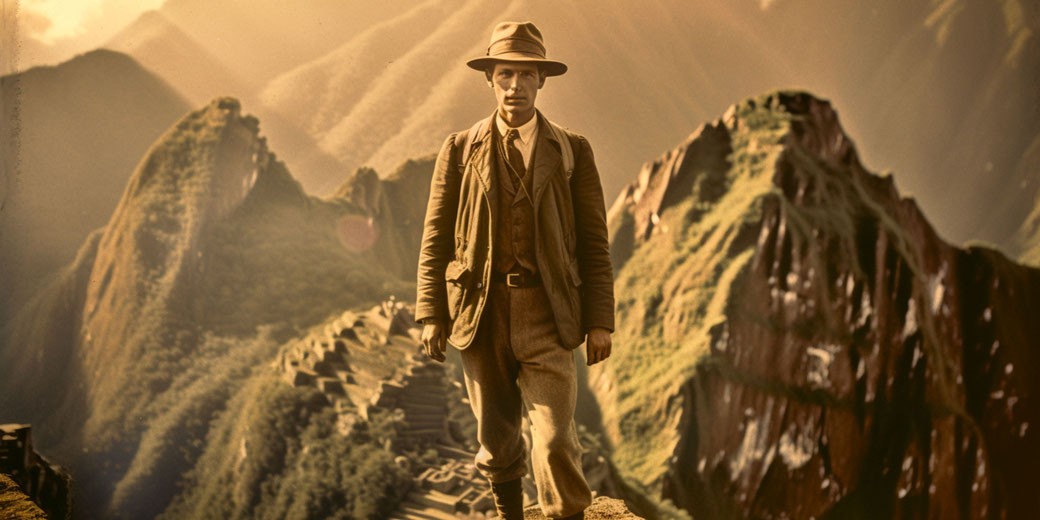
In July 1911, high above the Urubamba River in southern Peru, Hiram Bingham stepped into the overgrown ruins of an Inca settlement that local Quechua families living nearby had long known and used for agriculture.
Terraced slopes, finely cut stone walls, and ceremonial buildings stood hidden among thick plant growth, unknown to the wider world yet deeply significant to the Indigenous communities of the Andes.
Located at an altitude of 2,430 metres above sea level, the site stood in a very remote location. Soon after his return to the United States, Bingham claimed that he had uncovered what he believed to be the lost city of the Incas, which he initially misidentified as Vilcabamba, and with the support of Yale University and the National Geographic Society, he brought Machu Picchu to international fame.
His early life
Hiram Bingham III was born on 19 November 1875 in Honolulu, where his upbringing was heavily influenced by the missionary work of his family and the islands' culture.
His grandfather was Hiram Bingham I, who had sailed to Hawaii in 1820 as one of the first American Protestant missionaries, and his father was Hiram Bingham II, who had continued that tradition.
Raised in a household that blended strict religious teaching with a clear focus on study, the younger Bingham absorbed the values of duty and personal discipline that underpinned his scholarship, though he later pursued a path that moved away from church work.
Soon after completing his early education in Hawaii, he left for the mainland United States, where he attended Phillips Academy in Massachusetts.
Then, at Yale, he graduated in 1898, where he showed a clear interest in languages and history.
Later, he undertook graduate studies at the University of California, Berkeley, before completing a PhD at Harvard, where he focused on Spanish colonialism in South America.
His research developed a strong desire to test historical records against what he believed remained hidden in the Andes.
By the time he began lecturing at Yale, Bingham had already developed a reputation for his engaging presentations about South American history.
He combined literary flair with detailed analysis of colonial sources, especially those describing the Inca Empire’s final decades.
His burgeoning academic career
Not long after he had received his doctorate, Bingham joined Yale’s faculty, where he taught Latin American history and built a following among students who were drawn to his blend of narrative energy and historical rigour.
Although his academic focus remained on the Spanish conquest and its long-term effects, he increasingly framed his work as a kind of detective story, where historical texts could lead to real locations.
By 1906, he had taken a leave from Yale to attend the Pan-American Scientific Congress in Chile, which gave him his first experience of the South American interior.
During that journey, he crossed the Andes by mule and visited several colonial-era towns that had once served as outposts during the Spanish expansion.
Soon afterwards, he began to imagine an expedition that would connect written sources with unexplored regions of Peru.
While Bingham lacked formal archaeological training, he possessed strong organisation and persuasiveness, which allowed him to secure funding from both Yale and the National Geographic Society.
By 1911, Bingham had gathered enough support to launch what he called the Yale Peruvian Scientific Expedition.
As part of it, he had official backing from the Peruvian government, practical help from the local military, and a group of students and porters.
He initially set off along the Urubamba River valley and relied heavily on historical maps, local reports, and early Spanish accounts, which hinted at the location of Inca strongholds hidden in the jungle-covered mountains.
Journey to South America
Shortly after he arrived in the Cusco region, Bingham visited several remote sites, including Choquequirao and Vitcos.
Both had been associated with the Inca resistance after the Spanish conquest. He travelled on foot and by mule, often guided by Quechua farmers and soldiers provided by the Peruvian government.
Despite the physical hardship, he continued to search for the lost city of Vilcabamba, which had remained unconquered for nearly four decades after the fall of Cusco in 1533.
On 24 July 1911, a local landowner directed Bingham to a farmer named Melchor Arteaga, who led him up a narrow path to the ridge of Machu Picchu.
There, under the guidance of a Peruvian sergeant and surrounded by mist and dense vegetation, Bingham reached a group of stone ruins.
He later described the scene as an extraordinary discovery. Agricultural terraces stepped down the mountainside, while residential buildings and temples stood with their walls still intact.
A ritual platform that later scholars identified as the Intihuatana indicated the site's ritual importance.
While Quechua families had lived nearby and used the land for farming, Bingham interpreted the site as unknown to modern science at that time.
At first, he believed Machu Picchu to be Vilcabamba, based on its scale, isolation, and style of construction.
He returned the following year with a larger team, including surveyors, photographers, and excavation staff.
Among them were Clarence Hay, Harry Foote, and other assistants who were from Yale and the National Geographic Society.
With their help, he began to clear the site and to document its layout, and he uncovered burial chambers, storage facilities, and staircases that had been carved directly into the stone.
From this point, Bingham’s work shifted from exploration toward explanation. He aimed to link the ruins to the Inca resistance and frame their survival as part of a larger historical puzzle.
The discovery of Machu Picchu
Over the next few years, Bingham published widely on his findings. His early reports appeared in Harper’s Magazine and were later expanded into books, including Inca Land in 1922.
In April 1913, National Geographic devoted an entire issue to his work, with over 200 pages of photographs and analysis.
These writings portrayed him as the man who had recovered a forgotten world, and his photographs were produced in collaboration with National Geographic and largely presented Machu Picchu as both mysterious and majestic.
His style combined archaeological description with elements of adventure writing, and his repeated use of the phrase “lost city” gave Machu Picchu a romantic image that proved highly appealing to foreign audiences.
During the 1912 and 1914 expeditions, Bingham removed more than 5,000 artefacts from the site, which he recorded, including pottery, tools, ornaments, and human remains.
These included black-on-red ceramics, bronze blades, decorative beads, and more than 100 skeletal remains, which Bingham had initially believed to be female attendants, though later analysis showed a more balanced gender distribution.
With official permission from the Peruvian government, he shipped them to Yale’s Peabody Museum, where they were studied.
However, the agreement required their eventual return, a condition that would later become central to a long-standing dispute between Peru and Yale.
Bingham’s interpretation of the ruins influenced much of the early scholarship on the Inca site, as he argued that Machu Picchu had been a royal estate that was possibly linked to the emperor Pachacuti.
He even speculated that people had also used it as a religious centre or ceremonial retreat.
Over time, new research would challenge several of his claims, but during his lifetime relatively few questioned his conclusions publicly, and, as a result, he remained the main voice on Machu Picchu’s meaning, location, and historical importance for decades.
Why so many people criticised him
Soon after his discovery became public, scholars and Peruvian officials began to question Bingham’s narrative because the term "discovery" ignored the presence of the Quechua people who had lived, farmed, and named the site for generations.
In addition, some of his interpretations relied more on historical imagination than careful archaeological method.
His misidentification of Machu Picchu as Vilcabamba, for instance, persisted well into the twentieth century, even after other researchers, including Gene Savoy in 1964, confirmed that Espiritu Pampa matched the description of the final Inca capital more closely.
As criticism grew, so did concern over the artefacts that Bingham had taken from Peru.
Although he had received permission to study them abroad, the delays in their return led to accusations of taking advantage of local people and resources.
Requests for their return date back to at least the 1970s, and renewed calls intensified in the early 2000s.
In 2012, after lengthy negotiations, Yale returned thousands of pieces to Peru, following an agreement reached in 2010.
They were housed in the Museo Machu Picchu, Casa Concha, a historic building in Cusco that was refurbished and reopened to house the collection, which is dedicated to Inca history.
In academic circles, Bingham’s lack of archaeological training became another point of contention, since his excavation techniques were seen as careless and sometimes damaging.
Although he had brought Machu Picchu to global attention, his tendency to centre himself in every narrative left little room for Indigenous knowledge or Peruvian collaboration.
Later historians have worked to correct this imbalance and have increasingly highlighted the role of local guides, workers, and oral traditions in maintaining knowledge of the site..
Later life and legacy
After concluding his expeditions, Bingham entered military service during the First World War, where he joined the Army Air Service and reached the rank of lieutenant colonel.
He later served as the lieutenant governor and then senator for Connecticut, holding office in the 1920s and early 1930s.
While his political career never eclipsed his fame as an explorer, it gave him a national platform from which he continued to speak about education and exploration, and he used that platform to promote ongoing historical research.
In his later writings, Bingham continued to defend his claims about Machu Picchu, even as alternative interpretations received support.
He lectured frequently, published further memoirs, and positioned himself as a pioneer of modern exploration.
His most widely read work was Lost City of the Incas, which was published in 1948 and presented his version of events in a highly personal tone.
He died in Washington, D.C., on 6 June 1956 and was buried with full honours at Arlington National Cemetery.
Today, Bingham is remembered by many for his expeditions and for the questions his work raised about cultural ownership, academic authority, and historical storytelling.
His discovery brought international attention to Incan civilisation and changed the course of Andean archaeology.
In 1983, UNESCO declared Machu Picchu a World Heritage Site, and it now regularly draws millions of visitors each year.
Yet his approach reflected the attitudes of an era that often celebrated foreign explorers over local knowledge.