
How did ancient Greek hoplite warfare work?
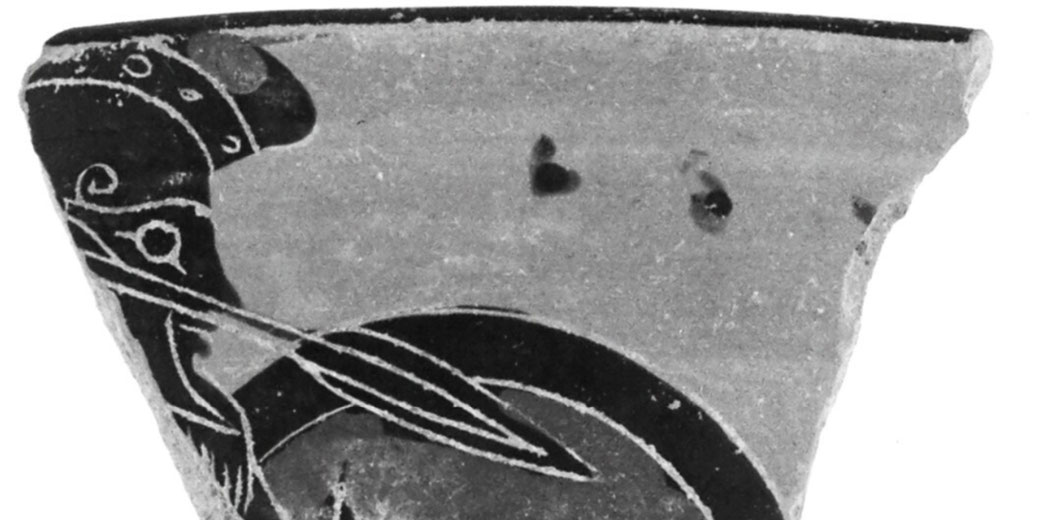
Among the many military systems of the ancient Mediterranean, the Greek hoplite phalanx is famous for its emphasis on group strength shown through a tight formation of citizen soldiers.
Developed by independent city-states such as Sparta, Athens, and Corinth during the eighth and seventh centuries BCE, this form of warfare typically required tight coordination achieved through physical discipline and steady loyalty to the polis.
As hundreds of men often advanced in locked step behind overlapping shields, success depended less on individual skill and more on mutual protection resulted from shared tactics that kept the formation together under pressure.
Who were the hoplites?
During the early Archaic period, Greek warfare shifted away from heroic duels and toward organised infantry battles, as population growth and rising competition among poleis led to more frequent armed conflict.
Property-owning male citizens generally became responsible for military service, and those who could afford their own equipment formed the backbone of their city’s army.
This usually included the zeugitai class, whose moderate wealth allowed them to equip themselves as hoplites.
Regular training and campaigns during the fighting season, backed by an expectation of civic duty, generally reinforced this system, especially in places like Sparta, where warfare was a major part of public life.
Although most battles typically occurred during summer months to avoid disrupting agriculture, cities remained on alert for disputes over borders, trade access, or long-standing rivalries.
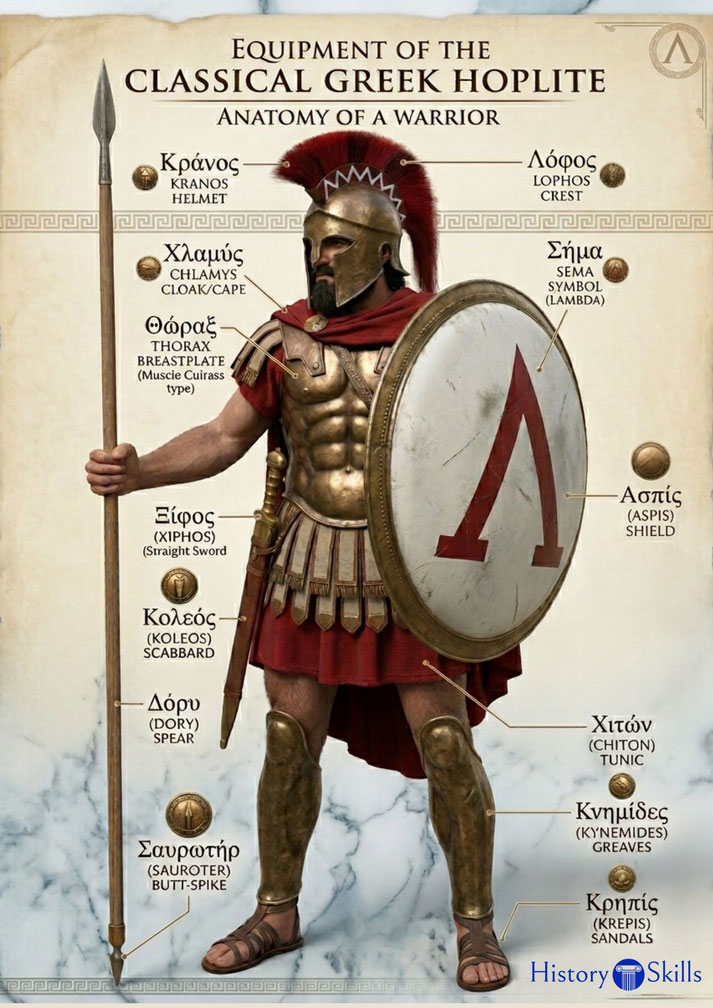
Each hoplite typically carried a specific set of equipment that prioritised defence and formation fighting.
First, the aspis shield served as the most important piece. Although modern writers sometimes use the term 'hoplon' for this shield, in ancient Greek the word 'hoplon' referred more generally to a weapon or piece of equipment, not specifically the shield.
Regardless, craftsmen made it from wood and covered it with a layer of bronze, and it curved around the body and spanned roughly one metre in diameter, which allowed it to protect both the bearer and part of the man to his left.
Some shields bore distinctive emblems, such as the lambda symbol used by Spartans.
Next, the hoplite wore a bronze helmet, a cuirass of metal or stiffened linen, and bronze greaves to shield the legs.
Surviving artefacts such as helmets from Olympia and Corinth suggest how the armour evolved over time to improve visibility and airflow.
For weapons, he typically wielded a doru, a spear two to three metres long tipped with an iron point and balanced by a bronze butt-spike, and when the spear had snapped during battle, he drew a short sword called a xiphos, which acted only as a last resort.
Phalanx formation explained
To fight effectively, hoplites typically formed a tight infantry block called a phalanx, which usually consisted of eight or more rows.
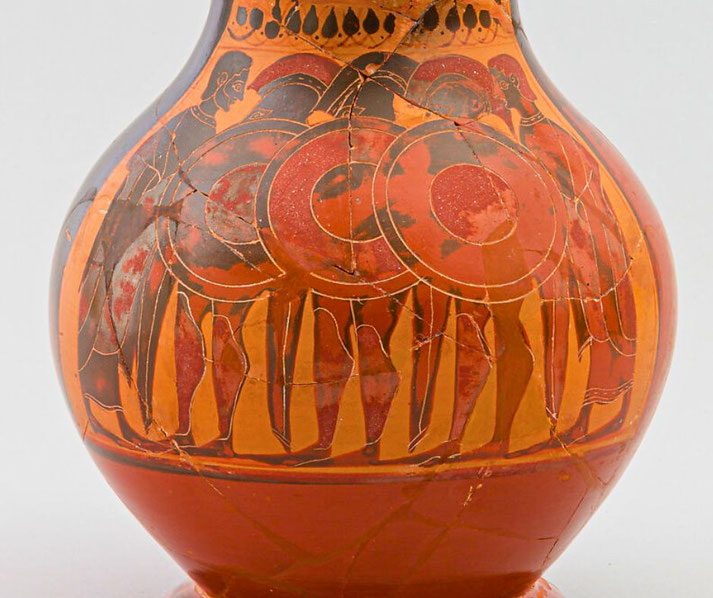
Soldiers normally aligned their shields so that each one partially overlapped the shield of the man on the left, which created a wall of bronze and wood.
To protect the exposed right flank, commanders often placed best-trained troops on that end since each man’s right side remained exposed, so phalanxes tended to drift right as they advanced.
Coordination and mutual trust, maintained through a steady marching rhythm, generally kept the formation intact, and the strength of the phalanx came not from individual prowess but from its collective movement and density.
In some cases, such as the Theban Sacred Band, commanders occasionally deepened their lines significantly to place more force at a single point.
Initially, the opposing lines often approached at a steady pace before they sped up in the final moments to close the distance quickly and limit the risk from missile attacks such as javelins and arrows.
At the moment of contact, both sides collided in a brutal contest known as othismos, or “the push.”
Ancient sources generally described this as a physical clash of shield against shield, though some modern scholars argue that the term may have referred more to the continuous pressure of the fighting than to literal pushing.
In either case, men in the front ranks usually stabbed overhand with their spears, while those behind maintained forward pressure and filled gaps when losses occurred.
In most engagements, the side that held formation longer typically forced its opponent to retreat.
Once a phalanx had broken apart, fear spread quickly, and the victors usually chased only briefly, as Greek warfare tended to avoid prolonged slaughter after a rout.
On rare occasions, battles such as Delium in 424 BCE revealed how unusual tactics or failure to keep the formation together could result in disastrous defeat.
Battle command tactics
Often, command during battle remained limited to simple verbal signals or trumpet calls, since the confusion and noise made detailed orders impossible to hear.
As such, preparation before battle often mattered more than decision-making during the fighting.
Formations had to be trained in advance, and officers generally relied on discipline rather than flexibility.
Most hoplite battles ended within a few hours, and although losses usually remained moderate, the results were serious, as a single defeat could lead to the loss of farmland, forced submission to a rival polis, or the end of political independence.
Fallen soldiers were often collected under a temporary agreement and given funeral honours or had monuments erected on the battlefield.
Between the seventh and fifth centuries BCE, hoplite warfare generally remained the standard form of conflict among Greek city-states, with many battles showing the effectiveness of the phalanx.
At Sepeia in 494 BCE, the Spartans used surprise and superior training to defeat Argive forces and they reportedly used ritual procedures that may have included a period of truce or prayer.
At Tanagra in 457 BCE, Athenians and Boeotians fought to a standstill. In Sparta, military success largely rested on a lifelong training system known as the agoge, which produced soldiers who prioritised obedience and endurance.
The agoge also included institutions like the krypteia, which reinforced discipline and built loyalty to the state.
In contrast, Athenian hoplites generally formed part of a more varied force that included sailors, archers, and light infantry, especially during the Peloponnesian War, where different tactics played an increasing role.
How Leuctra and Macedon changed the hoplite
Over time, Greek generals gradually began to challenge the strictness of traditional hoplite tactics.
By the fourth century BCE, Theban commander Epaminondas had introduced new strategies, such as a tactic that deepened one wing of the phalanx, which he used to great effect at the Battle of Leuctra in 371 BCE.
There, Theban forces broke the Spartan right flank after they concentrated their force at one point instead of spreading it evenly across the line.
The death of King Cleombrotus I during this battle indicated a dramatic shift in Greek power.
Later, Macedonian rulers such as Philip II and Alexander the Great significantly changed infantry warfare by replacing the short doru with the longer sarissa and by adding cavalry, archers, and skirmishers to their armies.
Although the Macedonian phalanx retained some similarities to the old hoplite model, its greater flexibility and the use of different troop types allowed for more decisive and varied campaigns.
Even though hoplite warfare declined in importance after the rise of Macedonia, its influence largely remained part of Greek identity.
Archaeological finds such as Corinthian helmets and spearheads and red-figure pottery that depicts phalanx combat showed how important the hoplite ideal was to Greek society.
Pottery such as the Chigi Vase, which is dated to around 650 BCE, gives early visual evidence of the phalanx in action.
Meanwhile, writers such as Herodotus, Thucydides, and Xenophon, all described or participated in hoplite warfare, treated battles as examples of political life that showed civic virtue and personal honour.
Tyrtaeus, the Spartan poet, praised those who stood firm in formation and scorned cowards who abandoned their comrades.
In the end, the phalanx came to symbolise the Greek polis itself: a community of equals, bound by obligation, working as one.