
The science behind the boomerang and why it worked so well

In 1975, Dutch physicist Felix Hess submitted a 555-page doctoral thesis at the University of Groningen that was titled Boomerangs, Aerodynamics and Motion and was arguably the most comprehensive scientific study of boomerang flight that had ever been produced.
Hess had spent seven and a half years researching the problem full-time, and his work confirmed what Aboriginal Australians had understood through observation and craft for thousands of years: the returning boomerang is a flying device of remarkable aerodynamic sophistication.
Understanding how a curved piece of wood can trace a wide circular arc through the sky and return to its starting point requires an appreciation of aerodynamic lift and uneven force distribution, as well as gyroscopic precession.
An ancient tool with aerodynamic purpose
Long before any physicist described the forces acting on a spinning airfoil, First Nations Australians were crafting boomerangs with carefully curved wing profiles.
Some of these were returning boomerangs that were designed for controlled circular flight, and others were heavier non-returning weapons that were intended to fly straight for hunting or fighting.
The oldest surviving Australian boomerang was recovered from the Wyrie Swamp in South Australia in 1973 and has been dated to approximately 10,000 BCE, and it is now held in the South Australian Museum in Adelaide.
Rock art depictions in the Kimberley region of Western Australia are estimated to be up to 20,000 years old and also show boomerangs in use, which suggests that the technology is considerably older than the physical evidence alone indicates.
Aboriginal makers traditionally selected naturally curved pieces of wood, which were often taken from the junction of a trunk and a root or branch, and spent days scraping the timber into its final form.
This choice of timber also followed a practical logic, because naturally curved grain made the finished weapon stronger and less likely to split under the stress of throwing and spinning, as well as impact.
As the Wurundjeri Woi-wurrung Elder Bob Mullins explained during a 2025 archaeological study that was published in Australian Archaeology, the wood was soaked in water and dried gradually to achieve the correct bend before it was finished with tools.
The resulting cross-sectional profile of each wing meant that the top surface is convex and the underside is flatter, which produces the same aerodynamic effect as a modern aircraft wing or a propeller blade.
Every returning boomerang, whether ancient or contemporary, depends on this airfoil profile to generate the lift that is necessary for flight.
In practical use, Aboriginal Australians could employ boomerangs for tasks such as hunting birds and striking small game, as well as driving animals toward nets and waiting hunters.
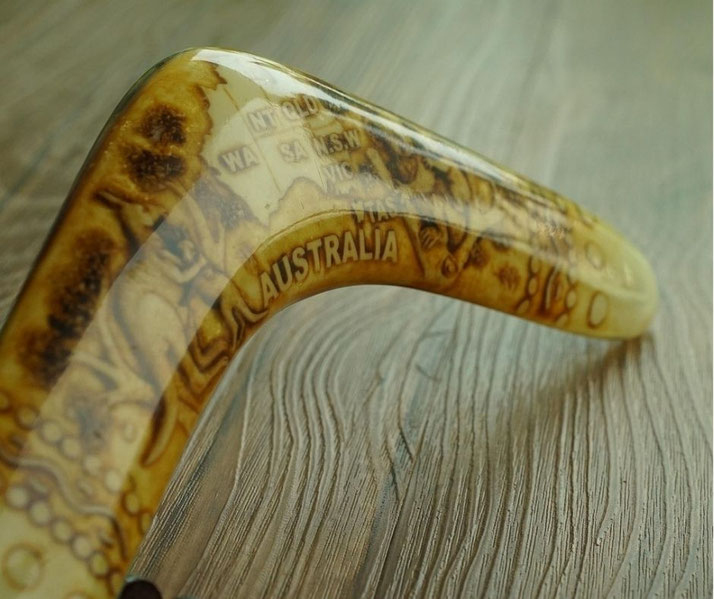
How does a spinning airfoil generate lift?
At its most basic, a returning boomerang is a pair of wings that are joined at an angle and that typically form a shallow V-form or a gentle curve.
Each wing possesses the cross-sectional profile of an airfoil, which means that air that travels over its convex upper surface moves faster than air that passes beneath its flatter underside.
According to Bernoulli’s principle, faster-moving air exerts lower pressure, so the pressure difference between the top and bottom surfaces creates an upward force that is known as lift.
Lift also depends on the wing meeting the airflow at a suitable angle of attack, which helps the airfoil maintain the pressure difference that is needed to stay aloft.
As long as the boomerang is spinning, both wings continuously cut through the air and produce this lift, which is what keeps the device airborne during its flight.
For this flight pattern to work, the boomerang must be thrown in a near-vertical orientation with considerable spin and usually into a light breeze.
Since the boomerang spins rapidly, typically between 8 and 14 revolutions per second, each wing alternates between being at the top of the spin cycle and at the bottom.
At the top of the cycle, the advancing wing moves in the same direction as the boomerang’s forward motion through the air, so the combined airspeed over that wing is higher.
At the bottom of the cycle, the retreating wing moves against the direction of forward travel, which reduces its effective airspeed.
The result is a persistent imbalance: the wing at the top of the rotation always generates more lift than the wing at the bottom. It is this uneven lift distribution that initiates the boomerang’s characteristic turn.
Why the boomerang turns instead of falling over
If the boomerang were a static object, the greater lift on one side would simply cause it to topple.
A spinning boomerang, however, behaves as a gyroscope, and gyroscopes do not respond to forces the way stationary objects do.
The rapid spin first stabilises the boomerang in flight, which keeps its plane of rotation steady long enough for the aerodynamic forces to redirect it.
A spinning gyroscope obeys gyroscopic precession, which states that any force that is applied to a spinning object takes effect approximately 90 degrees later in the direction of rotation.
In practical terms, the precession effect redirects the uneven lift that pushes harder at the top of the spin, and this turns the boomerang’s flight path into a curve rather than causing it to tip sideways.
Dr Hugh Hunt is an engineering dynamics researcher at the University of Cambridge and has described the boomerang as a gyroscope whose aerodynamic forces generate a twisting moment that causes the device to precess and move along a circular path.
The analogy to riding a bicycle with no hands is useful: leaning a moving bicycle to the left makes it steer in that direction rather than causing it to fall, because the spinning wheels behave gyroscopically.
In the same way, the uneven lift on a spinning boomerang produces a smooth, continuous turn that eventually brings the device back toward the thrower.
Right-handed and left-handed returning boomerangs are therefore crafted as mirror images of one another, and each curves in the opposite direction during flight.
The role of layover and the hovering return
A second gyroscopic effect is responsible for the boomerang’s gradual transition from vertical flight to a horizontal hover near the end of its path.
When a boomerang is first thrown, it spins in a nearly vertical plane, but the centre of lift on the device sits slightly ahead of its centre of gravity.
As a result of this offset, a forward-pitching force acts on the spinning disc of rotation.
Once again, gyroscopic precession redirects this pitching force by 90 degrees, so instead of tipping forward, the boomerang slowly tilts from vertical to horizontal over the course of its flight. Aerodynamicists refer to this process as ‘layover.’
By the time the boomerang has completed most of its circular path and returned near the thrower, its plane of rotation has shifted to roughly horizontal.
At this point, the lift from the spinning wings acts directly upward against gravity, which produces a slow, hovering descent rather than a sharp drop.
Interestingly, as forward speed decreases due to aerodynamic drag, the spin rate actually increases slightly to conserve angular momentum, which is the same physical law that causes an ice skater to spin faster when they pull their arms inward.
The boomerang therefore arrives back at the thrower in a gentle, saucer-like hover that is stable enough to be caught by hand.
How modern science confirmed ancient engineering
Since the 1970s, physicists and engineers have used wind tunnels and computer simulations, as well as tracking systems, to verify mathematical models of boomerang flight.
A 2022 study by Ryspek Usubamatov was published in the International Robotics and Automation Journal and proposed an updated model that incorporated eight related inertial torques that are generated by the rotating boomerang, and the study argued that earlier models had oversimplified gyroscopic effects.
More recently, Prasad Gudem at the University of California, San Diego, used a meshed ultra-wideband tracking system with 16 anchors and a radio tag that was embedded within a test boomerang to measure its flight trajectory in real time during controlled trials, then compared results against computational predictions that were derived from blade element theory.
All of this research has generally confirmed that the returning boomerang relies on aerodynamic lift from its airfoil-profiled wings and uneven lift distribution that is caused by the combination of spin and forward motion, as well as gyroscopic precession that converts these forces into a curving, layover flight path.
What Aboriginal Australians achieved through generations of skilled observation and craftsmanship, modern physics now explains through equations of fluid dynamics and rotational mechanics.
The boomerang is, in the end, arguably one of the oldest and most elegant demonstrations of applied aerodynamics in human history.