
Why did Alexander build so many cities named after himself?
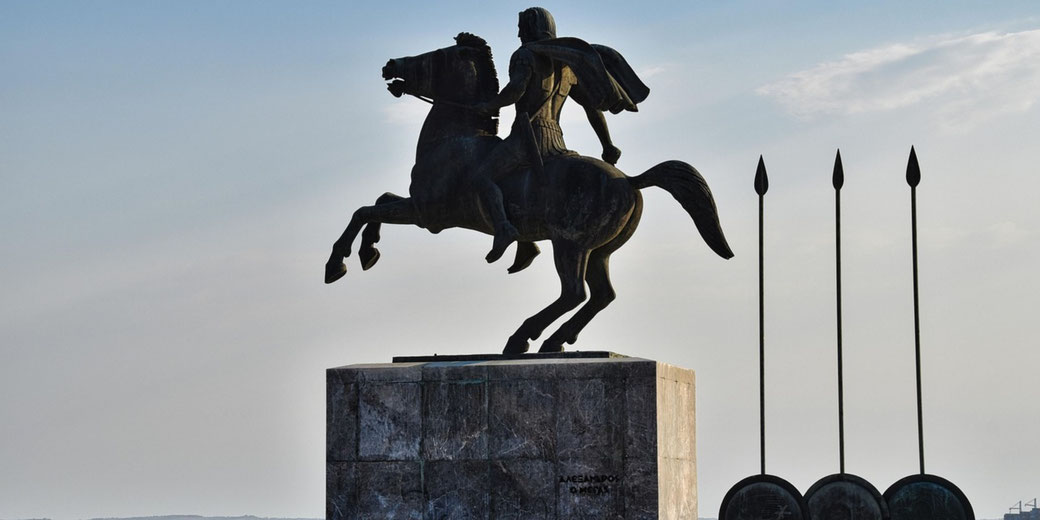
Across the massive empire forged by Alexander III of Macedon, at least twenty cities had the same name: Alexandria.
Between 334 and 323 BCE, as he advanced from the Hellespont to the Indus, Alexander regularly ordered the building or renaming of towns across Asia.
Each 'Alexandria' often was a military base that also housed administrative offices and promoted Hellenisation, but its main purpose appeared to be to glorify the conqueror whose name it bore.
Why did Alexander found cities?
During his campaign, Alexander founded cities as practical instruments of control.
In 332 BCE, he ordered the construction of Alexandria in Egypt at the western edge of the Nile Delta, and he chose the site for its sheltered harbour and near the Canopic branch of the Nile.
He had personally planned the city’s layout, which Arrian recorded, and had told engineers to build it on a rectangular grid with broad avenues and fortified walls.
Dinocrates of Rhodes, who was a well-known architect later associated with other royal projects, has traditionally been credited with assisting the design, though ancient sources provide limited confirmation.
Greek settlers and army veterans, who had been granted land, made up the city’s main population, while Egyptian labourers had supported its agricultural production and trade, and, as a result, the city became both a centre of trade and a secure outpost of Macedonian rule.
Over time, some ancient sources claimed its population was over 300,000, although modern estimates vary widely.
Elsewhere across the empire, other Alexandrias followed similar designs but served different strategic purposes.
In Mesopotamia, a settlement that is often referred to as Alexandria near the Tigris may have controlled river access to Babylon and to other regions.
In Central Asia, Alexandria Eschate, meaning "The Furthest", was built in the Ferghana Valley to designate the eastern edge of Macedonian expansion and to guard against nomadic raids.
Today, it is the modern city of Khujand in Tajikistan. Also, long key routes such as the Royal Road and the Khyber Pass, cities like Alexandria Arachosia and Alexandria in the Caucasus enabled Alexander to station troops, store supplies, and extend his control into difficult terrain.
Often, each site occupied a junction that controlled trade routes and improved frontier defence in order to secure the empire’s most unstable regions.
Finally, Alexandria Arachosia was widely believed to have stood at what is now Kandahar in Afghanistan and was a critical garrison and administrative centre in the eastern provinces.
Administrative role of Alexandrias
Critically, the cities often supported imperial rule, as royal officials operated from buildings designed to collect taxes and tribute and to maintain communication with other parts of the empire.
In many cases, local satraps and their appointed episkopoi typically oversaw Macedonian rule.
Often, roads were constructed to connect Alexandrias to each other and to pre-existing urban centres, and this network generally allowed couriers and commanders to travel quickly and respond faster to uprisings or invasions.
In several regions, such as Bactria and Sogdiana, the Alexandrias provided critical infrastructure that allowed the management of rebellious populations that had resisted Macedonian control.
At the same time, each Alexandria helped spread Greek culture. Markets, theatres, gymnasiums, and temples allowed Hellenic customs to take root far from Greece.
Many scholars believe that the archaeological finds from Ai-Khanoum are those of Alexandria on the Oxus, which reveal a theatre that seated over 5,000 people, a Greek-style gymnasium, and a Herôon dedicated to Alexander.
Greek became the language of administration, and coinage, which depicted Alexander’s image, supported his political authority.
Educators and philosophers also arrived to teach Greek literature and values, while craftsmen and merchants supported trade.
Over time, local elites participated in civic life and adopted Greek language and religious practices and adapted local dress to Hellenic fashions, a change that strengthened the social order that matched Macedonian interests.
In regions such as Egypt, Greek religion blended with local beliefs, and Alexander himself, who visited the Oracle of Siwa, was associated with Amun.
Political significance of Alexander’s cities
For Alexander himself, the cities largely reinforced his personal presence across the empire.
In many cases, when he named them after himself, he had established permanent markers of conquest that required no royal court to maintain authority.
Statues, inscriptions and dedications in newly founded Alexandrias showed him as a victorious general and, increasingly, as a god.
In some cases, such as the city of Nicaea in the Punjab, the name commemorated a specific military triumph, though it was not named Alexandria.
Consequently, each site helped cultivate a personal cult that aligned civic loyalty with devotion to Alexander.
Over time, these cities had played a central role in maintaining unity within the empire because, after Alexander’s death in 323 BCE, his generals fought for control of the territories he had conquered, yet many of the cities continued to operate as administrative capitals or military outposts.
The Ptolemies ruled Egypt from Alexandria, which became one of the leading cultural centres of the ancient world.
Others, such as those in Bactria and Arachosia, supported successor states like the Greco-Bactrian Kingdom.
Regardless, the name Alexander remained visible not only on the map but also in the buildings, rituals and political systems of the ancient world.