
The unlucky cat who survived the dramatic sinking of three battleships in World War II
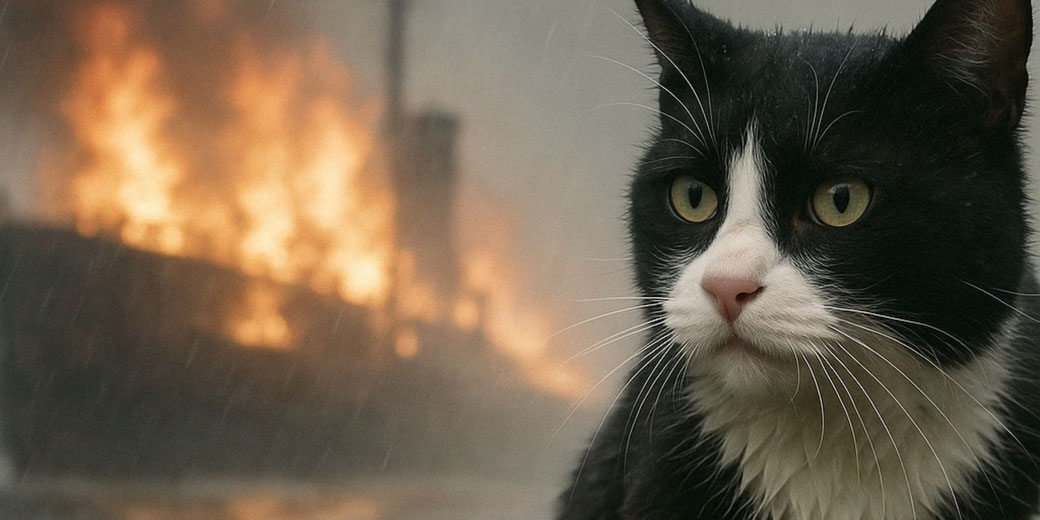
Naval warfare during the Second World War sank thousands of ships and claimed millions of lives, but one cat defied the odds with a remarkable pattern of survival.
Known as “Unsinkable Sam,” this black-and-white tomcat lived through the destruction of the Bismarck and HMS Cossack, and he later survived the loss of HMS Ark Royal, three of the most famous warships lost between May and November 1941.
His survival often baffled sailors and earned him an unusual kind of fame, as stories of the cat who could not be drowned travelled between Gibraltar and Belfast, and even reached the British press.
Aboard the Bismarck: The beginning of the legend
When the Bismarck left Gdynia on 18 May 1941 to begin Operation Rheinübung, its goal had been to attack Allied merchant convoys and prevent supplies from reaching Britain.
The 41,700-ton battleship carried over 2,200 men, and among them was a small black-and-white cat who was likely brought aboard by a sailor who wanted a familiar companion.
By 24 May, the Bismarck had entered the Denmark Strait, where it met HMS Hood and HMS Prince of Wales.
In the opening moments of battle, Bismarck sank the Hood with a direct hit to the magazine, killing all but three of its crew.
British commanders were clearly stunned by the loss of their pride ship and ordered the Bismarck hunted down.
Over the next three days, aircraft from HMS Ark Royal had damaged the Bismarck’s steering gear, and on 27 May, battleships King George V and Rodney opened fire at close range.
The Bismarck sustained heavy hits and began to sink. As fires spread below deck, the order to scuttle the ship went out, and hundreds of men jumped into the icy Atlantic. Only 111 survived.
After the fighting had stopped, the British destroyers HMS Dorsetshire and HMS Maori recovered survivors.
Among the wreckage that still floated on the surface, sailors reportedly spotted a small cat that clung to a plank.
They pulled him aboard and gave him the name “Oscar,” in reference to the naval signal flag for “man overboard.”
Though most of the Bismarck’s crew had died, the cat came out without injury. His survival would not be his last.
Life on the HMS Cossack and a short-lived rescue
Soon after his rescue, Oscar became the ship’s cat aboard HMS Cossack, a Tribal-class destroyer that was assigned to escort duty in the Atlantic and Mediterranean.
Cossack displaced around 2,500 tons, had already earned a reputation for aggressive convoy protection, and had taken part in the Altmark Incident the previous year.
Oscar adapted very quickly to his new ship, and he moved along the deck with the same ease he had shown aboard the Bismarck.
The crew readily accepted him, and they fed him scraps and let him roam where he pleased.
For several months, he travelled with them as the ship escorted convoys and took part in missions that supported Malta.
During September 1941, Cossack took part in Operation Halberd, which aimed to supply the besieged island of Malta.
British naval commanders viewed the operation as very important in resisting Axis control in the Mediterranean, and Cossack played an important role in protecting the convoy.
By late October, however, the destroyer had been returning from one of these missions when it came under attack from U-563, a German submarine under the command of Oberleutnant Klaus Bargsten, which patrolled west of Gibraltar.
At 21:15 on 24 October, a torpedo slammed into the forward section of Cossack, killing more than 20 men and disabling much of the ship’s interior.
Engineers worked around the clock to stabilise the ship, and for several days the crew managed to keep her afloat under tow.
On 27 October, with damage worsening and water rising below deck, the ship finally sank.
Out of her crew, 159 were rescued. Oscar had survived again. Rescuers recovered him from the wreck, and once he reached Gibraltar, naval officials began to take a more serious interest in his safety.
Final 'posting' on the HMS Ark Royal
As soon as Oscar had recovered, officials assigned him to HMS Ark Royal, the aircraft carrier that had previously helped sink the Bismarck.
The 22,000-ton Illustrious-class carrier had a reputation for surviving near-misses and had taken part in several very dangerous operations in the Mediterranean.
Its crew were already familiar with the risks of submarine warfare and welcomed the cat who had outlived two sinkings.
Some sailors treated him as something of a good-luck charm. Others were more superstitious and joked that he escaped just in time.
On 13 November 1941, Ark Royal sailed back toward Gibraltar after it had delivered aircraft to Malta.
At 15:41, the German submarine U-81, which was under the command of Friedrich Guggenberger, fired a single torpedo that struck starboard near the engine room.
The explosion knocked out power and flooded the lower compartments. As the list increased, the captain ordered the crew to abandon ship.
Over the next few hours, more than 1,400 men evacuated safely. One sailor died during the incident.
Oscar was found unharmed among the survivors and had outlived his third warship in under seven months.
By the time he reached shore, his reputation had spread. Newspapers called him “Unsinkable Sam,” and naval officers agreed that he would no longer be posted to sea.
Retirement and later life
After the sinking of Ark Royal, Sam spent several weeks at the Governor’s residence in Gibraltar, where he lived a quiet life compared to the months of torpedo warnings and air raids.
Later that year, the Royal Navy transferred him to a home for sailors in Belfast city, where he lived until his death in 1955.
A pastel portrait that was completed during his retirement was widely attributed to artist Georgina Shaw-Baker and shows him seated on a plank that floats on the water, with storm clouds in the distance.
That image now hangs in the National Maritime Museum in Greenwich and offers a visual reminder of the strange journey that took him across two navies and through three doomed ships, all against the setting of the deadliest ocean war in history.
Although no wartime logbook officially documented his presence aboard all three ships, the consistency of crew accounts supports the story.
Sailors who were British or German had good reason to remember the cat who returned from the sea when so many men had not.