
Why did the Soviet Union reject Marshall Aid?
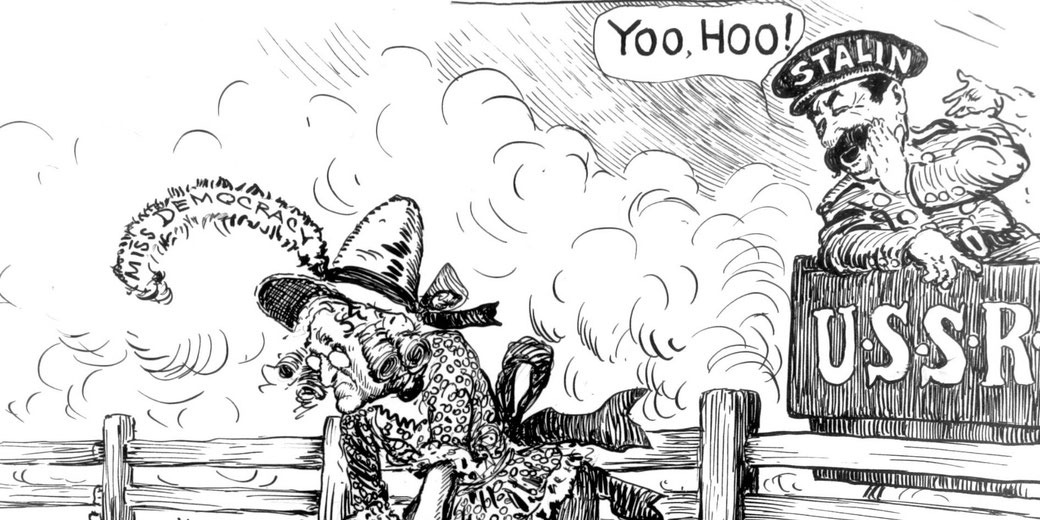
When US Secretary of State George C. Marshall delivered his famous Harvard University address on 5 June 1947, he offered American economic assistance to every war-damaged nation in Europe, including the Soviet Union.
Since the offer appeared generous and open-ended, it placed the Soviet leadership in an extraordinarily difficult position, as accepting aid would have required economic transparency and cooperation with capitalist nations.
The proposal soon became known by its formal title, the European Recovery Program (ERP), and it later required participating European states to coordinate their requests through shared planning bodies.
Within weeks, Soviet Foreign Minister Vyacheslav Molotov walked out of the Three-Power talks in Paris on 2 July 1947, and Eastern European governments then withdrew from the follow-up Conference on European Economic Co-operation, which opened in Paris on 12 July 1947.
But why?
Stalin’s initial openness to the proposal
As surprising as the eventual rejection was, Stalin did not immediately dismiss the American offer.
The USSR had suffered catastrophic wartime losses, with an estimated 27 million dead and much of its western territory devastated, which meant that any source of external funding held genuine appeal.
Soviet reports also claimed that German forces had destroyed about 1,710 towns and around 70,000 villages, and that the war had ruined large parts of Soviet industry and transport, including tens of thousands of factories and about 65,000 kilometres of railway track.
Stalin also faced the demands of the Fourth Five-Year Plan for 1946 to 1950, which prioritised the rehabilitation of war-damaged regions and the restoration of transport networks.
As a result, Stalin directed Molotov to attend the Paris meeting that began on 27 June 1947, where Molotov met British Foreign Secretary Ernest Bevin and French Foreign Minister Georges Bidault to discuss a joint European response to Marshall’s offer.
Molotov arrived with an unusually large delegation of 89 economic experts, which was a signal that Moscow had seriously assessed whether American aid could support Soviet reconstruction.
As the details of Marshall’s conditions became clearer during the Paris talks, Stalin’s calculations changed rapidly.
The American programme required participating nations to disclose economic data and to coordinate recovery plans through collective European institutions, which also required them to accept oversight regarding how funds were spent.
For a command economy that had been built on state secrecy and centralised planning, these transparency requirements were fundamentally incompatible with the Soviet system of government.
The fear of losing control over Eastern Europe
Perhaps the most significant factor that drove Moscow’s rejection was the threat that Marshall Aid posed to Soviet influence in Eastern Europe.
Since 1945, the USSR had been constructing a buffer zone of friendly states across Poland and Czechoslovakia, as well as Hungary and the Balkans.
Because Marshall’s plan offered aid to all European nations without distinction, it carried the potential to draw Eastern Bloc countries into economic alignment with the West, which would have weakened Soviet authority over their political direction.
As such, Stalin feared that American dollars would create economic dependency on Washington and pull his satellite states away from Moscow’s orbit.
Scholars such as Scott Parrish and Mikhail Narinsky have argued that the Soviet rejection was a natural response from a non-capitalist state that was attempting to avoid integration into the capitalist world economy.
From Moscow’s perspective, the Marshall Plan looked like an attempt to recreate the interwar “cordon sanitaire,” a chain of Western-aligned buffer states that had been designed to contain Soviet power.
The Czechoslovak crisis of July 1947 showed how seriously Stalin took this threat.
After Molotov left Paris on 2 July, the Czechoslovak government issued a formal acceptance on 4 July 1947 of the British and French invitation to attend the follow-up Paris conference, which opened on 12 July.
When the Czechoslovak cabinet had approved participation unanimously, Stalin summoned a delegation that was led by Prime Minister Klement Gottwald and Foreign Minister Jan Masaryk to Moscow.
In a blunt meeting on 10 July, Stalin told them that their participation would be interpreted as helping to isolate the Soviet Union.
Czechoslovakia reversed its decision on 10 July, and Poland, where leader Władysław Gomułka had expressed similar interest, faced equal pressure and likewise declined.
The question of German reconstruction
Another critical concern for Moscow involved the programme’s treatment of Germany.
Molotov had argued during the Paris negotiations that the Soviet Union could not accept a plan that treated German recovery, especially in the western occupation zones, as essential to European reconstruction and that bound participants to shared planning arrangements outside Soviet direction.
Between 1941 and 1945, German forces had destroyed an estimated 1,700 Soviet towns and around 70,000 villages, and the Kremlin had expected punitive reparations rather than rehabilitation.
Soviet suspicion grew in early 1947 as the United States and Britain moved toward an integrated West German economy.
On 1 January 1947, the American and British occupation zones merged economically into Bizonia, which was a step that made later West German recovery plans easier to coordinate.
Since the Marshall Plan explicitly stated that European prosperity depended on German economic recovery, this clashed directly with Soviet strategic interests.
Stalin wanted a weakened Germany that would be incapable of future aggression, and he had been extracting reparations that were measured in the billions of dollars from the Soviet occupation zone, depending on how removals and valuations were counted.
American aid to Germany threatened to rebuild the very industrial capacity that Moscow wanted permanently reduced.
Ideological opposition and the accusation of economic imperialism
At a bare minimum, the Soviet rejection also carried a powerful ideological dimension.
Marxist-Leninist theory held that capitalist nations used economic aid as a tool of exploitation and political control.
On 18 September 1947, Soviet Deputy Foreign Minister Andrei Vyshinsky addressed the United Nations General Assembly and accused the United States of violating the organisation’s founding principles.
Vyshinsky argued that American economic resources, which had been distributed as relief to needy nations, had become an instrument of political pressure that was designed to impose Washington’s will on independent states.
What is more, Soviet propaganda reinforced this message domestically and throughout the Eastern Bloc.
The communist newspaper Pravda described the programme as American interference in European domestic affairs.
For the Soviet leadership, accepting Marshall Aid would have meant legitimising the idea that capitalism could rescue war-damaged economies, which was a concession that undermined the foundational claims of communist ideology.
The Soviet alternative and the hardening of Cold War splits
Following the rejection, Moscow moved quickly to consolidate its economic hold over Eastern Europe.
Between 22 and 23 September 1947, Stalin convened a meeting of nine European communist parties near Szklarska Poręba in Poland, with representatives from the communist parties of the USSR and Poland, as well as those of Czechoslovakia and several other Eastern Bloc states alongside the French and Italian parties.
At this gathering, Soviet ideologist Andrei Zhdanov delivered his “Two Camps” speech, which formally declared the world divided between an imperialist American camp and a democratic Soviet camp.
From this meeting, the Communist Information Bureau, or Cominform, was established to coordinate party activities and enforce ideological discipline across the bloc.
On the economic front, the Soviet Union expanded its existing network of bilateral trade agreements with satellite states into a formal structure.
On 25 January 1949, the Council for Mutual Economic Assistance, or Comecon, was publicly announced, with the Soviet Union and Bulgaria as well as Czechoslovakia and several other Eastern European states as founding members.
Ultimately, the Soviet rejection of Marshall Aid was driven by a combination of security concerns and ideological conviction, together with the determination to maintain political control over Eastern Europe.
By refusing American assistance, Stalin preserved his grip on the satellite states in the short term.
The long-term consequence, however, was the economic stagnation of the Eastern Bloc at precisely the moment when Western Europe, which was fuelled by about $13.3 billion in American aid, had entered the fastest period of economic growth in its history.