
What did the young Queen Elizabeth II do during WWII?
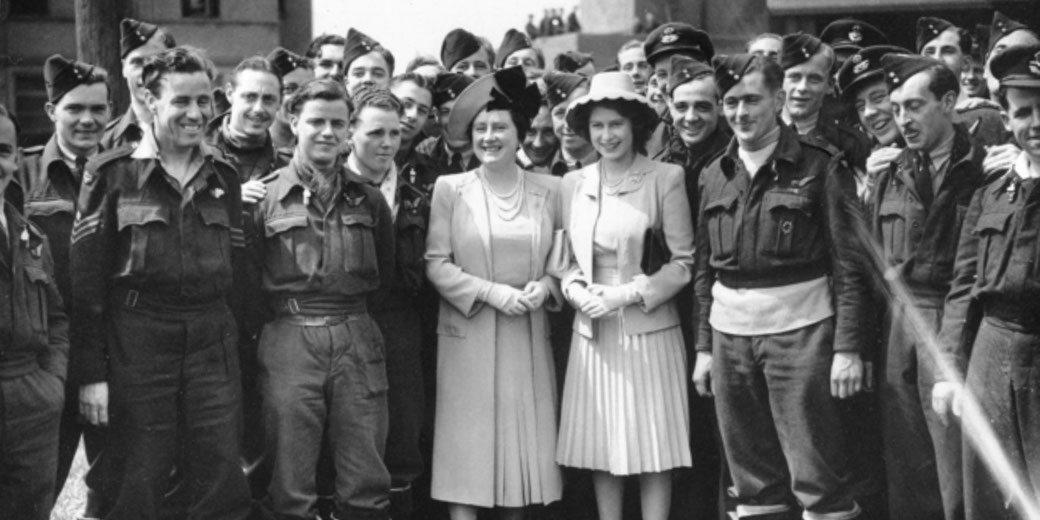
As German bombers targeted British cities and Allied troops fought Axis forces on distant fronts, a teenage princess began to prepare for a lifetime of service.
While most royal heirs remained largely shielded from danger, Princess Elizabeth requested mechanical training, joined the Auxiliary Territorial Service, and worked on military trucks just outside London.
Between 1940 and 1945, she took part in wartime broadcasts, was subject to strict rationing and blackout regulations, and became the first female member of the British royal family to perform military duties while in uniform during wartime.
The life of Princess Elizabeth before the war
On 21 April 1926, Princess Elizabeth Alexandra Mary of York was born as the first child of the Duke and Duchess of York, who later became King George VI and Queen Elizabeth.
Although she had not been expected to reign at birth, the abdication of her uncle, Edward VIII, in 1936 changed the course of her life permanently and placed her second in the royal succession behind her father.
As she came to understand the significance of her future role, she began to receive an education that focused heavily on constitutional history, religion, and languages, all under the close supervision of her mother and her governess, Marion Crawford.
At home, she lived in some privacy at 145 Piccadilly, a London residence that offered a simple setting for royal children during the interwar years and remained close to the seat of British power.
She developed an especially close bond with her younger sister, Princess Margaret, who was born in 1930, and their relationship would remain a steady and reassuring presence throughout her life.
Although the public occasionally saw the young princess at formal occasions, most of her early experiences largely occurred far from the political stage, and her understanding of monarchy grew gradually through observation rather than direct involvement.
After her father’s unexpected accession to the throne in December 1936, Elizabeth assumed the role of heir to the throne.
As the royal household adjusted to the responsibilities thrust upon it by the abdication crisis, the young princess became aware that her life would now unfold under the watchful gaze of both the British public and the Commonwealth overseas.
The outbreak of WWII and its impact on the royal family
When Britain declared war on Germany on 3 September 1939, Princess Elizabeth was only thirteen years old.
King George VI and Queen Elizabeth made the decision to keep their daughters in Britain instead of evacuating them abroad as many suggested.
They moved them first to Balmoral, then to Sandringham and finally to Windsor Castle, where they would remain for the duration of the war under heavy guard.
As German bombs rained down on London during the Blitz, Buckingham Palace itself was hit several times, including once that destroyed the palace chapel.
However, the king and queen refused to leave the capital, which made their presence during air raids a symbol of support.
Although the princesses lived away from the main danger zone, they participated in air raid drills, obeyed blackout restrictions, and adapted to rationing like many other young people.
At Windsor, Elizabeth and Margaret staged Christmas pantomimes to raise money for the troops, while their parents continued public engagements in bombed-out neighbourhoods and hospitals.
Over time, the conduct of the royal family helped gradually build public confidence during uncertain times, and Elizabeth began to understand that monarchy required more than being born into it.
She observed how the king and queen kept a visible presence and followed strict routines that generally kept public morale steady, which had taught her that presence during crisis could have a unifying effect, even when no power had been formally exercised.
Princess Elizabeth's wartime broadcasts
By 1940, as evacuation schemes separated families and nightly blackouts spread across the country, Princess Elizabeth had begun to take on increasingly visible duties.
At fourteen, she made her first public address on 13 October 1940, when she delivered a speech on BBC’s “Children’s Hour” that was directed to those who had been evacuated overseas.
From Windsor Castle, she spoke with calmness and clear delivery, and she told children across the Commonwealth that they had not been forgotten and that peace would return.
She concluded her speech with the words, "When peace comes, remember it will be for us, the children of today, to make the world of tomorrow a better and happier place."
For many listeners, the broadcast showed that the princess could connect with the public and reassure them.
Her speech did not rely on royal formality but used plain language and a calm tone to ease fears during the Blitz.
As a result, the moment began her public life during the crisis and led many to view her less as a distant heir and more as a voice of reassurance in wartime.
Soon after the broadcast, she continued to support charity work and regularly visited military hospitals and training centres.
Occasionally, she accompanied her parents during events to boost morale, although her primary responsibilities remained modest.
She also assisted with campaigns like Wings for Victory, which raised funds for RAF aircraft, and regularly visited wounded soldiers at institutions such as Great Ormond Street Hospital.
Still, the broadcast had introduced her to the public as someone who was willing to communicate directly, and it laid the groundwork for future appearances that would carry far greater personal risk.
Elizabeth’s role in the Auxiliary Territorial Service (ATS)
By early 1945, Elizabeth had turned eighteen and requested to join the armed forces in a more active capacity.
After discussions with military officials and royal advisers, King George VI formally agreed to allow her to enlist in the Auxiliary Territorial Service, the women’s branch of the British Army that had originally formed in 1938 and was incorporated officially in 1941.
On paper, she became No. 230873 Second Subaltern Elizabeth Windsor, who by March had begun to train as a driver and mechanic at the No. 1 Mechanical Transport Training Centre in Camberley.
During her training, she operated ambulances, trucks and jeeps, which possibly included Austin K2s and Bedford lorries, and worked on engines and gearboxes under the guidance of instructors who generally treated her like any other recruit.
She studied engine maintenance, learned to read military maps, and followed a strict routine of mechanical tasks.
Public photographs showed her in oil-stained overalls, and she stood beside open engine hoods, which led newspapers to nickname her “Princess Auto Mechanic.”
She had completed her five-week course, and although she had not reached higher rank before the war’s end, she was eventually promoted to Junior Commander, equivalent to Captain.
For many in the public, her enlistment had clear symbolic value. She became the first female member of the British royal family to serve in uniform during wartime, and her visible presence in the ATS showed the monarchy's commitment to national service.
Her decision to train alongside ordinary women, rather than take a ceremonial role, helped make the crown appear closer to ordinary people during a time when every household had contributed to the war effort.
The precise origin of the remark was uncertain, and Winston Churchill was widely quoted as describing her as "a young woman of character" in recognition of her decision to serve.
How this experienced shaped the future queen
On 8 May 1945, the day Germany surrendered, Elizabeth and Margaret stepped beyond the palace gates and joined the crowds outside Buckingham Palace.
Elizabeth and Margaret were dressed in their ATS uniforms and were accompanied by officers as they walked among civilians who were celebrating victory and shared in the overwhelming sense of relief.
They wore caps and military dress and remained largely unrecognised, which let them see people's joy up close.
That experience, which had gone unrecorded by cameras and which was largely unknown at the time, remained one of her most cherished memories.
Later in life, Elizabeth often referred to the war as the most important period in her personal growth.
She had watched her parents face great pressure, had experienced the constant threat of attack, and had chosen to speak and act publicly in the service of her country, which changed her expectations of monarchy and prepared her for the responsibilities she would inherit seven years later.
Her wartime record had largely earned her public respect less through titles or family background and more through a willingness to accept hardship and to take responsibility in public life.
For the generation that had fought and suffered, Elizabeth had shared their war as a participant rather than as a spectator.
In her 21st birthday speech from Cape Town in 1947, she vowed, "I declare before you all that my whole life, whether it be long or short, shall be devoted to your service," a promise grounded in the trials and duties she had first embraced during the Second World War.
When she became queen in 1952, many already widely recognised her as someone who had proven herself long before she wore the crown.