
Operation Torch: How a risky American invasion of north Africa led to a dramatic shift in WWII
Although the North African coast lay far from the industrial heartland of Nazi Germany, Allied commanders in 1942 selected it as the first battleground for American troops against Axis forces.
Between 8 November 1942 and 13 May 1943, Operation Torch introduced over 100,000 Allied personnel into French Morocco and Algeria and challenged the loyalties of Vichy France, which in turn triggered a rapid German occupation of Tunisia.
By the time the campaign ended, the Allies had removed most Axis control from the southern Mediterranean and had built important battlefield experience that opened the way for the Italian campaign.
The situation in 1942
After the United States had declared war in December 1941, American and British leaders had debated where to strike first.
While General George C. Marshall and other senior American officers pressed for an immediate invasion of northern France, Prime Minister Winston Churchill argued for a Mediterranean approach, which would allow Allied forces to wear down Axis power in stages and avoid the heavily defended French coast.
Eventually, Roosevelt accepted Churchill’s plan, judging that an attack on North Africa would secure control of the sea, provide combat exposure for American divisions, and relieve Axis pressure on Egypt.
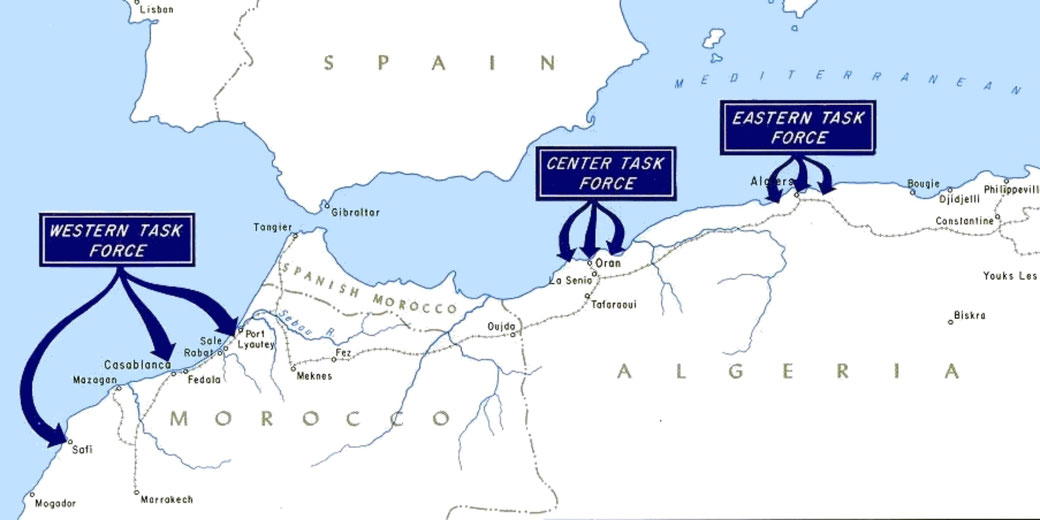
At that point, Allied planners moved relatively quickly. They organised a three-part landing across very long distances, which involved separate naval and ground task forces.
General George S. Patton led the Western Task Force toward Casablanca in French Morocco, while General Lloyd Fredendall directed the Central Task Force against Oran, and General Kenneth Anderson commanded the Eastern Task Force, which advanced on Algiers.
Support from the Royal Navy and US Navy helped ensure a generally steady flow of reinforcements, munitions, and air cover.
By early November, the invasion force contained over 100,000 troops and more than 500 ships and stood ready for deployment across 1,600 kilometres of North African coastline.
The force included American and British troops alongside Free French soldiers, who were each assigned to specific landing zones and missions.
Importantly, Allied commanders faced the uncertainty of Vichy French reactions.
Although officially neutral, the Vichy regime had collaborated with Germany since 1940, and its military officers remained under unclear orders.
Allied intelligence officers and diplomats reached out to French generals who might cooperate, including Admiral François Darlan, whose sudden presence in Algiers gave negotiators a critical contact.
Still, the possibility of open resistance remained high, and planners expected that at least some French forces would resist.
General Dwight D. Eisenhower held the position of Supreme Commander of the Allied Expeditionary Force and oversaw the negotiations and planning.
The role of Vichy France and the risk of resistance
At dawn on 8 November 1942, Allied forces began landing across the Moroccan and Algerian coasts.
In Casablanca and Oran, French artillery opened fire on American ships, and ground forces resisted with tanks and machine guns.
American troops were largely unfamiliar with desert conditions and urban combat and took heavy casualties in the first hours of the assault.
Naval exchanges off Casablanca saw multiple US destroyers damaged by coastal batteries.
Meanwhile, in Algiers, anti-Vichy plotters staged a local coup that disabled key communication hubs and reduced French resistance in the city.
By 10 November, negotiations between Admiral Darlan and Allied officials had reached a breakthrough.
Darlan agreed to order a ceasefire across North Africa in exchange for temporary political authority, which American commanders recognised for military convenience.
Though Charles de Gaulle and other Free French leaders condemned the deal, it prevented a long civil conflict and allowed Allied forces to redirect their attention to the rapidly developing situation in Tunisia.
Darlan held the title of commander-in-chief of all Vichy armed forces and was assassinated by a young French monarchist, Fernand Bonnier de La Chapelle, on 24 December 1942.
German response and the race for Tunisia
Within days, the German response grew noticeably more serious. Hitler authorised the occupation of Vichy France and deployed the first units of the Wehrmacht into Tunisia.
General Walter Nehring coordinated a rapid build-up of German armour and infantry, and he was later replaced by General Hans-Jürgen von Arnim.
Italian divisions under General Giovanni Messe added to Axis strength. At their peak, Axis forces in Tunisia included approximately 100,000 troops, and this total combined both German and Italian units.
As the Axis fortified defensive lines near Tunis and Bizerte, Allied forces raced eastward in order to deny them the chance to entrench.
Codebreakers at Bletchley Park, who used Ultra intelligence, intercepted German communications that helped Allied commanders predict Axis reinforcements and supply movements.
Initially, American forces struggled. At Kasserine Pass in February 1943, US units, which were underprepared and poorly coordinated, fell back in disorder when attacked by experienced German troops.
The battle lasted from 19 to 24 February and resulted in over 6,000 American casualties, and this total included men who were killed or wounded, as well as those listed as missing, but it exposed significant weaknesses in leadership and training.
The setback caused significant concern in Washington and London. In response, General Dwight Eisenhower made major changes to command structures and replaced Fredendall with General Patton, who brought discipline and unity to II Corps.
Simultaneously, British forces under General Bernard Montgomery pushed west from Libya, and they joined American formations and tightened the Axis perimeter in northern Tunisia.
By March, Allied control of the skies and the sea had isolated Axis forces, and repeated bombing raids had disrupted supply lines while naval patrols had sunk convoys that attempted to reinforce German positions.
On 13 May 1943, the Axis in Tunisia surrendered, and over 250,000 German and Italian troops were taken prisoner.
The North African campaign had ended with a clear Allied victory.
Political and strategic consequences
In the weeks following the landings, the political situation remained tense.
Roosevelt’s decision to support Darlan alienated several Allied leaders and outraged the Free French, but it also delivered immediate operational control of French North Africa.
After Darlan’s assassination in December 1942, power had passed briefly to General Henri Giraud before De Gaulle consolidated leadership of the French resistance.
Rivalry between Giraud and De Gaulle, which persisted throughout early 1943, complicated efforts to unify the French war effort under a single command.
Internally, the episode showed the tensions between short-term military needs and political plans for after the war, which would continue to affect Allied diplomacy.
Militarily, Operation Torch helped change German strategy. The occupation of Vichy France required additional divisions that could have reinforced the Eastern Front, and the loss of Tunisia removed the last Axis-controlled territory in North Africa.
In the Mediterranean, the Allies now held Gibraltar and Malta alongside bases in North Africa, allowing convoys to move without interference and air forces to reach southern Europe.
Many resistance movements across occupied countries took renewed hope from the Allied success, and partisan activity often increased across France and Greece and throughout the Balkans.
On 27 November 1942, in direct response to the German occupation of Vichy France, the French scuttled their fleet at Toulon to prevent its capture.
Although connected to Operation Torch, the scuttling was primarily a reaction to the German launch of Case Anton.
For the United States, the campaign revealed several serious command deficiencies but also provided an important opportunity to correct them.
Patton’s reorganisation of II Corps, which combined with Eisenhower’s growing authority, transformed the American military presence from inexperienced to capable.
Many British commanders who had doubted American effectiveness now began treating them as partners in very large operations.
As a result, planning for the invasion of Sicily in July 1943 incorporated lessons learned during Torch and applied them in more demanding environments.
A precedent for Allied cooperation and victory
Operation Torch demonstrated that American and British forces could, under the right conditions, work under a unified command to achieve strategic objectives, and it established the system of command and planning that guided subsequent invasions.
Although initial setbacks exposed gaps in leadership and preparation, the final result showed that effective coordination between naval and ground forces that worked with air units across multiple fronts became possible.
The experience from amphibious landings and desert warfare worked together with the challenge of multinational logistics and often proved very important in planning the next phase of the war.
The codename "Torch" had symbolised this aim, as the invasion was seen as a torchbearer for the wider Allied push into Europe.
At the same time, the defeat of Axis forces in Africa forced Hitler to prepare for further retreats.
The Italian government was increasingly discouraged by the loss of Libya and Tunisia and faced public unrest that became more intense and heavy military strain.
When the Allies invaded Sicily just two months later, the weakened Italian defences collapsed very quickly.
Although multiple factors had contributed to Mussolini's fall, the invasion sped up his removal on 25 July 1943 by vote of the Fascist Grand Council, and this decision led to the first Axis government to exit the war.
Operation Torch had begun as a carefully planned gamble to enter the war in a manageable theatre, and by the end of the campaign it had achieved far more than its initial stated goals.
It largely removed Axis control from North Africa, gave many Allied commanders very important experience, and helped trigger a series of strategic consequences that changed the balance of the war in Europe.