
Why the Labrador Gun Battery failed to stop the Japanese capture of Singapore in WWII
As Britain expanded its global trade networks in the late nineteenth century, Singapore became a key point in its control of Asian sea routes.
Guarding the entry routes to Keppel Harbour was therefore a matter of imperial security, and British engineers built a coastal defence position on the rocky headland at the southern tip of Singapore Island near present‑day Labrador Park.
Building the fort and its preparations for WWII
Construction began in the late 1870s under the direction of the Royal Engineers, and the works cost an estimated £10,000 to complete.
Known at the time as Fort Pasir Panjang, the position initially mounted 7‑inch rifled muzzle‑loading guns and commanded a clear field of fire over the narrow channel that led to the harbour.
It was one of a series of 11 coastal fortresses that were designed to work together to protect the island from any threats.
Over the following decades, improvements were made to the site. A 9.2‑inch gun was later installed, and the fort formed part of the Faber Fire Command alongside positions such as Fort Siloso and Pasir Laba.
However, by 1912, this site in particular, had fallen into disuse, as the threat of potential attacks seemed unlikely.
With the rapid rise of Imperial Japan in the 1920s, it became clear that a region superpower could target Singapore once more.
Therefore, defensive structures like this might be of value once more.
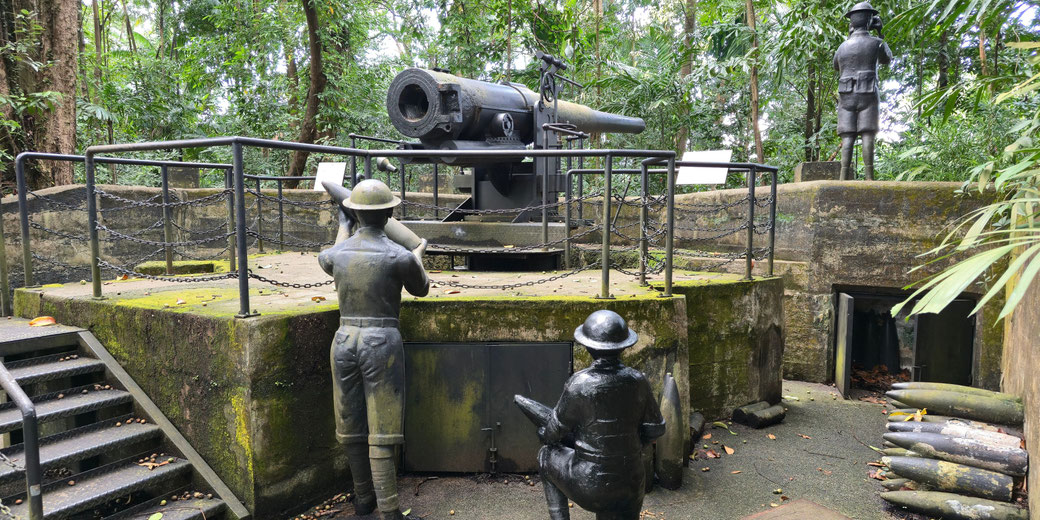
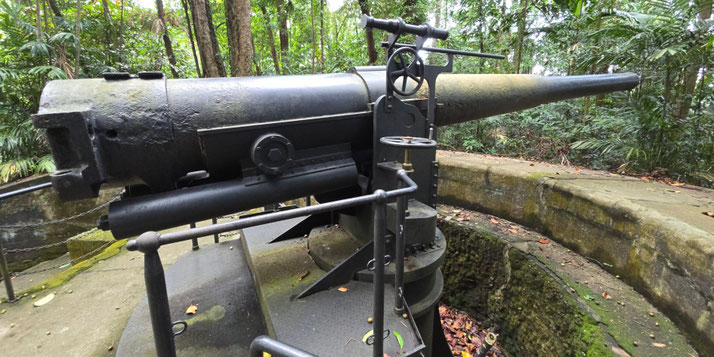
The position became known as the Labrador Battery only in the 1930s, when British authorities brought the site back into use and installed two BL 6‑inch Mk VII naval guns, each capable of firing a 102‑pound shell to a range of almost 10 miles.
Strong concrete structures provided protection for the crews, and underground magazines stored shells and cordite charges safely beneath the gun positions.
The garrison consisted of personnel from the Hong Kong and Singapore Royal Artillery, later organised as part of the 7th Coast Regiment, who trained regularly and regarded the position as a key element of the colony’s defences.
War mobilisation and the Japanese advance
The outbreak of the Second World War in the Pacific in 1941 increased the significance of the battery.
British commanders believed that Japan would attack from the sea, so the guns pointed towards the harbour entrance.
The Labrador Battery became one of the key points in the system known as Fortress Singapore.
The guns fired both high‑explosive and armour‑piercing shells, and the position contained range‑finding equipment that allowed the gunners to engage enemy vessels at long distances.
The garrison carried out frequent drills, and ammunition stores were kept fully stocked as the threat of war in the region grew.
Japanese forces landed in northern Malaya in December 1941 and advanced rapidly down the peninsula.
They captured major towns such as Kuala Lumpur and Johor Bahru by early 1942.
However, British commanders realised too late that the coastal guns were poorly suited for a land assault from the north.
The Labrador Battery’s weapons could fire inland, but their ammunition had been designed for naval targets and proved of limited use against infantry.
During the final days of fighting in February 1942, the guns fired several salvos towards Japanese positions near Pasir Panjang Ridge, but these efforts had little impact on the enemy advance.
The gunners fired their last rounds in the days before Singapore’s surrender on 15 February 1942.
Capture, obsolescence and preservation
British troops destroyed much of the battery’s equipment before the surrender to prevent it from being used by the enemy.
Specifically, the engineers removed the breech blocks and detonated charges that damaged the guns beyond repair.
Japanese forces later occupied the site and converted parts of the installation into storage facilities and observation posts that overlooked Keppel Harbour.
After the war, the battery became obsolete, as advances in air power and missile technology ended the value of fixed coastal defences.
The British authorities officially closed the site during the 1950s when Singapore moved towards self‑government.
However, the new Singaporean authorities kept what remained of the battery after independence.
The gun emplacements, tunnels and shell hoists provided a clear connection to the period when Singapore operated as a fortress for British naval power in Asia.
Surveys conducted in the 1990s even uncovered rusted shell casings, breech fragments and personal items such as buttons and mess‑kit tins left by the garrison.
The area was gazetted as a World War II historic site in 1995, and in 2002 it became part of Labrador Nature Reserve.
Today the Labrador Gun Battery is a rare reminder of the island’s military history that tourists can walk through for free.