
Who was Senator Joseph McCarthy, the architect of America's second 'Red Scare'?
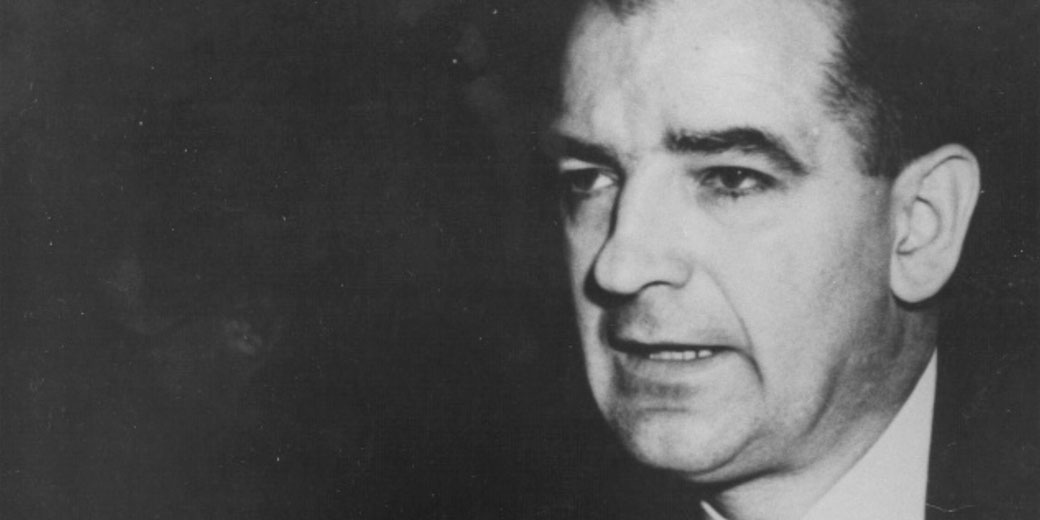
Between 1950 and 1954, at the height of postwar tension between the United States and the Soviet Union, the fear of communist subversion took hold of much of American political life.
During this period, Senator Joseph McCarthy of Wisconsin rose to national attention by claiming that communist agents had infiltrated the U.S. State Department and other key institutions.
As his accusations spread and his influence grew, he helped trigger a wave of political persecution and suspicion now known as the second Red Scare.
The campaign occurred against the backdrop of escalating Cold War hostilities that came after the Soviet Union's successful atomic bomb test in 1949 and the Communist takeover of China under Mao Zedong that same year.
Early life and political rise
Born on 14 November 1908 near Appleton, Wisconsin, Joseph Raymond McCarthy came from a Catholic farming family that had German and Irish ancestry, but he left school as a teenager to help support his household.
At age 20, he returned to formal education and completed four years of high school in one, then studied at Marquette University, where he earned his law degree in 1935.
After he had spent several years in private practice, he won election as a Wisconsin circuit court judge in 1939.
This result established him as a driven and self-promoting public figure. During the campaign, he falsely accused his elderly opponent of being too senile to hold office and relied on aggressive, often misleading claims that drew criticism.
During World War II, McCarthy enlisted in the United States Marine Corps and served as an intelligence officer in the South Pacific, where he had exaggerated his record and later used the nickname “Tail-Gunner Joe” as part of his political image.
He served for 30 months and received the Distinguished Flying Cross, but the circumstances surrounding this award stay unclear.
Official records do not confirm aerial combat missions, and his primary duties involved administrative and intelligence work.
After he returned in 1944, he ran for the U.S. Senate and, in the 1946 Republican primary, defeated incumbent Robert La Follette Jr., a long-serving progressive.
Once in the Senate, he struggled to gain traction and frequently relied on sensational speeches to attract attention, though he had few legislative achievements to his name.
Until 1950, his political career stayed largely unremarkable and unsteady.
The Wheeling Speech and rise to national attention
On 9 February 1950, during an appearance before the Republican Women’s Club of Wheeling, West Virginia, at the McLure Hotel, McCarthy dramatically held up a piece of paper and claimed it listed 205 communists working in the U.S. State Department.
He offered no proof, and the number soon changed to 81 in a letter to President Truman and later to 57 in a Senate speech.
As an aside, the 205 figure likely derived from a 1946 State Department report by Secretary James Byrnes that identified security concerns, while the 57 originated from a different internal list.
McCarthy mixed multiple sources together, and no official transcript of the Wheeling speech survives, which contributed to confusion over the precise figure he cited.
Even so, his claims often dominated newspaper headlines and radio broadcasts across much of the country.
At the time, public anxiety had already deepened following the convictions of State Department official Alger Hiss and atomic scientist Klaus Fuchs, both of whom had passed secrets to the Soviet Union.
Dean Acheson was the Secretary of State and had drawn criticism for expressing personal loyalty to Hiss, famously stating that he would not "turn his back" on a friend.
As a result, McCarthy’s accusations, however vague, often landed with force. He declared that communist infiltration had reached the highest levels of American government and that the Truman administration had failed to act.
Despite presenting little credible evidence, he positioned himself as a lone watchdog battling official indifference.
By casting suspicion without having to prove it, he built momentum with each appearance and grew more aggressive in his claims.
The Tydings Committee and the first investigations
Soon after his charges drew widespread national attention, the Senate authorised an inquiry to assess the truth of his claims.
Chaired by Senator Millard Tydings of Maryland, the Senate Foreign Relations Subcommittee on the Investigation of Loyalty of State Department Employees examined dozens of cases that McCarthy had raised and reviewed the loyalty files of State Department employees.
After several months of testimony and document analysis, the committee found that McCarthy had distorted the records and presented no valid evidence for his allegations.
In its final report, issued in July 1950, it described his charges as a “fraud and a hoax.”
Despite this rebuke, McCarthy stepped up his attacks by accusing Tydings of communist sympathies and circulating an altered photograph that falsely implied a connection between Tydings and Communist Party leader Earl Browder.
Photographic experts called the image a fake. During the 1950 midterm elections, McCarthy and his allies used these smears to target Tydings, who lost his Senate seat that November.
The outcome encouraged McCarthy, and he expanded his campaign and began accusing diplomats, librarians, clerks, and professors of communist ties.
As part of this, he often relied on hints, unverified reports, or old affiliations. Few of his targets had any ability to defend themselves publicly, as denial was interpreted as hiding the truth, and many lost their careers without formal charges.
The role of HUAC and Hollywood blacklisting
Although McCarthy had no involvement in the House Un-American Activities Committee, his rise coincided with HUAC’s public campaign against alleged communists in the entertainment industry.
In 1947, HUAC launched hearings into political activity in Hollywood, and these hearings targeted writers and directors, along with actors who had joined left-leaning organisations in the 1930s and 1940s.
The first group to be blacklisted became known as the "Hollywood Ten," and those who refused to testify or name others faced contempt of Congress charges and were barred from working.
Some actors initially supported the accused, and these included Humphrey Bogart and Lauren Bacall, but they later withdrew their support under pressure.
McCarthy adopted a similar approach in the Senate. Instead of Hollywood, he focused his investigations on federal institutions, particularly the State Department and the U.S. Information Agency, as well as the Army Signal Corps.
He worked closely with his chief counsel, Roy Cohn, and demanded access to personnel files and interrogated witnesses about their political associations.
In many cases, his questions focused on vague suspicions, and the hearings often featured aggressive questioning without any conclusion.
He sometimes presented documentation, but much of it had been misinterpreted or lacked relevance.
Accusation alone created consequences. As fear spread, relatively few people challenged his methods openly, and many institutions introduced loyalty oaths or internal screening to protect themselves.
The Army-McCarthy hearings and public backlash
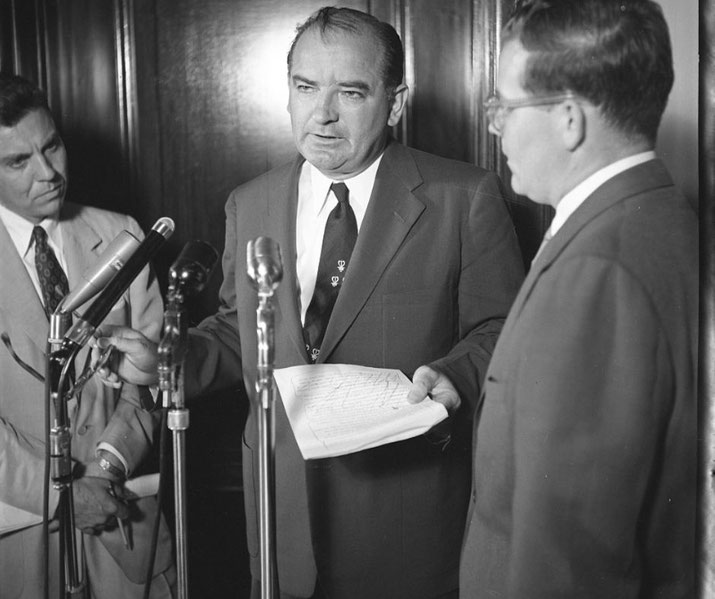
By 1953, McCarthy had become chair of the Senate Permanent Subcommittee on Investigations and turned his attention toward the U.S. Army.
He accused its leadership of being too relaxed in addressing communist infiltration and began targeting officers at Fort Monmouth in New Jersey.
The dispute escalated when the Army alleged that McCarthy had pressured it to grant special privileges to his aide, G. David Schine.
From 22 April to 17 June 1954, the Army-McCarthy hearings aired live on national television, with 36 days of hearings broadcast on the ABC and DuMont networks.
Millions of Americans watched McCarthy's tactics unfold in real time.
During the hearings, McCarthy repeatedly interrupted witnesses and insulted military officials, then moved on to broad accusations, again, often without credible documentation.
On 9 June, after McCarthy attacked a young attorney at Welch’s law firm, Army counsel Joseph Welch responded with the now-famous question: “Have you no sense of decency, sir, at long last?”
His full statement went further, saying, “Until this moment, Senator, I think I never really gauged your cruelty or your recklessness.”
The moment marked a turning point. Public reaction to the hearings shifted sharply, and many viewers, previously unsure of McCarthy’s critics, became alarmed by his conduct.
Journalists who had once hesitated began to challenge him, and commentators such as Edward R. Murrow used their platforms to dismantle his credibility with recorded broadcasts and targeted analysis.
Censure and decline
After McCarthy had faced months of growing criticism, the Senate took formal action to rein in McCarthy’s abuses.
On 2 December 1954, by a vote of 67 to 22, senators passed a resolution condemning him for conduct that brought the chamber into dishonour.
Though the resolution did not officially use the term “censure”, the action had the same effect and became widely known as such.
The resolution cited his repeated disregard for Senate procedures and his personal attacks on colleagues, together with a persistent failure to respect the rights of witnesses.
This punishment followed a detailed investigation by the Watkins Committee, which reviewed his behaviour and recommended punishment.
Although the measure did not remove him from office, it took away his influence and left him politically alone.
President Eisenhower, who had avoided direct public conflict with McCarthy, privately supported the Senate's action.
Following the vote, McCarthy lost his committee chairmanship and saw his speaking invitations disappear.
He continued to appear in the Senate chamber and issued occasional statements, but his speeches drew little attention.
He became increasingly withdrawn, and many people reported that he drank heavily.
He suffered from health problems in his final years. On 2 May 1957, he died of acute hepatitis at Bethesda Naval Hospital at the age of 48.
His impact on American society
McCarthyism helped change public life across much of the United States.
Thousands of workers in schools and universities, as well as in government agencies, lost their jobs after security reviews or anonymous accusations placed them under suspicion.
Many faced the end of their careers without ever learning who had named them or why they had been targeted.
Some people left the country, and others abandoned careers rather than face investigation.
Institutions introduced loyalty oaths and internal audits, along with political screening measures that helped them avoid being seen as negligent.
Earlier, President Truman had issued Executive Order 9835 in 1947, and this order launched the Loyalty Review Program, which screened millions of federal employees and helped lay the foundation for McCarthy's later campaigns.
Although McCarthy uncovered no active Soviet spies during his investigations, some individuals he accused had once held Communist Party membership or belonged to leftist organisations.
He failed to identify any espionage operations such as those that the VENONA project later revealed.
His accusations changed public debate and narrowed political discussion. Many people avoided controversial speech and joined community organisations cautiously, then engaged in self-censorship in ways that weakened free expression.
The period also coincided with the "Lavender Scare," a parallel campaign that purged suspected homosexuals from federal service under the belief that they were security risks.
Historians continue to debate McCarthy’s motives, but most agree that his tactics depended on fear rather than fact.
He exploited public anxiety and built a following based on anger and suspicion, and once exposed, he fell rapidly.
His rise showed how easily democratic systems could drift into repression when fear largely guided public policy.