
A disastrous miscalculation: Why Hitler foolishly declared war on America
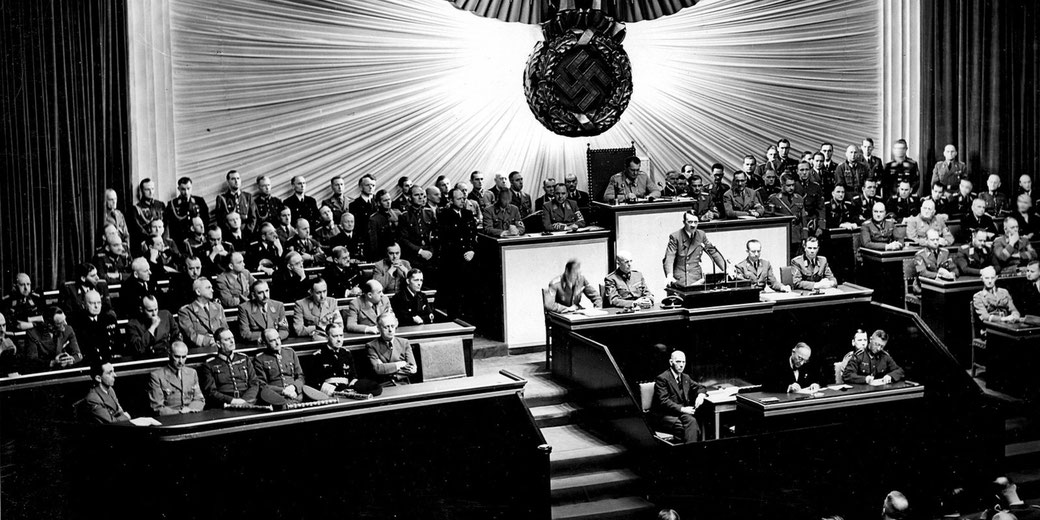
On 11 December 1941, Adolf Hitler delivered a speech before the Reichstag that surprised some of his closest allies. As Soviet forces drove German troops back from Moscow, the Luftwaffe was still largely unable to force British surrender and the Afrika Korps was locked in a long campaign in North Africa, Hitler chose to declare war on the United States, which had the world’s largest economy and extensive untapped military potential.
Until that point, American involvement had remained largely limited to shipping supplies across the Atlantic, but Hitler’s decision, taken without consulting others, triggered the nation's full war effort, which would tip the balance of the war.
Germany’s military position in late 1941
By late 1941, Germany had already fought multiple campaigns that consumed enormous manpower and resources.
The rapid victories of 1939 and 1940 had led Hitler to believe that swift offensives would probably continue to succeed.
Poland had collapsed in under a month, Denmark and Norway had surrendered with minimal resistance, and France had fallen within six weeks.
After Britain refused to negotiate peace, Hitler abandoned the planned invasion and turned his attention to the Soviet Union.
On 22 June 1941, Germany launched Operation Barbarossa, the largest land invasion in history.
Three army groups crossed the Soviet frontier with over three million soldiers, thousands of tanks, and hundreds of aircraft.
For the first several months, German units had captured large territories. Army Group North moved toward Leningrad, Army Group Centre threatened Moscow, and Army Group South advanced through Ukraine.
Hitler believed that a swift collapse of Soviet resistance would eliminate the USSR as a threat and free his forces for other theatres.
However, by November, the eastern campaign began to stall. Soviet forces had not disintegrated as had been expected.
Instead, they had fallen back in good order and had reinforced key positions. The Red Army launched its counter-attack on 5 December and pushed German troops back from the outskirts of Moscow as winter conditions set in.
Many German soldiers had lacked cold-weather clothing, fuel supplies had run low, and supply problems had left many front-line units vulnerable, as Hitler’s promise of a short war in the east proved empty.
Meanwhile, German forces were deployed across Western Europe and the Balkans.
Resistance activity in Yugoslavia and Greece forced the Wehrmacht to divert troops to operations against partisans.
Rommel’s Afrika Korps operated alongside Italian units and was often short of supplies and needed frequent reinforcement to fight the British in Libya and Egypt.
German industry, already under pressure, could not fully supply these far-flung campaigns.
The Pearl Harbor attack
On 7 December 1941, Japanese carrier-based aircraft struck the American Pacific Fleet at Pearl Harbor, destroying or damaging eight battleships and killing more than 2,400 American personnel.
The following day, the United States declared war on Japan. Roosevelt's address to Congress largely unified the American public and removed any domestic resistance that still existed to military action, as war production began immediately and conscription expanded to build a force that could fight on multiple fronts.
At that stage, Germany and the United States had not officially declared war on one another.
Although U-boats had attacked American shipping in the Atlantic, Hitler had instructed his navy to avoid direct confrontations that might provoke a formal declaration.
Notably, the sinking of the USS Reuben James on 31 October 1941 killed over 100 American sailors and had already strained relations.
The Tripartite Pact, which had been signed in September 1940, committed Germany, Italy, and Japan to mutual support only if one of them suffered an unprovoked attack.
Japan had struck first, so Hitler had no legal reason to intervene.
For example, had Hitler kept silent, Roosevelt might have struggled to convince Congress to approve war against Germany.
Public outrage focused squarely on Japan. Gallup polls at the time showed that only around 30 percent of Americans supported going to war with Germany unless provoked, though the exact figures varied slightly depending on the question asked.
While Roosevelt had long supported Britain and the Soviet Union through Lend-Lease, political support for war against Germany remained fragile.
Hitler could have forced the United States to fight a war in the Pacific first, delaying any direct confrontation with German forces.
Instead, he handed Roosevelt exactly what he needed.
What was Hitler’s decision-making process?
Hitler believed that American society lacked the unity and discipline needed for a prolonged war and he dismissed the United States as a culturally fragmented nation led by politicians who would falter under military pressure.
He had largely misunderstood the scale of American industrial power and had ignored intelligence reports that described the country’s growing wartime capacity, as ideology mattered more than evidence for Hitler.
Instead of weighing the military realities, he viewed Roosevelt as part of a global conspiracy.
Nazi propaganda frequently described the American president as a puppet of Jews and bankers, which fit Hitler’s distorted worldview.
He believed war with the United States had come to seem inevitable and that it would be better to initiate it on his own terms.
However, no military planners had proposed an offensive strategy against the Americans, and no timetable existed for such a conflict.
At the same time, Hitler assumed that declaring war would convince Japan to intensify its operations against the British Empire and possibly the Soviet Union.
He hoped that Japanese forces would invade Siberia and force Stalin to divert troops from the western front.
That outcome never occurred. Instead, Stalin had already redeployed Siberian divisions westward after Soviet spy Richard Sorge had confirmed that Japan would honour its neutrality pact with Moscow, which had been signed in April 1941.
Advisers such as Joachim von Ribbentrop, who urged caution, understood that American intervention would overwhelm Germany's already difficult situation.
Some, including Franz Halder and Wilhelm Keitel, had expressed concern. Yet Hitler dismissed those warnings.
His decisions increasingly relied on his personal beliefs rather than any rational strategic planning.
Hitler’s declaration of war against the US
On 11 December 1941, Hitler delivered a speech to the Reichstag in which he declared war on the United States.
He accused Roosevelt of repeated provocations and insisted that the German people had no choice but to defend themselves.
The speech used strong words and offered no evidence of an American attack.
Hitler presented the declaration as a necessary act, even though it achieved no direct military benefit.
German military leaders expressed concern. With the failure to capture Moscow and the onset of winter, they faced serious challenges in the east.
Meanwhile, British forces had begun to regain ground in North Africa, and aerial bombing continued over Germany.
Declaring war on a neutral superpower added another enemy to a conflict that Germany could not win outright.
As a result, the United States Congress declared war on Germany, and Roosevelt now had full authority to direct resources toward both the Pacific and European theatres.
American war planners intensified coordination with the British and Soviets.
Logistical systems and the factories that produced weapons scaled up dramatically, and commanders ordered much larger troop deployments to match that increase in capacity.
When Winston Churchill heard the news, he reportedly said he 'slept the sleep of the saved and thankful', knowing full well that Hitler had handed Britain a powerful ally.
Was it a massive strategic error?
Hitler’s declaration of war on the United States largely eliminated any realistic chance of avoiding American involvement in Europe.
Germany now faced a nation that could outproduce it in many categories: aircraft, tanks, fuel, trucks, and ships.
By 1944, the United States produced over 96,000 aircraft, more than twice Germany's output.
American factories, which ran around the clock, supplied their own military and those of Britain and the USSR.
The scale of output dwarfed anything German industry could manage.
Within months, the United States launched Operation Torch and placed troops in North Africa.
In 1943, American and British forces invaded Sicily and then the Italian mainland.
By June 1944, American troops led the D-Day landings in Normandy and opened the long-awaited second front.
At the same time, Lend-Lease shipments to the Soviet Union continued to arrive in massive quantities, which enabled Stalin’s forces to maintain momentum on the eastern front.
German forces, already stretched thin, ultimately could not withstand the combined assault.
Supplies dwindled, air superiority vanished, and defeats multiplied. Hitler gained no advantage from his declaration as Japan offered no support against the Soviets, and the American people united in purpose and did not collapse under pressure.
The war, which Hitler had once claimed would be short and victorious, dragged on until Berlin lay in ruins.