
The last days Adolf Hitler and the controversial stories of his death
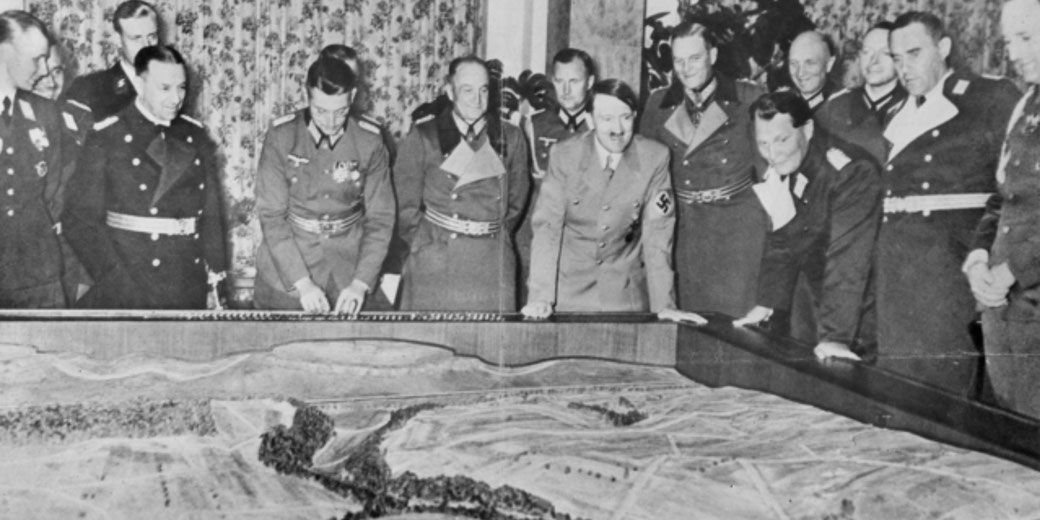
As April 1945 drew to a close, Soviet tanks closed around Berlin and artillery pounded the city centre, while Adolf Hitler shut himself away beneath the Reich Chancellery in an underground bunker.
Within those reinforced concrete walls, the Nazi regime fell apart in real time as Hitler delivered delusional orders and denounced imagined conspirators as he dictated his final testament.
Surrounded by a shrinking circle of loyalists and unwilling to flee, he married Eva Braun and prepared for his own death, and uncertainty and lies about his fate soon spread out from the ruins of Berlin.
Hitler's desperate situation
By 16 January 1945, Hitler had taken permanent residence inside the Führerbunker, an underground command centre 8.5 metres beneath the Reich Chancellery.
There, he isolated himself with a small inner circle that included Eva Braun, Propaganda Minister Joseph Goebbels and his wife Magda, and several secretaries such as Traudl Junge and Gerda Christian, along with Constanze Manziarly.
There was also a number of key military personnel, who included General Wilhelm Burgdorf and SS-Gruppenführer Hermann Fegelein.
By April, his physical and mental decline had become obvious to those around him.
His left hand reportedly trembled and his speech often faltered as he shuffled slowly through narrow corridors with a stoop and dragging foot.
Instead of accepting the military reality outside, he insisted that non-existent divisions could still mount counterattacks, and he refused all suggestions to leave Berlin.
On 20 April, his 56th birthday, he stepped briefly into the Chancellery garden to greet members of the Hitler Youth, such as boys from the 12th SS Panzer Division "Hitlerjugend," who had received decorations for bravery, and then he returned below ground.
Soon after, Hitler dismissed several commanders and accused others of treason during a furious outburst at a situation conference on 22 April, when he declared the war lost.
At that moment, he informed those present that he would stay in the city and end his life rather than surrender.
Eva Braun had remained in the bunker despite orders to evacuate and told those around her that she would die at his side.
Staff later recalled that she behaved cheerfully and hosted tea gatherings, and that she maintained a strange air of calm during heavy Soviet shelling overhead.
The suicide of Adolf Hitler and Eva Braun
By 28 April, Hitler had received confirmation that Heinrich Himmler had secretly approached the Western Allies to propose a conditional surrender.
Enraged by what he viewed as betrayal, he ordered the arrest of Himmler’s representative, Hermann Fegelein, who was captured in civilian clothing while attempting to flee.
After a brief and irregular court-martial, Fegelein was almost certainly executed, although the exact location and the identity of those who carried out the shooting remained unclear.
That same night, Hitler summoned his secretary, Traudl Junge, and dictated two documents: his personal will and a political testament.
In them, he named Grand Admiral Karl Dönitz as President of the Reich and appointed Joseph Goebbels as Chancellor, and he denounced Himmler and Hermann Göring as traitors.
Goebbels, Martin Bormann, and General Wilhelm Burgdorf signed the documents as witnesses, and courier Wilhelm Zander later carried copies out of the bunker.
Just after midnight, Hitler married Eva Braun in a short civil ceremony.
The following day, Hitler distributed personal possessions to staff and thanked his aides, and then he shared a modest lunch with secretaries.
Then, at approximately 3:30 pm on 30 April, he and Eva Braun retreated to his private study and closed the door.
Within minutes, those nearby heard the sharp sound of a gunshot. When aides entered, they reportedly found Hitler seated on a sofa with a visible head wound, while Eva Braun lay beside him after taking cyanide.
Several accounts later disagreed on whether the gunshot came before or after the ingestion of poison, and historians used the available testimony to explain the final moments.
Shortly before this, Hitler had ordered the poisoning of his dog, Blondi, and he had used a cyanide capsule to verify its effectiveness.
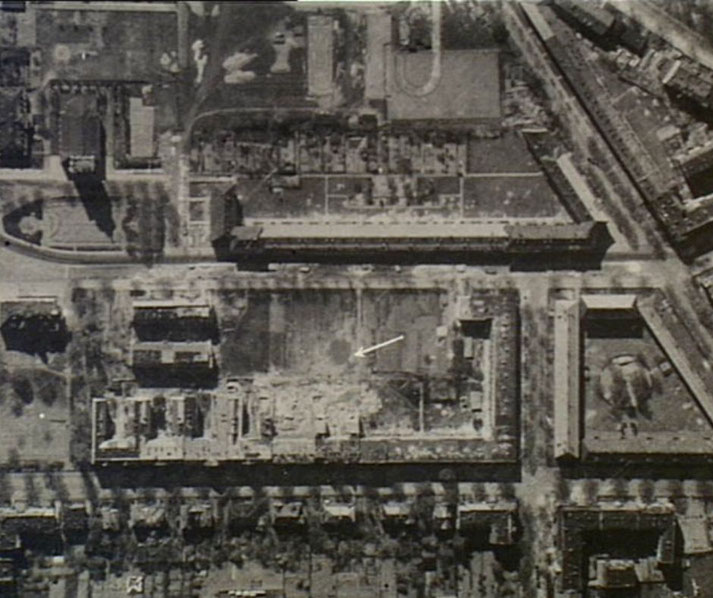
According to his instructions, their bodies were carried into the Chancellery garden, doused in petrol, and set alight.
Staff used blankets as makeshift stretchers while artillery fire echoed overhead.
By the time Soviet soldiers reached the site that evening, they found only burnt fragments of the corpses, which lay near a shallow crater in the soil.
Soviet investigation and the handling of the bodies
After they had secured the government quarter, Soviet troops began a quiet investigation under the supervision of SMERSH, the Red Army’s counter-intelligence agency.
Agents from the 3rd Shock Army, who served under General Vasily Chuikov, reportedly recovered skull fragments and jawbones, along with dental bridges near the garden wall.
Most importantly, the dental fragments appeared to match charts and models held by Hitler’s dentist’s assistant Käthe Heusermann and technician Fritz Echtmann, who confirmed that they were real and described them in exact detail, and they identified distinctive bridgework consistent with earlier dental work.
Even so, the Soviet leadership chose to hide the discovery. Stalin ordered his officials to cover up all findings, and by July, during the Potsdam Conference, he privately told U.S. President Harry Truman that Hitler might have escaped.
Publicly, Soviet statements shifted between silence and denial, along with vague comments, which allowed confusion to persist.
The burnt body fragments were later transported to Magdeburg and buried in the courtyard of a Soviet military base under KGB control that was codenamed “Object 4621.”
In 1970, Soviet authorities ordered the buried bones and other fragments to be dug up and totally destroyed, and the KGB feared that the grave would attract visits from neo-Nazis or political attention.
So, they burned the bones and scattered the ashes into the Elbe River, and this action left no permanent trace of the burial.
Western investigations
After the war, British intelligence launched Operation Nursery, an investigation focused on verifying Hitler’s death.
Historian and intelligence officer Hugh Trevor-Roper had been appointed by MI6, and he led the investigation and interviewed survivors from the bunker, who included secretaries and adjutants, as well as guards.
His report was released in 1947 as The Last Days of Hitler and outlined the sequence of events in detail and found no evidence that contradicted the suicide account.
American investigators reached similar conclusions during separate interrogations of German prisoners and officials.
For decades, Soviet secrecy prevented access to physical evidence, and the consistent testimony from bunker witnesses, coupled with documentation from the German high command, still left historians with little doubt.
Eventually, in 2000, Russian officials announced that the state archive held several bone fragments and dental fragments that they attributed to Hitler.
In 2017, French pathologist Philippe Charlier examined those items and concluded that the dental structure aligned with known records, including bridges and fillings.
He also detected traces of cyanide and identified a bullet wound in the skull fragment, which matched descriptions from the scene.
Conspiracy theories and disputed narratives
Over the decades that followed, conspiracy theories spread widely. Many stemmed from Stalin’s initial claim that Hitler might have escaped, a suggestion that U.S. intelligence quietly noted but never supported with evidence.
Early Cold War tensions encouraged such speculation, especially after Soviet publications hinted at escape without presenting proof.
Authors and journalists worked with television specials and revived the notion that Hitler had fled to Argentina by submarine or that he lived out his days in a secret Andean hideout.
Occasionally, the FBI received tips or letters claiming sightings of Hitler, which led to a file that grew over time but contained nothing proven.
Highly dramatic books repeated the rumours, and some public figures cited the lack of a body as suspicious, even though eyewitnesses had clearly described the disposal of the bodies.
Claims of a farewell letter from Eva Braun to her sister Gretl later circulated, although no verified copy survived.
Eventually, forensic research and cross-referenced testimonies, together with declassified documents, came together to confirm the standard account for most historians.
Even so, the popularity of Hitler’s survival myth showed a general reluctance to accept that such a destructive figure could vanish in a bunker and die by his own hand.
The narrative of escape often proved more compelling to audiences than the ordinary and self-inflicted end of a failed dictator.